Added
6-3-03, updated 3-11-14:
Judge Mathews' Report
Website Editor's Note
Sousa Court Reporters here in California typed-up Judge
Mathews' report
from a copy the Court faxed to highwayrobbery.net. Except
where explicitly noted, nothing has been changed or
deleted. Material
added by highwayrobbery.net is
enclosed in double square
brackets [[ ]]
.
If you republish this
report,
highwayrobbery.net would appreciate attribution.
Attachments
The three attachments referenced in the report are at the bottom of this page.
Notes about the attachments:
Attachment 1 - "Amber Time at Red Light Camera Intersections" - An undated list of 47 Baltimore camera installations and the amber times programmed into the signal controllers. Twenty-seven of the 47 had amber times of 3.0 seconds, 4 were set at 3.5, and 16 were set at 4.0.
Attachment 2 - "Location List" - The column labeled "Speed Limit" is actually the trigger/threshold speeds for those cameras (see FAQ # 27).
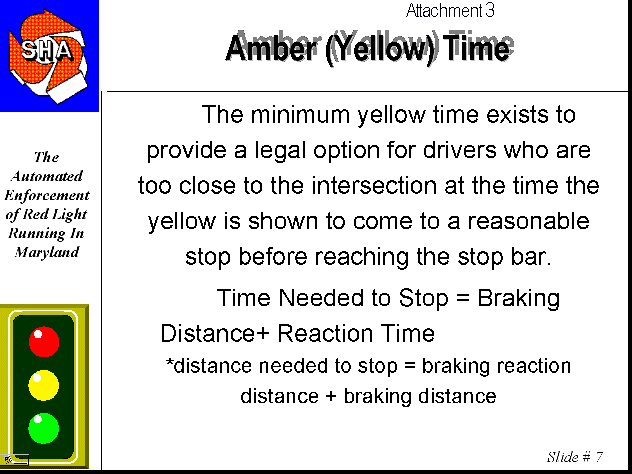
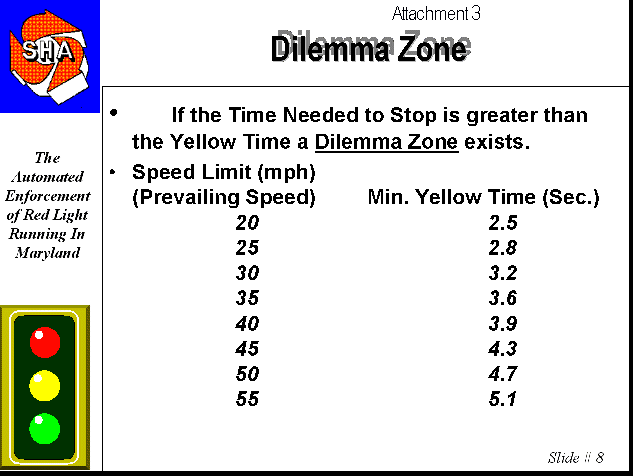
Attachment 3 - Note that Maryland's minimum yellow times are almost identical to California's.
Footnotes
The original footnotes, indicated by single square brackets [ ] will be found at the end of the report .
|
[[court seal]] DISTRICT COURT OF
MARYLAND KEITH E. MATHEWS 5800 Wabash Avenue November 25, 2002
As you know, the District Court of Maryland for Baltimore City hears citizens' challenges to the City's red light camera enforcement system. As a result of various complaints from the public, I decided to research the red light camera enforcement system in general and in particular for Baltimore City. I hope you find the enclosed report and recommendations helpful in your continuing effort to protect the public and ensure their confidence in the red light camera enforcement system in Baltimore City.
[[signature]] Keith E. Mathews Administrative Judge KEM/db
[[new
page]]
Red
Light Camera Enforcement System in Baltimore
City: For
Revenue or Safety? By Keith E. Mathews
1.
Contract
between
Baltimore City and Affiliated Computer Services,
Inc. (ACS) OVERVIEW The
Insurance
institute
of Highway Safety estimates that each year more
than 800 people die and 200,000 plus are injured
in crashes that
involve
red light running.[3] It
is estimated that
at a busy urban intersection, a motorist will
run a red light every 20
minutes. During
peak travel times, the
number of violations will increase.[4] To
protect
the public from accidents caused by red light
running,
Baltimore City has contracted with ACS, formerly
known as Lockheed
Martin IMS (LMIMS), to provide the technology
and general operation of
the red light camera system in Baltimore City. Prior
to
camera placement, the Baltimore City Department
of Public Works
(DWP) initiates site selection in consultation
with the Baltimore City
Police Department. ACS
then performs site
evaluations and installs the cameras. A
camera
is first set up at chosen traffic signals. It
is
then connected to the traffic signal and trigger
sensors called
“loops,” which are buried in the road at a given
intersection. The
system monitors the signal twenty-four
hours a day, under all weather conditions. The
first
picture is triggered by any vehicle passing over
the sensors at
both a predetermined minimum speed and a
specified time after the light
turns red. A second
picture is taken of
the
vehicle crossing over a second sensor. Both
pictures
include the date, time of day, the time elapsed
since the
light
turned red, the length of the yellow light, and
the speed of the
vehicle.[5] Statistics
provided
by
ACS show that 83,385 citations issued in 2001,
generating
$6,253,875 in revenue and 92,088 citations
issued in 2000, generating
$6,906,600 in revenue. As
of this date,
Baltimore City has in place 47 operational red
light cameras, making it
one of the largest programs in the country. See
Attachment 1. RECOMMENDATIONS
FOR
THE
OPERATION OF THE RED LIGHT CAMERAS IN
BALTIMORE CITY After
a
detailed
study of the RLCES, the following are
recommendations for
improving the functioning of the RLCES and
increasing positive
perceptions of the system in Baltimore City. 1) Regarding
the
Partnership
between ACS and the City of Baltimore One
of
the
largest concerns for the RLCES is the
contractual relationship
that exists between Baltimore City’s Department
of Transportation (DOT)
and ACS. When
questioned, a representative
from ACS stated that Baltimore City is the only
jurisdiction in
the nation that has this type of relationship. All
other
of ACS’ contracts are with the police
departments of each
individual jurisdiction that employs the RLCES. A
glaring
problem with the relationship is the amount of
money the RLCES
generates for the City. Acting
on behalf
of
Baltimore, the DOT has a political interest as
in obtaining greater
revenue by issuing more citations or enabling
ACS to obtain more
citations (i.e. by lowering the yellow light
times, having no delay
time, etc.). To
have the contract
administered by the same department that
controls the yellow-light
times
adds to the perception that the yellow light
time is lowered to
increase
revenue for the City and ACS.
A contract
with the police department is perceived as less
political, as the
police
department is more independent and more
concerned about safety than
revenue. It
is
recommended
that the contractual partners of the RLCES
should be the
Baltimore City Police Department and ACS, and
not the Baltimore City
Department of Transportation. 2) Contingency
Fee
vs.
Flat Fee Arrangement Critics
of
the
RLCES frequently cite the contingency fee
arrangement between
the City and ACS. As
it stands, ACS
receives $11-$27 per citation that is issued. The
City
receives the rest. Critics
argue
that, as ACS is a for-profit corporation, it
issues more citations in
order to generate greater revenue.
The
City
presently does not pay any out of pocket
expenses for the RLCES. ACS’
fee comes out of each citation.
Other jurisdictions that employ the RLCES
have
sought to portray a fairer image to the
community by eliminating the
contingency fee arrangement and opting for a
flat fee per camera/per
month arrangement. Both
Howard County,
Maryland and San Diego, California have switched
to this system. ACS
has
encouraged this arrangement with Baltimore City,
but it has yet to be
adopted. It is recommended that the
contingency fee arrangement be
abolished and that a flat-fee system be
adopted. 3) Unclear
Standards
for
Yellow Light Settings The
current
formula
for determining yellow light times is suspect in
light
of the time required for cars to safely come to
a complete stop. In
response to a citizen’s inquiry regarding
yellow light times, the State Highway
Administration (SHA) articulated
proper yellow light times necessary to avoid
“dilemma zones” holding
that “if the time needed to stop is greater than
the yellow time a
dilemma zone exists.” See
Attachment
3. The chart
provided by SHA describes
speeds of 45 mph and above needing more
than the
current
4 second maximum yellow time used by Baltimore
City order to avoid a
“dilemma zone.” See Attachment 2. Similar
complaints
were
echoed in San Diego. Following
the
Final Report on the RLCES in San Diego,
legislation was
passed entitled SB
667, the Peace Bill.
This
legislation set yellow light times at all
intersections where a RLCES
was present, taking into consideration the speed
limit on each road
preceding the red light.[11]
Prior to this
bill, the yellow light intervals suggested by
the Traffic Manual of
California (CalTrans) were permissive and not
mandatory. SB
667
required yellow light change intervals at
intersections at which
there is an automated enforcement system to be
mandatory. For
example,
the manual recommends that a road with a speed
limit of 25 mph
should have a 3.1 [[website editor: 3.0]]
second yellow light and
a road with a 50 mph speed limit should have a
yellow light interval of
at least 4.8 [[website editor: 4.7]]
seconds. Background
discussion
on the bill states that the DOT of California is
responsible
for developing specifications for traffic
control devices, such as the
time intervals for yellow lights.[12] However,
adherence
to those standards was not required. Complaints
by
citizens
in San Diego in particular suggested that the
yellow light
intervals at RLCES locations were too short,
thus creating a red light
speed trap. Arguing
in support of the
Peace
Bill, the California State Automobile
Association (CSAA) stated that
“standardizing yellow light intervals will
assure that the yellow light
time will be set for safety rather than
revenue-generating
purposes.”[13] It is recommended that the Baltimore
City DOT set forth
published standards for determining yellow
light intervals. In
determining yellow light intervals, the DOT
must take into account the
speed limit and gradient of the road, along
with the appropriate
braking
distance needed for a driver to safely come to
a stop. It
is
further recommended that yellow light
intervals set forth by the DOT
with the above-listed considerations be
mandatory for those
intersections which employ RLCES. Standardization
will
ensure residents of Baltimore City that the
yellow light time is
set for safety rather than revenue-generating
purposes. 4) Inconsistent
Yellow
Light
Times There
are
frequent
reports that yellow light times are
inconsistent. There
are reports that yellow light time
variations occur on the same light. A
rough
analysis of several citations issued in
Baltimore City documented
this phenomenon. A
light at the
intersection of Falls Road and Northern Parkway
has a City listed
standard of 3.5 seconds. In
four
citations,
the length of the yellow light on the citation
was recorded at 3.2,
2.9,
3.2 and 3.0 seconds. When
asked about this
at a meeting, both DOT and ACS stated that the
problem had been noted
and was “being looked into.”
In response
to
the Court’s written inquiry, the DOT described
inconsistent yellow
light
times as being caused by “fluctuations in the
voltage supply that cause
minor variances in the timing circuits within
the devices.”[14] However,
the DOT’s voltage explanation
accounts for only a 0.1 second variance and not
the 0.3 variance
described in the Falls Road and Northern Parkway
intersection example
described above.[15] There
is
also
a failure of the yellow light timings to adhere
to the city’s
own set standards. The
DOT sent the court
a
list of its yellow light settings at the
intersections where there are
RLCES. See
Attachment 1. A
rough analysis of approximately 181
citations yielded the following statistic. Approximately
39%
of the citations had inconsistent yellow lights
or a yellow light
setting inconsistent with the city standard. Most
alarming are instances when the inconsistent
yellow
light times have been less than the 3 second
federal minimum. Nearly
10% of the 181 citations surveyed
had a yellow light prior to the red light of 2.9
seconds. This
is
inconsistent with Federal standards and presents
a grave danger to
Baltimore City drivers. It is highly recommended that the
standardization of yellow
lights be enforced. A
grave danger exists
when yellow lights are inconsistent and/or
fall short of the minimum
federal guidelines. 5) Allowance
of
Delay
Time/Grace Period A
delay
time is the amount of time that exists from the
time the light
turns red until the point where a red light
citation will issue. This
time represents a “grace period” for
motorists entering the intersection against a
red traffic signal
indication.[16] As
discussed above, a red
light citation will issue once a car has passed
over the first loop at
a
predetermined speed after a set time that the
light has been red. One
representative from ACS stated that there
is no delay time in Baltimore City. Another
ACS
representative stated that there is a delay time
of .1 second in
Baltimore City. The
following
jurisdictions
have delay times that very from .3 to .5
seconds, as illustrated in the following table: Camera United Delay
Time Settings
In
a
rough
analysis of 181 citations issued by the
Baltimore City RLCES,
approximately 30% were issued with an infraction
time of .3 seconds or
less. This is a
large number, especially
considering the fact that other jurisdictions
employing RLCES have a
minimum of .3 seconds delay time during which a
citation will not issue. It is recommended that a uniform
delay time be established in
Baltimore City to instill confidence in the
program. This
delay
time need not be made public information, but
should be common
knowledge of ACS, the police officers signing
off on the tickets, and
the judiciary that enforces the RLCES
citations. 6) Maximum
Speed
Threshold The
minimum
speed
threshold serves to avoid the inclusion of
stationary or
near stationary vehicles in the intersection
that are stuck when the
light turns red.[18] In
the report issued
in San Diego, it was urged that the same minimum
speed setting of
between 12-19 mph for all intersections using
the red light camera
system is appropriate. Further,
the report
stated that “the impact of using a lower minimum
speed… is that more
violators will be cited than if a higher minimum
speed was used.”[19] When
seeking
information
for the locations of the Baltimore City RLCES,
ACS
sent to the court a list of all RLCES as of
March 27, 2002. See
Attachment 1. When
speaking to ACS to
confirm receipt of the faxed information, the
court’s law clerk
inquired
as to what the minimum speed column on the table
meant and was told (as
she wrote on the table) that the speed limit
listed was the minimum
speed threshold required for activation of the
cameras. When
being
briefed
on the RLCES, the Court was advised that the
minimum
speed threshold was to be 12 to 15 mph. Therefore
it
was very surprising to see a number of the
RLCES’ minimum speed
thresholds were set to 0 mph.
Also, two of
the intersections have a minimum speed threshold
of 25 or 35 mph. When
a follow-up question was posed to an ACS
representative, the Court was told that the
minimum speed threshold was
12 mph at the lowest. When
it was pointed
out that the table illustrated over 16
intersections that had a
threshold of 0 mph, the ACS representative
requested where the Court
had
obtained this information and asked that it be
faxed to ACS. The
Court then informed ACS that the
information had been received from ACS. Although
16
intersections
have a minimum speed threshold of less than 12
mph,
none of the citations surveyed included a
citation for a vehicle
driving
less than 12 mph. 7) Need
for
Clearly
Stated Objectives and Measurement Data There
are
no
clearly stated objectives as to the goal and
purpose behind the
RLCES in Baltimore. As
the standard
operating procedure for any new project,
especially in a program
designed to increase citizen safety, clearly
stated objectives and
measurement standards must be in place to ensure
that the program is
operating as planned. Most
importantly,
the
increase and/or decrease in intersectional
accidents at RLCES locations
should be determined, as well as the increase or
decrease in rear-end
collisions at these intersections. A
defense
often cited in court by someone who has received
a red light
citation is that he/she ran the light in order
to prevent being hit
from
behind. Data from
the Final Report on
the City of San Diego Photo Enforcement System
concluded that
although red light running did decrease as did
intersectional
accidents,
those decrease were outweighed
by the 3% increase in
rear end collisions occurring at red light
camera intersections.[20] The
DOT’s
response
to the Court’s written inquiry regarding any
increase or
decrease in collisions where red light cameras
are in place was vague
and incomplete. Data
for only 14 of the 47
intersections was available.
The 14
intersections were not named.
In addition,
the limited data provided was presented
according to the group of 14
intersections as a whole and contrasted with all
signalized
intersections in terms of percentage increase
and decrease of
collisions. Statistics should be collected, fully
explained, and
published as to the amount of rear-end
collisions occurring at RLCES in
order for the public and the City to determine
if the benefits of the
RLCES outweigh the risks of increased
accidents. In order to increase citizen confidence and ensure that the RLCES is proven effective, clear cut objectives and measurement standards need to be implemented. If the primary objective is to increase driver’s safety, that objective should so be stated. The objective should also be measurable.
The
following
should be determined: 1) An
analysis
of
the existing program should be performed by an
objective
party. 3) Accident
data
for
all types of accidents at intersections where
red light
cameras are in place
should be analyzed to
conclude the number of collisions attributable
to red light running,
the reduction (if any) in the number of
collisions, and also the number of rear-end
collisions occurring at red light camera
locations.
CONCLUSION The
central
purpose
of the Red Light Camera Enforcement System should
be to ensure public safety.
If
citizens
feel protected from red light running and
believe the RLCES is
operating
with integrity, they will support the RLCES. In
order
to achieve its purpose, the RLCES must therefore
be operated in a
consistent and fair manner.
---------------------------------------------------------- [1] Research and statistics provided by Melissa R. Alonzo, Esquire, Law Clerk. [2] Although a meeting has been held where representatives from the Department of Transportation (DOT) and ACS were present and subsequently, a tour of the ACS facility was held with a representative from DOT, obtaining follow-up information regarding the RLCES has proved difficult at best. Therefore, most of the information on which this report is based came from outside sources, specifically a Final Report on the City of San Diego Photo Enforcement System (hereinafter “Final Report”) that was prepared by an independent auditor, PB Farradyne. This report has been referred to often in explaining the functioning of the RLCES, in noting problems with the operation of the Baltimore City RLCES, and in making recommendations for the fair operation of the Baltimore City RLCES. The entire Final Report can be found here. [3]
See
Insurance
Institute for Highway Safety, “Q&A: Red
Light Cameras as
of November 2001.” http://www.hwysafety.org/safety_facts/qanda/rlc.htm
(last visited on July 18, 2002). Link as
of 2011: Q&A
as of 2011. [4] See id. [5]
See
Reni
Gertner, “Cities Are Using ‘Red Light Cameras’
to Catch Drivers.”
2001 LWUSA 685
http://lawyersweeklyusa.com/feature. cfm (last
visited
Sept. 7, 2001) (for general explanation of how
red light cameras
operate). [[As of June
3, 2003, available at:
http://www.nossaman.com/db30/cgi-bin/pubs/Steve%20Roberts%20Lawyers%20Weekly.pdf
]] [6] A city police officer is paid two hours overtime to go to the ACS facility and approve and digest the violations presented for that day. [7] See Julie Bykowics. “Police, workers say facility in Howard is Just the Ticket; Citations Processed for Red-Light Violations.” Baltimore Sun. Local Pg. 1B (Sept. 21, 2001). [8] See Julie Bykowicz. “Red Light Cameras are Defended; Officials Say Programs in Area are Unlike One Ruled Illegal in California. Officials Defend Red-Light Cameras.” Baltimore Sun, Local Pg. 1B (Sept. 6, 2001). [9]
U.S.
Department
of Transportation, Federal Highway
Administration. Manual
on Uniform Traffic Control Devices,
Millennium Edition at 4D-15 (MUCTD 2000)
(revised Dec. 28, 2001). [10] Letter from Alfred H. Foxx to The Honorable Keith E. Mathews of August 16, 2002. [11] See 2001 Cal Stat. 496. [12] See Automated Enforcement System, Hearing on SB 667 Before the Senate Rules Comm. On Unfinished Bus., Reg. Session 2001-02 (Sept. 4, 2001). [13] See id. [14] Letter from Alfred H. Foxx to The Honorable Keith E. Mathews of August 16, 2002. [15] See id. [16] See Final Report at 51. In San Diego, the grace periods applied to the 19 photo-enforced intersections varied according to the intersection. The report suggested that a uniform grace period be adopted. [17] See id. at 51. [18] See id. at 52. [19] See id. [20]
See
Final
Report at 7-11. For
comparison
purposes, the Final Report compared accidents
which occurred in the
first 3 months of the cameras operations as
the before group. ----------------------------------------------------- [[Attachments: Attachment
1: Locations and Amber Times
Attachment
2: Locations and Trigger/Threshold
Speeds Attachment 3:
Two Maryland State
Highway Administration Slides - below ]]
|
---------------------------------
RED LIGHT
CAMERAS
www.highwayrobbery.net
www.highwayrobbery.net