You are on the Condensed version of the Home / Defects page. Only 8000 words! There is an Expanded
version, with 18,000 words, at: Home / Defects - Expanded.

"Our research in Gardena has revealed there is no significant traffic safety impact as a result of the use of the red light cameras. At almost every intersection where we have cameras, collisions have remained the same, decreased very slightly, or increased depending on the intersection you examine. When combining the statistics of all the intersections, the overall consensus is that there is not a noticeable safety enhancement to the public."
Police Chief Edward Medrano, in City of Gardena, California staff report presented at city council meeting.
"Mr. Saunders [President of RedFlex] suggests jurisdictions refrain from issuing a [rolling right] ticket except when a pedestrian is in
the crosswalk."
Interview of James Saunders, President of RedFlex until Mar. 2015, in Dec. 26, 2014 Wall Street Journal column
(archived copy) with headline, sub-headline and first line:
"Can the Red-Light Camera Be Saved?
"Money-hungry politicians discredit a hopeful safety innovation.
"A promising industry betrayed by the behavior of its customers—that’s the story of the red-light camera business."
"Our judicial officers must balance their responsibility for enforcing the law with their responsibility to protect the public from abuse of those laws."
From the LA Superior Court's explanation of its decision to not report ignored red light camera tickets to the DMV.
"Traffic rules account for most of the contact by average citizens with law enforcement and the
courts. Enforcement of laws which are widely perceived as unreasonable and unfair generates
disrespect and even contempt toward those who make and enforce those laws."
The Appellate Department, in People vs. Goulet
Photo Enforcement
Defects
The defects below are listed in
the chronological order they came to my attention, with the newest
ones at the end. So, the numbers don't necessarily reflect
their significance.
Defect # 1 - blurry photo of the driver - is the one which gets the most cases dismissed - if the
defendant (you) takes the case all the way to a not-guilty trial.
In addition to the defects listed on this page (below), on the Camera
Towns page there is more discussion of the defects as they relate to
specific cities or counties.
Along with defending their ticket, every motorist needs to go on the
offensive. Part of each motorist's handling of their ticket
should
be a call to their legislators. See the Legislation section on the Action page for details.
DEFECT # 1: DRIVER'S FACE PHOTO
In California, photo enforcement tickets can put a point on your driving record. So, they
have to have a picture of your
face. A picture of your license plate doesn't
establish that you did the
crime - it only establishes that your car did it, and anyone could have been
driving your car.
A bad "face" photo - blurry, or picturing a
driver whose name is not on the ticket - is a common
reason for dismissal of red light camera tickets.
(If you have not received a ticket
with photos on it - all you have received is a "Courtesy Notice"
from the Court, or a notice from a collection agency - you will
need to phone the issuing police department and ask them for a copy
of the ticket.)
Important: Is It a Fake / Snitch Ticket?
Does your
"ticket" have the address of the Court on it? If it doesn't,
or if it says, "Do not contact the court," it's not really a ticket
at all. It's a police trick! See the section entitled
"Police Going Too Far..." on the Your Ticket page.
Is It Someone Else in the
Photo?
If your name is on the ticket but it's not your face in the photo,
you don't have to
identify the person driving.
For more info on how to handle this situation, go to the "It's Not Me!" section on the
Your Ticket page.
(If the mismatch between the person ticketed and the actual driver is really obvious, like a combined age AND gender mismatch, please let me know about your ticket.)
Photo Blurry?
If it is your face in the photo, but it's blurry, read on...
The "face" photo on the ticket sent to me
was very blurry. The ticket said that I could go to the police
station and be shown the original photo, so I did, and it was just
as blurry.
Vehicle Code
Section 210 requires
that the photo be "clear,"
so the lack of the required clear photo was part of my challenge to
the ticket. Read the discussion about driver's photos on page 255 in the 13th Edition or page 277 in the 14th Edition of
Fight Your Ticket, and the Foley decision (2010).
Unfortunately, a judge evidently has a lot of latitude as to what
"clear" means. Commissioner Randall F. Pacheco, who heard my case,
ruled against me, saying: "The driver in the picture has remarkably
similar coloring and facial structure."
In
most cities, on the day of trial (not arraignment), many tickets
are dismissed "first thing" at the request of the police, due
to poor quality face photos. ("First thing" meaning right
after the judge comes in, or right after the defendant has
been called forward for his trial.) If
your photo is very blurry, plead not guilty, come in for a trial -
maybe your ticket will be dismissed. If it's not dismissed "first
thing," the
ticket still could be dismissed during the trial once the judge
gets a look at the photo. To
convict you, the judge needs to be convinced "beyond a reasonable
doubt" that it is you. But
you need to know that while some judges are likely to reject bad
photos, others will readily
accept a photo with only a fraction of a blurry face visible behind the
rear view mirror and
sunglasses. If the photo is blurry and the judge hasn't noticed
that (or if the officer hasn't shown the photo to the judge), bring it
to the judge's attention. Don't say "It's not me," as that would
be perjury if you know it actually is you. (See FAQ # 21 on
the
Links/Ref page for more information about perjury.) Simply ask the
judge, "Are you sure it's me?"
Or you could say, more formally, "I
request dismissal of this ticket as there isn't proof beyond a
reasonable doubt that I was driving the vehicle." The preceding
two phrases are not testimony, so give you the added advantage that if
the judge asks you, "Well then, who is it?" you can tell him that you
have not agreed to testify.
At trial,
some defendants with blurry face photos have successfully raised
"reasonable doubt" in the judge's mind by showing him a snapshot of
them together with similar-looking family members or
friends.
At one trial the defendant
argued that the photo could be any one of a number of his employees who
had access to the truck. The photo wasn't totally blurry - the
officer quipped, "Do you have a twin brother?" and the judge said, "I
think it is you - I see shades and a nose." But then the judge (a retired judge brought in temporarily) said,
after taking another look at a blow-up of the photo, "If he murdered
somebody, I don't see why I should treat a traffic case any
differently." He then dismissed the case.
The burden of proof (the job of convincing the judge it's you) is
on the People (the officer and his photos). (See the discussion of the law in the "It's Not Me!" section
of the Your Ticket page.) You're not required
to help the officer convict you - the Fifth Amendment says, "No person... shall
be compelled in any criminal case to be a witness against himself."
You should (politely) invoke that right if the judge
asks questions like, "Is that you in there?" or "Do you recognize
yourself?" (For more info about remaining silent, read the Fourth Step of the "It's Not Me!" section.)
Sometimes,
the officer forgets to display the face photo to the judge. If
that happens, wait until he
finishes all his testimony and the judge signals you that it is your
turn, then make a motion to dismiss for lack of proof that you were
driving the car.
The original face photo displayed at your trial
will be clearer than the copy you received in the mail or saw on the
Internet. If you are trying to decide whether to fight the ticket
based on a
blurry photo and would like to see
how good the "original" is, call the phone number on the ticket (often
in the upper corner on the back) and make an
appointment to go to the police department and look at the photos.
At
the appointment, ask the officer to blow up the face photo, just like
he does at a trial. (For a preview of what your visit to the
police department might be like, read "Contact the Police," which is
part of Step One of the
"It's Not Me!" section on the Your Ticket page.)
If it's not convenient for you to visit the PD to view the original
photos, or the police are unwilling to show them to you, you can use Discovery to get copies of the photos mailed or emailed to you!
Did Someone Turn Your Name In?
If the ticket (now in your name) was originally issued in someone else's name, and that person
filled-out the affidavit form and supplied your
name to the police, their written affidavit identifying you as the driver cannot be used against
you in court. And I have never seen an
officer/prosecutor even try to do so, because it would so clearly be hearsay. If he was really
desperate to convict you, the prosecutor would need to subpoena the
person who identified you to come to court and testify in person; I have never seen that
happen, either. See the "Were You Snitched On?" paragraph on the Your Ticket page.
Did You Turn Your Name In?
If the original "ticket" was actually a fake ticket (Snitch
Ticket) issued in your name, and you filled-out the affidavit form and
later received a real ticket (Notice to Appear) in the mail, your
affidavit identifying yourself as the driver ordinarily could not be
used against you in court, due to the Fifth Amendment. Unless you
testify that it wasn't you driving! See the "Did You Snitch on
Yourself?" paragraph on the Your Ticket page.
Face Photo Checklist
Finally, these three things bear
repeating:
1. Make
sure it's not a
Snitch Ticket - which can safely be ignored.
2. If it's not you in the photo, you don't
have to identify the person driving.
(See the "It's Not Me!" section on the Your Ticket page)
3. If it is a real
ticket and it is you in the photo, keep in mind that you probably have
the option to ignore
it.
This (above) is the only version of Defect # 1 - the version on the Expanded Home / Defects page is identical.
Home/Defects Page (Condensed):
DEFECT # 2: YELLOW LIGHT TOO SHORT FOR THE SPEED ON THE STREET
If you were ticketed for a right turn, Defect # 2 may not be the place to start, because present California rules allow a city to set the yellow light for a left or right turn to as short as 3.0 seconds, even on a high speed street, if the turn is controlled by a green arrow.
Instead, first have
a look at "Churning" in Defect # 9, below. Then, come back here.
A tiny change in the length of the yellow light can have a huge effect on the quantity of violations. The economic effect
is so significant that some red light camera contracts - those in Bell Gardens, Citrus Heights, Corona, and Hawthorne - appear to provide
for a monetary penalty against the city if city traffic engineers lengthen the yellows.
Vehicle Code Section
21455.7
says that yellow lights cannot be shorter than the length stated in the
CalTrans Traffic Manual (the MUTCD). The following CalTrans table shows how long yellows
need to be for a straight-thru movement.
(Under present California rules, which could be revised in 2021 (see For Turns - Some Hope in 2021, below), the minimum yellow
for a left turn or right turn phase is 3.0 seconds, no matter how high the posted speed limit is, if the turn is controlled by a green arrow.)
|
Condensed
from Table 4D-102 Minimum Yellow Light Change
Interval, California MUTCD 2014
Edition, as revised Nov. 7, 2014
Speed
Until 7-31-15: Use
Posted Speed
After 8-1-15: Use 85th%,
Rounded Up
|
Minimum
Yellow Interval |
| MPH |
SECONDS |
| 25 or less |
3.0 |
| 30 |
3.2 |
| 35 |
3.6 |
| 40 |
3.9 |
| 45 |
4.3 |
| 50 |
4.7 |
| 55 |
5.0 |
| 60 |
5.4 |
| 65 |
5.8 |
|
A Nov. 7, 2014 revision to the MUTCD requires California cities to have re-set their yellows - for through movements, not turns - based upon the 85th Percentile Speed of traffic rounded up to the next 5 mph increment, by Aug. 1, 2015. Some yellows could be 0.3 or 0.4 longer. (The Cities of San Mateo and Daly City failed to re-set their yellows prior to the Aug. 1 deadline, and in late 2015 announced they would be refunding or canceling nearly 1300 tickets issued Aug. 1 or later. The City of Los Alamitos needs to refund or cancel about 1000 tickets, but may resist doing so. The City of Oxnard needs to refund several hundred tickets, but may resist doing so.) For more details about the new requirement, see the Expanded version of Defect # 2.
Definition: The 85th Percentile Speed is used in the Speed Trap Law (Vehicle Code Section
40802) which requires that wherever a city wishes to use
radar for speed enforcement, they must do a radar speed survey
sampling the speed of 50 to 100 cars. The 85th Percentile is always
higher than the Posted Speed Limit.
For Turns - Some Hope in 2021
Under present rules a city can set the length of the yellow for a turning movement (right, or left) to as little as 3.0 seconds, even on a high speed street, if the turn is controlled by a green arrow. However, in Nov. 2014 CalTrans recommended longer yellows for right and left turns where the turn lane exceeds 150 feet in length, and in 2020 a national engineering organization (the ITE) recommended the use of a new formula providing longer yellows. And in 2021 a group of national safety organizations recommended that that formula be applied.
"On March 2, 2020, after 55 years of getting the math wrong, ITE released its
new yellow light practice with the correct math. The correct math, if applied as
stated in the ITE Journal and adopted by DOTs, will bring an end to the red-light camera industry."
(That comment - by a physicist member of a small team which was instrumental in
getting the ITE to revise its formula - was found in the comments below
this blog
entry: https://blog.photoenforced.com/2011/02/what-is-proper-length-for-yellow-light.html It
is the 4th of the six comments and is noted as being from a year ago. Another member
of that team explained the new formula, in an article published in
the March 2020 ITE Journal.)
Then, a little more than a year later, on May 6, 2021, five national safety groups, including the AAA, IIHS and the NSC, published a new Automated Enforcement Checklist which says, "Ensure that yellow light timing conforms to the Manual on Uniform Traffic Control Devices and the Institute of Transportation Engineers [ITE] guidelines."
That endorsement by those prominent groups should make it easier for motorists to convince
CalTrans and the DOTs in other states (and local city councils) that the new ITE formula should
be used to calculate the length of yellows. The article including the new checklist
is on the main page at iihs.org.
Cities found to have too-short yellows:
Union City, Sept. 2005
San Bernardino, Nov. 2008
San Carlos, Jan. 2009
Victorville, July 2009
Redlands, Sept. 2009
Menlo Park, July 2010
Loma Linda, Sept. 2010
Fremont, Nov. 2010
Sacramento, Jan. 2012
San Mateo, Nov. 2015
Daly City, Dec. 2015
Napa, Dec. 2015
Oxnard, May 2016
Los Alamitos, June 2016
Fremont, Jan. 2017
Citrus Heights, Feb. 2017
Metro/MTA, Feb. 2017
For information on how to measure the length of the yellow, see the big yellow box in Step 2 of the "Handling Your Ticket" section on the Your Ticket
page.
This (above) is the condensed Version
of Defect # 2 -
The original (un-condensed) version is at Defect # 2 - on expanded Home page.
'CHEAT SHEET' AVAILABLE
If all these Code sections (and other numbers) are beginning to circle around in your head, I suggest that
you go to the Site Index and print out the 'Cheat Sheet'
available there. That way, you will have a ready reference to refresh your memory. I use it too!
Home/Defects Page (Condensed):
DEFECT # 3:
MERGED WITH DEFECT # 2
Home/Defects Page (Condensed):
DEFECT # 4:
PHOTO ENFORCEMENT WARNING SIGNS TOO SMALL,
ABSENT, ETC.
Vehicle Code Section 21455.5 requires the posting of warning signs.
From 1995 to Dec. 31. 2012 it gave a city the option to locate the signs at all the main entrances to town "including, at a minimum, freeways, bridges, and state highway routes" (in a city with a large airport, I think that the airport should have been considered to be a "main entrance") or at each camera-equipped intersection and "visible to traffic approaching from all directions." (At a typical intersection it required four signs even where there was only one camera monitoring one direction of traffic.) Most cities chose to post the intersections rather than the town entrances, and occasionally some forgot to post all four directions at the intersection.
On Jan. 1, 2013 Section 21455.5 changed. The option to post the entrances to town was deleted and a requirement to post a sign near each camera was added. That new requirement to always post a sign near each camera may sound like an improvement over the previous law which gave a city the option to post no signs at the intersection, but in my opinion it makes us less safe. How? See the discussion in SB 1303 on the Action/Legis page.
The revised version of Section 21455.5 says that 2013 would be a transition period, to allow cities time to change their signs to comply with the new law. Cities were required to complete the changes by Jan. 1, 2014.
Unchanged was the requirement for signs to comply with CalTrans specifications: They must be at least 30" wide and 42" inches
high, the bottom edge must be at least 7 feet above the pavement level (5 feet in rural areas), and they must be
laid-out per this CalTrans design...

Please note that there is no requirement
to post signs at right turns, telling you "stop before turning" or something like that.
This (above) is the condensed Version of Defect # 4 -
For more info about signs, the original (un-condensed) version is at Defect # 4 - on the expanded Home page.
Home/Defects Page (Condensed):
DEFECT # 5: XEROX/ACS/CONDUENT CAMERA
Defect # 5 is about problems where the cameras are run by ACS, which until 2017 was a division of Xerox but now is Conduent Inc. Until late 2018 ACS provided the cameras in San Francisco, and currently provides cameras to Beverly Hills, plus more than 100 cameras located along the light rail lines and Orange Line busways of the Los Angeles County Metropolitan Transportation
Authority/MTA/Metro. ACS (originally Affiliated Computer Services - not to be confused with ATS, a competitor) was a pioneer in the
photo enforcement Industry but was overtaken by other companies offering more modern equipment. For many years ACS did not win a new contract in California,
until it was awarded the Beverly Hills contract in 2014. Tickets from older ACS cameras have a distinctive black data box (0.5
by 1.25 inch) superimposed on the photos.
The data box includes the 'cat face' trademark
of Gatsometer,
the Dutch camera
manufacturer.
Many ACS installations still do not include a
video camera, while the Industry norm is to save a video clip of the
violation - essential if the city wishes to issue tickets for rolling right turns. Also, in many ACS installations, the only Limit
Line photo is taken by a camera facing the driver, thus does not show
the signal the driver was looking at (see first example below), while
the Industry norm is to take two photos - one facing the driver, the other a "forward-facing" photo (second example).
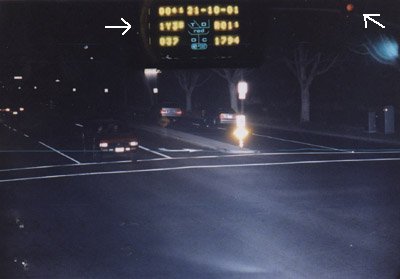
This ACS Limit Line photo shows only the signal
opposing traffic is looking at (upper right arrow).
Some ACS Limit Line photos show no signal at all.
highwayrobbery.net added the arrows.

Typical (non-ACS) "forward-facing" Limit Line photo, shows
signal the driver is looking at.
I.
The lack of a "forward-facing" Limit Line photo showing the signal may have delayed the discovery
of a major problem at an ACS camera at Whittier / Atlantic in East LA. Nearly 3000 tickets issued at that
intersection were reversed by the court, after it was discovered that the camera issued many tickets prematurely, possibly while
the light still was yellow. This problem could occur with an ACS
camera anywhere in the world. (More info about the Whittier /
Atlantic reversals is in the East LA section on the Camera Towns page.)
An ACS camera in your town could have this problem if either (A) or (B) exists.
(A) The "1Y..." or
"2Y..." imprint (see arrow in first example above) on your top photo (assuming it
is more legible than the example above) is not followed
by:
(1) " 30 " or more in a 25 mph zone or for a left or right turn violation,
(2) " 32 " or more in a 30 mph zone,
(3) " 36 " or more in a 35 mph zone,
(4) " 39 " or more in a 40 mph zone, or
(5) " 43 " or more in a 45 mph zone.
(B) The camera has been aimed, as in
the first example above, so that the signal head (other arrow) is
visible, and the visible
light you see is yellow, not
red. It's best to
check a ticket with small "red time" - 1/10th or 2/10ths of a
second - " R001 " or " R002 " in the top
photo on the ticket. See also Defect # 7, below.
If your ticket is
not in color, or isn't clear enough so that you can't perform the
checks above, you can call the police department and ask them what the numbers are, or go in and look
at their copy of the ticket. Their phone number should be on
the back of the ticket. (Before you go visit the police, read II., below.)
II.
Following the ticket reversals in East LA, some cities with
ACS installations
added an extra camera to take a "forward-facing" photo. But some California cities did
not. Several appeal court decisions (
Bohl, Moore, Graham, Salseda) have
addressed that issue.
If you go to cite-web.com to look at your ACS photos, the
forward-facing photo may or may not be there - assuming one was
taken. If you really want to know, for sure, if a forward-facing
photo exists for your ACS citation, I suggest asking for Discovery.
For more information on how to read the
"Late Time" or "Red Time" printed on your ticket, see the How to Read
Your Late Time box in Defect # 7, below.
This (above) is the condensed Version of Defect # 5 -
The original (un-condensed) version is at Defect # 5 - on expanded Home page.
Home/Defects Page (Condensed):
DEFECT # 6: CITY DIDN'T ISSUE WARNING TICKETS FOR 30 DAYS
& other required warnings
Defect # 6 applies when the installation of "your" camera was not followed by a 30-day period
during which warning tickets were issued by that camera, and you got your ticket during that period. This is most likely to happen if "your" camera was not the
first one installed in town.
(There are two other types of warnings required - see the expanded version of Defect # 6.)
Vehicle Code
Section 21455.5 says, in part:
|
21455.5:
(b) Prior
to issuing citations under this section, a local jurisdiction
utilizing an automated traffic enforcement system shall commence a
program to issue only warning notices for 30 days.
( This requirement is not new - it was first enacted, although not in exactly the same words, by
Section 4 of Senate
Bill 833 of 1995, which was effective Jan. 1, 1996 and said,
"Any city utilizing an automated traffic enforcement system at
intersections shall, prior to issuing citations, commence a program
to issue only warning notices for 30 days." )
|
Section 21455.5
doesn't make it clear whether a city having a pre-existing system
is required to issue warning tickets when it adds a new
camera. As a result, while all cities issued warning tickets at the time they installed their first camera, many cities
did not issue warning tickets from the cameras they added weeks or months later.
Hawthorne, Inglewood, Santa Ana and Stockton are examples of cities that issued
warning tickets at their first camera location only - but there are many more.
In 2014 the California Supreme Court issued a decision in People v. Gray, about warning tickets. The Court agreed that a city must issue warning tickets when it adds a
new camera to its system, but it limited that protection to benefit only those violators whose violations occurred when the new camera first became operational. So, if "your" city installed "your" camera and did not issue warning tickets for 30
days after that installation, and your violation occurred during that period, this issue can be raised
in court.
Issuing warning
tickets may be a "foundational" requirement (read the Gray decision) - Defects #'s 2 - 4 and 10
are others.
This (above) is the condensed Version of
Defect # 6 -
If you want more details, the original (un-condensed) version is at Defect # 6 - on expanded Home page.
Home/Defects Page (Condensed):
DEFECT # 7: SIGNAL LIGHT BULBS TAKE A WHILE TO COME ON
...and So Do LEDs
AKA: The "Filament" Defense
This defect is applicable only to tickets with small "Late
Times" - 0.20 (two tenths of a second, or 200 milliseconds) or less. If you can't find your Late Time, or can't read it,
see the big purple-ish box, below.
California Vehicle Code Section 21453, which
is the law you
have been charged with violating, says:
"A driver facing a steady red... shall stop...." (Emphasis added.)
The defect is that LEDs
(light-emitting diodes), the fastest-acting light source used in
signals, can take slightly more than 0.1 second to light-up
(turn-on) after the power has been
applied. If you
have a ticket with a 0.1 Late Time, that turn-on delay may be longer than the Late Time you were cited for. And
the old-fashioned, but occasionally still-in-use incandescent bulbs, take about
twice as long. If your Late Time was very short (or you suspect that it was), compare the brightness of the red
in the first photo...
Portion of "First photo," taken when front
of car
was 1 - 2 feet behind limit line,
Late Time indicated as approx. 1/10 sec.
...to the brightness of that same lamp in the second photo.
Portion of "Second photo," taken approx. 1 sec. later,
when car was in the
middle of the intersection.
If it is noticeably brighter in the second photo, then you have photographic evidence that you were not
facing a "steady" red at the time you were at the limit line, and you should be sure to read the Expanded version of Defect # 7.
How to Read Your Late Time
You may need a magnifying glass, a pocket calculator, or a
crystal ball !
Late Time is how long the signal already had been red (actually,
how long power had been applied to the red light bulb) when your
picture was taken. The red light camera industry is so new that there's no standard
terminology. Thus, Late Time is also often called "duration," "time into
red," "red time," or abbreviated as "TR."
There's also no standard as to the number of decimal places - Some red light
cameras display the Late Time rounded down to tenths
of a second, others display hundredths of a second, and some of
the newest cameras have four digits to the right of the decimal place. In
at least one city (Culver City) the number of digits varies from camera to camera.
Pointing up the lack of standards, several cities formerly using Nestor-brand camera systems don't display the Late Time at all, even though
Nestor
systems clearly had the capability to do so.
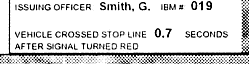
(From
sample ticket at the end of
a Nestor brochure.)
A possible motive to leave it off could be so that they can
cite for very short Late Times (like 0.1 second) without widespread
criticism (including some from judges) about "Mickey Mouse" tickets.
If you phone the PD to ask what your Late Time was, they probably
will say that to get that information, you must come in to the police
station. The visit to the police station serves to grind you
down, make it harder for you to fight your ticket. See the Cerritos, Costa Mesa,
Pasadena, Davis or San Bernardino sections on the Camera
Towns page for more information.
Many red light cameras imprint the Late Time right on the
top[2] photo on your ticket - but the format has not been standardized. So
here is how some of the more common cameras would display a Late
Time of 1/10th (one tenth, or 0.1) of a second.
The now almost-obsolete (but still used in some locations) ACS "wet film" 35mm
cameras print 1/10th of a second as R001 . While it's not a 1/10th of a second ticket, the top
photo in Defect # 5 above is a good example of a ticket from an ACS
35mm camera. The tenths digit is smaller than the rest and is
always very hard to read; to be sure of what the tenths digit is,
you may need to call the issuer of the ticket. On the example, the Late Time is 1.1 second, displayed as
R011 (in the middle row on the right
side of the data box).
Early RedFlex cameras, such as Culver City's first seven installations,
used 35mm "wet film" and displayed the data in bright, but fuzzy, red
numerals in a strip across the top of the photos[2]. They would print
a 1/10th second Late Time as Red T. 000.1
RedFlex's newer cameras, which are digital and take 12 seconds of video, display
the data in tiny faint white letters on a black strip at the top edge of the photos[2] (best way to read them is by
putting the ticket up on the window). They would print a 1/10th
second Late Time ("duration," "TR," or "time into red") as
either 0.10 or 0.1000. At court in Culver City I have
seen some RedFlex "video" tickets with only the tenths digit displayed. The officer told
the court that this occurs when
they are having a problem with their live data link.
Most brands of cameras (ACS, RedFlex, etc.) have an additional time
counter, often called "elapsed time," which starts at zero at the
instant the first photo is taken. It will tell you the time that
elapsed between the first photo and the second. Sometimes
using the elapsed time (subtracting it from the elapsed Late Time
shown in the second photo
on the ticket) will help you to figure out what the hard-to-read
Late Time (in the first photo) is. For example, here are the
data boxes from the first and second photos on a typical ticket -
actually the same ACS one used in Defect # 5, above.
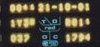
If you subtract the elapsed time of 0.89 (shown in the middle row,
left side, below) from the elapsed Late Time of 2.0 (
" R020 " in middle row, right side, below) you get
1.11, which confirms that the Late Time shown in the first photo
(middle row, right side, above) is 1.1 (after rounding off).
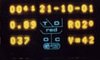
For more practice reading Late Times, see this page.
If
you are making time/distance calculations, see: The Math Page.
[2] If two photos have a Late Time imprint, the applicable number will be the smaller one.
|
This (above) is the condensed Version of Defect # 7 -
The original (un-condensed) version is at Defect # 7 - on expanded Home page.
Home/Defects Page (Condensed):
DEFECT # 8: TICKET MAILED
LATE,
OR TO THE WRONG ADDRESS,
OR WITHOUT PROPER PROOF OF MAILING,
OR INCOMPLETE
Most of Defect # 8 could apply to any violation,
anywhere.
(A) Many defendants are unaware that they ran a light. Many other defendants loaned their
car to someone else. So that defendants are able to remember
what they were doing on the date of the violation, or to whom they
had loaned their car, California law gives the police only a limited
amount of time (15 days)[4] to deliver a genuine Notice to Appear to the registered owner's letter box.
And, of course, the police need
to send it to the right address.
[4] Vehicle Code Sec. 23 says, "The giving of notice by mail is complete upon the expiration of four days after deposit of the notice in
the mail...." So, if the postmark is more than 11 calendar days after the date the violation
occurred, the service of the Notice to Appear could be defective and you could file a demurrer to make the ticket disappear.
If you're not the registered owner, please note: The
15-day requirement applies to the first
mailing of a Notice to Appear, which is usually to the registered owner
of the car. If
he or she received a genuine Notice to Appear, then gave your name to
the police who then re-issued the ticket to you, the 15-day requirement does
not apply to the timing of the mailing to you. But if what the
registered owner received was something other than a genuine Notice to
Appear (maybe a Snitch Ticket?), you might be able to file a demurrer. For more info about
demurring, see Defect # 8, Expanded.
(B) And since red light camera
Notices to Appear are not handed to you in person by a motor officer who
obtains your signature, the law requires the police to
obtain some evidence that the Notice to Appear was actually
mailed.
(C)
Some cities leave the court's phone number off the Notice to Appear, or
provide an incomplete address for the court (both of which are required on the official form), in an apparent attempt to make it harder
for defendants to have their day in court.
The Law
In
California, Vehicle Code Section
40518 says (in part, with
emphasis added):
|
40518. Whenever
a written Notice to Appear has been issued by a peace officer or by a
qualified employee of a law enforcement agency
on a form approved by the Judicial Council ...
and delivered
by mail within 15 days of the alleged
violation to the current address of the registered owner of
the vehicle on file
with the department, with
a certificate of mailing obtained as evidence of
service ...
|
This (above) is the condensed Version of Defect # 8 -
The original (un-condensed) version is at Defect # 8 - on expanded Home page.
'CHEAT SHEET' AVAILABLE
If all these Code sections (and other numbers) are beginning to circle around in your head, I suggest that
you go to the Site Index and print out the 'Cheat Sheet'
available there. That way, you will have a ready reference to refresh your memory. I use it too!
Home/Defects Page (Condensed):
DEFECT # 9: "CHURNING"
Quotas, Enforcement on Left or Right Turns, Signals
which Change Too Quickly, Cameras at Confusing Intersections, Federal
Guidelines
"Traffic rules account for most of the contact by average citizens with law enforcement and the
courts. Enforcement of laws which are widely perceived as unreasonable and unfair generates
disrespect and even contempt toward those who make and enforce those laws."
The Appellate Department, in People vs. Goulet
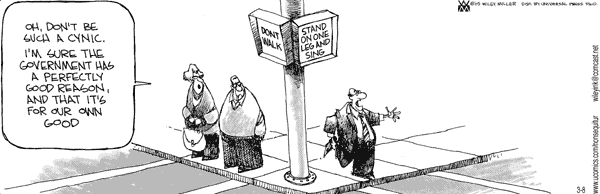
Nonsequitur, by Wiley Miller. Shop at www.gocomics.com/nonsequitur/
A. Ticket Quota$
Section 11.14 of the Feb. 2009 contract between the City of Walnut and RedFlex penalized the City if:
"...the City or Police waives more than 10 percent of valid violations forwarded to the Police for acceptance...."
The contract between Los Angeles County MTA ("Metro") and ACS required:
"The Contractor shall be required to maintain, at a minimum, the existing rates of citations issued by location...."
In Apr. 2011 a jury awarded $2 million to two LAPD motorcycle officers who alleged that their supervisors retaliated against them for complaining about traffic ticket quotas. Article, LA Times, 4-12-11
In June 2011 the mainstream media revealed that the LA County Superior Court was not reporting ignored red light camera tickets to the DMV. By the following month, payment of tickets had dropped in half. To bring their ticket revenue back up, some cities began to issue a lot more tickets. Baldwin Park, Commerce, Covina, Culver City, Hawthorne, Lynwood, Santa Clarita, South Gate, Walnut and West Hollywood - more than half of the red light camera cities in LA County - increased ticketing by more than 50%. For more info, see Set # 2 on the LA County Docs page. Ticketing also increased 50% or more in some cities outside of LA County: Corona, Garden Grove, Highland, Los Alamitos, Oakland, Redding, Riverside, San Bernardino, San Mateo, Santa Ana, South San Francisco, Stockton and Victorville.
Ticket quotas are illegal in California - see CVC 41600 - 41603.
B. Churning Right Turn$
"There is nothing so useless as doing efficiently that which should not
be done at all."
Prof. Peter F. Drucker
"Basically they're [the camera company] saying we're going to make money off that intersection if we put it there. It's a half million dollars in fines that we would not normally have collected."
Emeryville Police Chief Kenneth James. Source.
Sgt. Sharon Kaufman: "My only question is since most of the violations are right turns, how long would that be sustainable?"
RedFlex rep Mark Riggs: "I can say that most intersections that have right turns enforced continue to produce consistent numbers."
2013 email exchange about proposed new camera in Menlo Park
"Mr. Saunders [President of RedFlex] suggests jurisdictions refrain from issuing a [rolling right] ticket except when a pedestrian is in
the crosswalk."
Interview of Saunders in Dec. 26, 2014 Wall Street Journal column headlined: "Can the Red-Light Camera Be Saved? - Money-hungry
politicians discredit a hopeful safety innovation.”
There has been a shift away from ticketing people who run straight thru intersections, towards ticketing
drivers who "roll" a right turn. It has become the profit center of most systems, and
some of the newest contracts (between cities and red light camera
providers) acknowledge the economic importance of rolling right enforcement by making it a contractual obligation.

Clause found in the Nov. 2007 San Carlos and Feb. 2008 Belmont contracts.
The San Carlos and Belmont contracts merely required those cities to enforce on rolling rights, without
specifying exactly what would happen if the cities had refused to
do so. On the other hand, the Dec. 2007 Citrus Heights contract, the Jan. 2008 Bakersfield contract, the June 2008 Napa
contract, the Oct. 2008 Bell Gardens contract, the Nov. 2008 amendment of the Ventura contract, the Dec. 2008 Lynwood contract, and the Feb. 2009 Walnut contract all provided for a monetary
sanction against the city.
Why did RedFlex find it necessary to force cities to enforce rolling rights? We need look no further than Ventura. Before 2008, the City was not contractually required to ticket rolling rights, and chose - correctly - to give it very little emphasis. Because of
the low ticket volume - combined with 'cost neutral' terms - by 2008 the City owed RedFlex a "balance carried forward" of $1.7 million.
By 2014 the debt had increased - despite the amendment - to $2.7 million, which RedFlex
was forced to forgive in 2015 as part of negotiations for a new contract with the City. See Set # 2 of
Ventura Documents
.
A Few Important Notes about Right Turns
(1) The price - In 2010, 2012, 2015, 2016, 2017 and 2018 there were bills in the legislature to reduce the fine for rolling rights. None passed! See the Legislation section on the
Action page.
At least one city used to do what the three bills proposed: Until Aug. 2008 the City of LA cited
its rolling right turns under Subsection (b) of CVC 21453, instead of
(a), which resulted in a much-lower fine. And a few judges in other cities offer reduced fines to
defendants with rolling right tickets.
For perspective: New York City charges $50 for all its camera tickets, and in Oct. 2009 the Lafayette, Louisiana City-Parish Council reduced the fine for rolling rights to $25, from the previous $125.
(2) At right turns, the city is not required
to post signs telling you "stop before turning" or something like that. See FAQ # 27 and
Sign Requirements for more details. But if you were cited for a turn at a corner having a sign saying "no turn on red," please
contact me about it.
(3) Under present rules a city can set the length of the yellow for a turning movement (right, or left) to as little as 3.0 seconds, even on a high speed street, if the turn is controlled by a green arrow. However, in Nov. 2014 CalTrans recommended - but did not require - longer yellows at those locations where the turn pocket exceeds 150 feet in length.
If the turn is not controlled by a green arrow, the length of the yellow should be set according to the speed of the through traffic.
For more info about right turns, read the expanded versions of Defects # 2 and # 9.
C. Churning Left Turn$
A tiny increase in the length of the yellow makes a huge decrease in the number of left turn violations.
If cities wish to reduce left turn running, they should
lengthen the yellow, make sure the green arrow is long enough - and demand-activated - and that the turn pocket is
large enough for the demand. In most cities, the photo enforcement on left turn arrows is a form of Churning.
Under present rules a city can set the length of the yellow for a turning movement (left, or right) to as little as 3.0 seconds, even on a high speed street, if the turn is controlled by a green arrow. However, in Nov. 2014 CalTrans recommended - but did not require - longer yellows at those locations where the turn pocket exceeds 150 feet in length.
If the turn is not controlled by a green arrow, the length of the yellow should be set according to the speed of the through traffic.
For more about left turns, read the expanded versions of Defects # 2 and # 9.
Take Political Action
If you have a ticket for a turn, left or right, call your State legislators, and your auto club, and complain
about the heavy ticketing and the way out-of-proportion fine. For phone
numbers see the Legislation section on the
Action page.
Other than the quotas, the things noted
in Defect # 9 above are mostly political issues - it would be
difficult to use them to beat your ticket. If you would like to
read more about them (including Federal guidelines), see
Defect # 9, on the expanded Home page.
This (above) is the condensed Version of Defect # 9 -
The original (un-condensed) version is at Defect # 9 - on expanded Home page.
Home/Defects Page (Condensed):
DEFECT # 10: PROBABLE CAUSE, FOUNDATION,
CONSTITUTIONALITY, HEARSAY, CONFRONTATION
Defect # 10, Subsection A:
SOME FOUNDATIONAL REQUIREMENTS: WARNING SIGNS, WARNING TICKETS,
LONG-ENOUGH YELLOWS, AND WRITTEN GUIDELINES
At a trial, Foundation is the introductory evidence necessary to establish the admissibility
of other evidence.
There was no witness to the crime. The case is based solely upon physical evidence - the
photos and the data the computer recorded. But the police can't use evidence
if it was gathered illegally. Vehicle Code 21455.5 (in box, below) specifies things the
City must do and must not do in order to legally gather red light camera evidence.
To make this concept clear, here is an extreme example: Suppose
you're accused of shooting a convenience store clerk, and the police
have produced a gun that matches the bullets found in the clerk; the
gun also has a full set of your fingerprints on it. It is almost
perfect evidence - just
like the photos the red light cameras take - except for one problem.
The police obtained the gun illegally, by breaking into your
house without a warrant. So, they will not be able to use the gun
in court, and will have to depend upon other evidence, and eyewitness
testimony, to make
their case.
At your red light camera ticket trial, the officer will testify first, and he is supposed to begin his
testimony by "laying the foundation."[5] Without having to be reminded to do it, most officers will give a brief
foundational speech (sometimes very brief) saying that they posted warning signs
(Defect # 4), made announcements 30 days before starting up the system, gave
warning tickets for 30 days (Defect # 6), have long enough
yellows (Defect # 2), etc.
[5] Think of the evidence as a house; houses collapse if they have no foundation.
When it's your chance to cross-examine him, you could ask
the officer if he provided public notice 30 days before firing up your camera,
issued warning tickets for the first 30 days
of operation (of your camera - see Defect # 6),
had four signs (full 30" x 42") posted at
your intersection at the time you were ticketed,
and has written guidelines.
Home/Defects Page (Condensed):
Defect # 10,
Subsection B:
FOUNDATIONAL REQUIREMENT: PAY-PER-TICKET
("COST NEUTRAL") CONTRACTS ARE PROHIBITED
Vehicle Code Section 21455.5 prohibits "pay per ticket" contracts. 21455.5(h) says:
(h)(1) A contract [with a red light camera supplier]... may not
include... payment... based on the number of citations generated,
or as a percentage of the revenue generated..."
( Full text is in the big box, below. )
The author of 21455.5 wrote:
"Paying red light camera vendors [suppliers] based on the number of tickets
issued undermines the public's trust and raises concern that
these systems can be manipulated for profit."
(Official comment by Senator - then
Assemblywoman - Jenny Oropeza, published in 8/27/03 legislative
analysis of
AB 1022 of 2003.)
Many cities are ignoring that law. An example was
Marysville, where the contract signed Dec. 21, 2004 said:
"Fixed fee of $6,030 Per Month Per Designated Intersection Approach..."
"Payment [to camera supplier RedFlex] will only be made by Customer [the City] up to
the amount of cash received by Customer from Yuba County through the collection
of red light citations up to the amount currently due."
"Cost neutrality is assured to Customer using this methodology as Customer
will never pay RedFlex more than actual cash received." (Bolding added.)
In other words, contrary to the misleading "fixed fee" language, RedFlex will get less money if
there are fewer tickets, and more
money if there are more.
The known examples of illegal or cost-neutral contracts are Bakersfield‡, Baldwin Park‡, Bell Gardens‡,
Capitola‡, Cathedral City‡, Cerritos‡, Citrus Heights‡, Commerce‡, Corona‡, Costa Mesa*‡, Covina‡, Culver City*‡, Daly City‡, Davis*, Emeryville*‡, Encinitas*‡, Escondido*‡, Fairfield‡, Fullerton, Gardena‡,
Glendale*‡, Grand Terrace, Hawthorne‡, Hayward‡, Hemet‡, Highland‡, Inglewood‡, Laguna Woods*‡, Lancaster‡, Loma Linda‡, Long Beach‡, Los Alamitos, Los Angeles County, Lynwood‡,
MRCA*‡, MTA/Metro, Marysville‡, Menlo Park‡, Millbrae*, Modesto‡, Montebello‡, Moreno Valley, Murrieta‡, Napa*‡, Newark*‡, Oceanside‡, Oxnard‡,
Paramount‡, Rancho Cucamonga, Redding‡, Redwood City*‡, Redlands, Riverside‡, Rocklin‡, Roseville, San Bernardino*‡, San Juan Capistrano*,
San Leandro‡, San Mateo*‡, Santa Ana‡, Santa Clarita‡, Santa Maria, Solana Beach‡, South Gate*, City of South San Francisco‡, Stockton‡, Union City, Upland, Ventura‡, Victorville‡,
Walnut‡, Whittier‡, Yuba City‡, and Yucaipa.
* This city recently amended its contract, or signed a new one,
changing the pay to its camera vendor to "flat rate."
For more details, see the city's entry on the Camera Towns page.
‡ This city's contract is available in the city's entry on the Camera Towns page or in the city's Documents page.
This list of cities with cost neutral contracts may not be up-to-date - there could be an amendment that has not come to my attention.
Appeal Victories!
In 2008, 2009, 2010 and 2011 defendants won appellate
court decisions saying
that cost-neutral contracts are illegal. See the expanded version of Defect # 10 - B for more information.
Check the contract in "your" city. It may be available on the city's Documents page, here on highwayrobbery.net. Or, you can get it by calling the city clerk, at city hall. If the
contract was signed or amended after Jan. 1, 2004 and the quantity of tickets (or
the amount of ticket revenue the city gets from the court) has any effect upon the amount paid to the camera supplier, make a motion (or add to your Trial by
Declaration)
to exclude the camera evidence, because it was gathered
illegally.
Home/Defects Page (Condensed):
Defect # 10, Subsection C:
MOTION TO STRIKE EVIDENCE AND CHALLENGE CONSTITUTIONALITY
In association with the National Motorists Association (NMA), an attorney prepared a 20-page defense brief (Fairfax) asking a
court in Fairfax, Virginia to strike the evidence and rule the underlying ordinance unconstitutional.
While
some of the brief would
apply only to a ticket in that city, many sections of it might be
useful in California.
See the Links/Ref page for more information about the NMA.
Defect # 10, Subsection D:
HEARSAY / CONFRONTATION
Ordinarily, when someone wants to use a document, letter or photo as evidence
in court, they need to bring in a live person to testify as to the document's
authenticity and accuracy. And the opposition gets to cross-examine - "confront" - that person. Without that "live" authentication, the
document could be ruled to be "hearsay," and excluded from
evidence. There is an exception to the hearsay rule, for
documents created by a government employee - but many of the documents
the police present in court have been created by a private company's
employees who are not government employees, thus have no official duty to report accurately. Numerous recent
decisions by California Appellate Divisions and the US Supreme Court have addressed this hearsay/confrontation issue.
In Sept. 2012 Gov. Brown signed a new law diminishing a defendant's ability to object on hearsay grounds. See SB 1303 of 2012, on the Action/Legis page.
RedFlex holds a patent on a method to alter/intensify portions of photos.
Also see the Getting Records / Discovery page, read about California's Truth in Evidence law, and
the Best Evidence Rule.
Defect # 10, Subsection E:
PROBABLE CAUSE
Some cities issue a real ticket to the registered owner of the vehicle, even when it is obvious (an age and/or gender mismatch) that he or she was not the driver at the time of the violation. In 2014 there was a trial court decision about that lack of Probable Cause, in
People v. Tho--. An earlier decision is in Section III(B)(2) of Judge Ronald Styn's Aug. 15, 2001
ruling in People v. John Allen. Also see Set # 16 on the Culver City Docs page.
The Law
|
Text of
California Vehicle Code Section
21455.5, effective Jan. 1, 2004, with the significant changes effective Jan. 1, 2013 (due to SB 1303 of 2012 - see the Action/Legis page) shown in Italic and strikeout type:
(a) The limit
line, the intersection, or a place designated in Section
21455,
where a driver is required to stop, may be equipped with an
automated traffic enforcement system if the governmental agency utilizing
the system meets all of the following
requirements:
(1) Identifies the system by signs posted within 200 feet of an intersection where a system is operating that clearly indicate the system's presence and are
visible to traffic approaching from all directions in which the automated traffic enforcement system is being utilized to issue citations. or posts signs at all major entrances to the city, including, at a
minimum, freeways, bridges, and state highway routes. A governmental agency utilizing such a
system does not need to post signs visible to traffic approaching the
intersection from directions not subject to the automated traffic
enforcement system. Automated traffic enforcement systems installed
as of January 1, 2013, shall be identified no later than January 1,
2014. [[Also see subsection (j), below.]]
(2) Locates the system at an intersection,
and ensures that the system meets the criteria specified
in Section
21455.7. [[See Defect # 2.]]
(b) Prior to
issuing citations under this section, a local jurisdiction
utilizing an automated traffic enforcement system shall commence a
program to issue only warning
notices for 30 days. The local
jurisdiction shall also make a public announcement of the automated
traffic enforcement system at least 30 days prior to the
commencement of the enforcement program.
(c) Only a governmental agency, in cooperation with a law
enforcement agency, may operate an automated
enforcement system. As used in this
subdivision, "operate" includes all of the following
activities A governmental agency that operates an automated traffic enforcement system
shall do all of the following:
(1) Develop uniform guidelines
for screening and issuing violations and for the processing and
storage of confidential information, and establishing procedures to
ensure compliance with those guidelines. For systems installed as of January 1, 2013, a
governmental agency that operates an automated traffic enforcement
system shall establish those guidelines by January 1, 2014.
(2) Perform administrative
functions and day-to-day functions, including,
but not limited to, all of the following:
(A) Establishing guidelines for
selection of a location. Prior
to installing an automated traffic enforcement system after January
1, 2013, the governmental agency shall make and adopt a finding of
fact establishing that the system is needed at a specific location
for reasons related to safety.
(B) Ensuring that the equipment is regularly
inspected.
(C) Certifying that the equipment is properly
installed and calibrated, and is operating properly.
(D) Regularly inspecting and maintaining warning
signs placed under paragraph (1) of subdivision (a).
(E) Overseeing the establishment or change of
signal phases and the timing thereof.
(F) Maintaining controls necessary
to assure ensure that only those citations that have been reviewed and
approved by law enforcement are delivered to violators.
(d) The activities listed in subdivision (c) that relate to the operation of the system
may be contracted out by the governmental agency, if it maintains overall control and
supervision of the system. However, the activities listed [[ and in bold type, above ]] in paragraph (1) of, and
subparagraphs (A), (D), (E), and (F) of paragraph (2) of, subdivision (c) may shall not be
contracted out to the manufacturer or supplier of the automated enforcement system.
(e) The printed representation of computer-generated information,
video, or photographic images stored by an automated traffic
enforcement system does not constitute an out-of-court hearsay
statement by a declarant under Division 10 (commencing with Section
1200) of the Evidence Code.
(e)
(f)
(1) Notwithstanding Section 6253 of the Government Code, or any other law, photographic records
made by an automated enforcement system shall be confidential, and shall be made available only to governmental
agencies and law enforcement agencies and only for the purposes of this article.
(2) Confidential information obtained from the Department of Motor Vehicles for the
administration or enforcement of
this article shall be held confidential, and shall not be used for any other purpose.
(3) Except for court records described in Section 68152 of the Government Code, the confidential records and
information described in paragraphs (1) and (2) may be retained for up to six months from the date the information
was first obtained, or until final disposition of the citation, whichever date is later, after which time the information
shall be destroyed in a manner that will preserve the confidentiality of any person included in the record or information.
[The prohibition of cost neutral contracts, formerly Subsection 21455.5(g), is now at 21455.5(h).]
(f)
(g) Notwithstanding subdivision (d) (f), the registered owner or any individual identified by the registered owner
as the driver of the vehicle at the time of the alleged violation shall be permitted to review the photographic
evidence of the alleged violation.
(g)
(h)
(1) A contract between a governmental agency and a manufacturer or
supplier of automated traffic enforcement equipment may shall not
include provision for the payment or compensation to the manufacturer or supplier based on the number of citations generated,
or as a percentage of the revenue generated, as a result of the use of the equipment authorized under this section.
(2) Paragraph (1) does not apply to a contract that was entered into by a governmental agency and
a manufacturer or supplier
of automated enforcement equipment before January 1, 2004, unless that contract is renewed, extended, or amended on or after
January 1, 2004.
(3) A governmental agency that proposes to install or operate an
automated traffic enforcement system shall not consider revenue
generation, beyond recovering its actual costs of operating the
system, as a factor when considering whether or not to install or
operate a system within its local jurisdiction.
(i) A manufacturer or supplier that operates an automated traffic
enforcement system pursuant to this section shall, in cooperation
with the governmental agency, submit an annual report to the Judicial
Council that includes, but is not limited to, all of the following
information if this information is in the possession of, or readily
available to, the manufacturer or supplier:
(1) The number of alleged violations captured by the systems they
operate.
(2) The number of citations issued by a law enforcement agency
based on information collected from the automated traffic enforcement
system.
(3) For citations identified in paragraph (2), the number of
violations that involved traveling straight through the intersection,
turning right, and turning left.
(4) The number and percentage of citations that are dismissed by
the court.
(5) The number of traffic collisions at each intersection that
occurred prior to, and after the installation of, the automated
traffic enforcement system.
(j) If a governmental agency utilizing an automated traffic
enforcement system has posted signs on or before January 1, 2013,
that met the requirements of paragraph (1) of subdivision (a) of this
section, as it read on January 1, 2012, the governmental agency
shall not remove those signs until signs are posted that meet the
requirements specified in this section, as it reads on January 1,
2013.
|
This (above) is the condensed Version of Defect # 10 -
The original (un-condensed) version is at Defect # 10 - on expanded Home page.
Disclaimers / Notes
Don't run red lights. It
is a dangerous practice - Russian Roulette with a car. This
website is inspired by the short-sighted cities that have chosen to
"rig" their cameras and signals to maximize profits - and minimize
safety.
This site is a free-of-charge
public service. I am not selling anything, and cannot accept
donations. I ask each person who uses this website to call their legislators and their
auto club. See the Action page.
Contributions of information are welcomed. See
the Help & Info Needed
section on the Action page. And if you operate a website or a
"blog," please mention highwayrobbery.net.
 You can buy that coffee mug at Dilbert.com
You should double-check any material
obtained here, before you use it.
If you would like to fight your ticket but do not want to appear personally in court, or cannot easily
do so, you could do a Trial by Declaration, through the mail. See the Your Ticket page. Or, I can refer you
to lawyers who specialize in traffic
tickets. I do not accept any kind of compensation, not even a free lunch, from
these attorneys.
During the first three years of this site's existence I attended traffic court twice a
week, and there is an extensive chronology of those visits in the Culver City, Inglewood and Hawthorne sections on the Camera
Towns page. Even if your ticket is not from one of those three cities, you may find the
information there to be useful.
While Defects # 5, # 7, # 8 and # 9 (above) could apply to a camera anywhere in the world, most of the information on this website applies primarily to tickets issued under California Vehicle Code Section 21453; the law in other states is different. There is some "national" information on the Links/Ref page.
Most of the information on this website applies
only to tickets issued in California.
I update portions of this website almost daily. If you are making a return visit after
an absence of more than a day, I recommend that you hit the "reload" or "refresh" buttons,
to make sure you have the latest version of the page you're interested in.
If losing your case would cost you your job or your ability to get one, hire a lawyer. Hire a lawyer if you have been charged with a misdemeanor (red light camera tickets are infractions), because a misdemeanor conviction can land you in jail for up to six months.
"Aggressive fighting for the right is the noblest sport the world affords."
Teddy Roosevelt
All information, documents and data posted on this website has been obtained legally, primarily from case documents provided by defendants, from media reports, from government websites, and from requests made under the California Public Records Act ( Govt. Code 6250 ).
I have modified portions of this website to make it more accessible from hand-held devices. If you are having trouble reaching it, are having to do a lot of scrolling to find what you want, or just have a design suggestion, please let me know. The modifications should be invisible when the site is viewed on a laptop or desk-top computer.
Is this Site Reliable?
I am not a lawyer, or a government "insider," and may have some erroneous or incomplete materials on this site. You should double-check any material obtained here, before you use it. Use the link in the Reference section on the Links/Ref page to review the latest version of any Vehicle Code section upon which you are basing your defense.
Despite the paragraph above, other people consider this site to be pretty reliable.
"Mayor Rhodes Rigsby said... he trusted the website and has taken its advice in the past."
San Bernardino Sun, Oct. 13, 2010
"...according to data posted on highwayrobbery.net that Napa Police Capt. Jeff Troendly said looked 'spot on.' "
Napa Valley Register, Nov. 13, 2011
Why?
"While not on an existential par with events in Syria and Iraq, someone has to worry about our self-inflicted war
on ourselves and our submission to dystopian efficiency over humanity."
From Cry, Your Car's on Hidden Camera, by Kathleen Parker, in the Washington Post 9-23-14 (archived copy)
Internal
Links
You are on the Condensed Version of the Home / Defects page.
For the expanded (original) version,
click: Home / Defects - Expanded.
Onward, to Camera Towns
page
Back, to Top
of Condensed Home page
Email: For my address, go to
the Action page.
PHOTO ENFORCEMENT 'CHEAT SHEET' AVAILABLE
If all these Code sections (and other numbers) are beginning to circle around in your head, I suggest that
you go to the Site Index and print out the 'Cheat Sheet'
available there. That way, you will have a ready reference to refresh your memory. I use it too!
Please also note that this is a condensed version of the
Home/Defects page. If you are having trouble finding something that you saw before, it might
be something that is only on the original/expanded version of
the page - which is still available, and fully maintained.
---------------------------------
RED
LIGHT CAMERAS
www.highwayrobbery.net
www.highwayrobbery.net