Contact/Email Address
Legislation/Speed Cameras Coming?
Fake/Snitch Tickets, Issued by the Police!
No Ticket Yet? Be Prepared
Journalists/Bloggers/Webmasters
FAQ Frequently Asked Questions
Alternatives to Cameras
Library of Transcripts, Briefs, Decisions
Search
This is the original ("Expanded") version of the Home / Defects page.

WELCOME TO HIGHWAYROBBERY.NET
Info & Advice about California Red Light Camera Tickets
"A sense of confidence in the courts is essential to maintain the fabric of ordered liberty for a free people and three things could destroy that confidence and do incalculable damage to society: that people come to believe that inefficiency and delay will drain even a just judgment of its value; that people who have long been exploited in the smaller transactions of daily life come to believe that courts cannot vindicate their legal rights from fraud and over-reaching; that people come to believe the law - in the larger sense - cannot fulfill its primary function to protect them and their families in their homes, at their work, and on the public streets."
US Supreme Court Chief Justice Warren Burger, 1907 - 1995, in address to Am. Bar Assn. meeting, Aug. 10, 1970.
You are on the original ("Expanded") version of the Home / Defects page. 18,000 words! There is a shorter version ( 8000 words), at Home / Defects - Condensed.
Please be sure to read the What's Hot box at the top of the Condensed Home page, and the Disclaimers/Notes section at the bottom of that page.
Defect # 1 - blurry photo of the driver - is the one which gets the most cases dismissed - if the defendant (you) takes the case all the way to a not-guilty trial.
In addition to the defects listed on this page (below), on the Camera Towns page there is more discussion of the defects as they relate to specific cities or counties.
Along with defending their ticket, every motorist needs to go on the offensive. Part of each motorist's handling of their ticket should be a call to their legislators. See the Legislation section on the Action page for details.
DEFECT # 1: DRIVER'S FACE PHOTO
You are on the original ("Expanded") version of the Home / Defects page.
For a condensed version,
click: Home / Defects - Condensed. But please note: There is just one version of Defect # 1 - the version below is identical to the version on the Condensed page.
In California, photo enforcement tickets can put a point on your driving record. So, they
have to have a picture of your
face. A picture of your license plate doesn't
establish that you did the
crime - it only establishes that your car did it, and anyone could have been
driving your car.
A bad "face" photo - blurry, or picturing a
driver whose name is not on the ticket - is a common
reason for dismissal of red light camera tickets.
(If you have not received a ticket
with photos on it - all you have received is a "Courtesy Notice"
from the Court, or a notice from a collection agency - you will
need to phone the issuing police department and ask them for a copy
of the ticket.)
Important: Is It a Fake / Snitch Ticket?
Does your "ticket" have the address of the Court on it? If it doesn't, or if it says, "Do not contact the court," it's not really a ticket at all. It's a police trick! See the section entitled "Police Going Too Far..." on the Your Ticket page.
Is It Someone Else in the Photo?
If your name is on the ticket but it's not your face in the photo, you don't have to identify the person driving. For more info on how to handle this situation, go to the "It's Not Me!" section on the Your Ticket page. (If the mismatch between the person ticketed and the actual driver is really obvious, like a combined age AND gender mismatch, please let me know about your ticket.)
Photo Blurry?
If it is your face in the photo, but it's blurry, read on...
The "face" photo on the ticket sent to me
was very blurry. The ticket said that I could go to the police
station and be shown the original photo, so I did, and it was just
as blurry.
Vehicle Code
Section 210 requires
that the photo be "clear,"
so the lack of the required clear photo was part of my challenge to
the ticket. Read the discussion about driver's photos on page 255 in the 13th Edition or page 277 in the 14th Edition of
Fight Your Ticket, and the Foley decision (2010).
Unfortunately, a judge evidently has a lot of latitude as to what
"clear" means. Commissioner Randall F. Pacheco, who heard my case,
ruled against me, saying: "The driver in the picture has remarkably
similar coloring and facial structure."
In
most cities, on the day of trial (not arraignment), many tickets
are dismissed "first thing" at the request of the police, due
to poor quality face photos. ("First thing" meaning right
after the judge comes in, or right after the defendant has
been called forward for his trial.) If
your photo is very blurry, plead not guilty, come in for a trial -
maybe your ticket will be dismissed. If it's not dismissed "first
thing," the
ticket still could be dismissed during the trial once the judge
gets a look at the photo. To
convict you, the judge needs to be convinced "beyond a reasonable
doubt" that it is you. But
you need to know that while some judges are likely to reject bad photos, others will readily
accept a photo with only a fraction of a blurry face visible behind the rear view mirror and
sunglasses. If the photo is blurry and the judge hasn't noticed
that (or if the officer hasn't shown the photo to the judge), bring it
to the judge's attention. Don't say, "It's not me," as that would
be perjury if you know it actually is you. (See FAQ # 21 on the
Links page for more information about perjury.) Simply ask the judge, "Are you sure it's me?"
Or you could say, more formally, "I
request dismissal of this ticket as there isn't proof beyond a
reasonable doubt that I was driving the vehicle." The preceding two phrases are not testimony, so give you the added advantage that if
the judge asks you, "Well then, who is it?" you can tell him that you have not agreed to testify.
At trial,
some defendants with blurry face photos have successfully raised
"reasonable doubt" in the judge's mind by showing him a snapshot of
them together with similar-looking family members or
friends.
At one trial the defendant
argued that the photo could be any one of a number of his employees who
had access to the truck. The photo wasn't totally blurry - the
officer quipped, "Do you have a twin brother?" and the judge said, "I
think it is you - I see shades and a nose." But then the judge (a retired judge brought in temporarily) said,
after taking another look at a blow-up of the photo, "If he murdered
somebody, I don't see why I should treat a traffic case any
differently." He then dismissed the case.
The burden of proof (the job of convincing the judge it's you) is
on the People (the officer and his photos). (See the discussion of the law in the "It's Not Me!" section
of the Your Ticket page.) You're not required
to help the officer convict you - the Fifth Amendment says, "No person... shall
be compelled in any criminal case to be a witness against himself."
You should (politely) invoke that right if the judge
asks questions like, "Is that you in there?" or "Do you recognize
yourself?" (For more info about remaining silent, read the Fourth Step of the "It's Not Me!" section.)
Sometimes,
the officer forgets to display the face photo to the judge. If that happens, wait until he
finishes all his testimony and the judge signals you that it is your turn, then make a motion to dismiss for lack of proof that you were driving the car.
The original face photo displayed at your trial
will be clearer than the copy you received in the mail or saw on the Internet.
If you are trying to decide whether to fight the ticket based on a
blurry photo and would like to see
how good the "original" is, call the phone number on the ticket (often
in the upper corner on the back) and make an
appointment to go to the police department and look at the photos. At
the appointment, ask the officer to blow up the face photo, just like
he does at a trial. (For a preview of what your visit to the police department might be like, read "Contact the Police," which is part of
Step One of the
"It's Not Me!" section on the Your Ticket page.)
If it's not convenient for you to visit the PD to view the original photos, or the police are unwilling to show them to you, you
can use Discovery to get copies of the photos mailed or emailed to you!
Did Someone Turn Your Name In?
If the ticket (now in your name) was originally issued in someone else's name, and that person filled-out the affidavit form and supplied your name to the police, their written affidavit identifying you as the driver cannot be used against you in court. And I have never seen an officer/prosecutor even try to do so, because it would so clearly be hearsay. If he was really desperate to convict you, the prosecutor would need to subpoena the person who identified you to come to court and testify in person; I have never seen that happen, either. See the "Were You Snitched On?" paragraph on the Your Ticket page.
Did You Turn Your Name In?
If the original "ticket" was actually a fake ticket (Snitch Ticket) issued in your name, and you filled-out the affidavit form and later received a real ticket (Notice to Appear) in the mail, your affidavit identifying yourself as the driver ordinarily could not be used against you in court, due to the Fifth Amendment. Unless you testify that it wasn't you driving! See the "Did You Snitch on Yourself?" paragraph on the Your Ticket page.
Face Photo Checklist
Finally, these three things bear repeating:
1. Make sure it's not a Snitch Ticket!
2. If it's not you in the photo, you don't
have to identify the person driving.
(See the "It's Not Me!" section on the Your Ticket page)
3. But if it is you in the photo, don't say, "It's not me,"
as that would be perjury.
This (above) is the only version of Defect # 1 - the version on the Condensed Home / Defects page is identical.
Home/Defects Page (Expanded):
DEFECT # 2: YELLOW LIGHT TOO SHORT FOR THE SPEED ON THE STREET
You are on the original ("Expanded") version of the Home / Defects page.
For a condensed version,
click: Home / Defects - Condensed.
If you were ticketed for a right turn, Defect # 2
may not be the best place to start, because present
California rules allow a city to set the yellow light for
a right turn to as short as 3.0 seconds, even on a
high speed street, if the turn is controlled by a green
arrow.
Instead, first have a look at "Churning" in
Defect # 9, below. Then, come back here.
A tiny change in the length of the yellow can have a
huge effect on the quantity of "through" and left turn
violations. (To see it for yourself, have a look
at the Redflex Redlight Offender Statistics bar charts
available on over 50 cities' Documents pages here at
highwayrobbery.net.) The economic effect is so
significant that some red light camera contracts - those
in Bell Gardens, Citrus Heights, Corona, and Hawthorne -
appear to provide for a monetary penalty against the
city if its traffic engineers lengthen the yellows.
Vehicle Code Section
21455.7 reads (with emphasis
added):
|
(a) ...the minimum yellow light change
interval shall be
established in accordance with the Traffic
Manual of the [California] Department of
Transportation.
(b) ...the minimum yellow light change intervals relating to designated approach speeds provided in the Traffic Manual... are mandatory.... (c) A yellow light change interval may exceed the minimum interval established pursuant to subdivision (a). |
The "Traffic Manual" cited above in 21455.7 is available
online. Its full name is the California Manual on
Uniform Traffic Control Devices, or MUTCD - see
CalTrans on the Links page.
Until a Nov. 7, 2014 revision it said (with emphasis
added):
"Section 4D.10 Yellow Change and Red Clearance
Intervals"
"Standard: The minimum yellow light change interval
shall be in
accordance with Table 4D-102. The posted
speed limit, or the
prima facie speed limit... shall be used for
determination of the
minimum yellow light change interval for through traffic
movement."
The Nov. 7, 2014 revision
says (with emphasis added),
"Section 4D.26 Yellow Change and Red Clearance
Intervals"
"Standard: The minimum yellow change interval for
through traffic movement shall be determined by using
the 85th percentile speed of free-flowing
traffic rounded up to the next 5 mph increment."
"See Table 4D-102..."
Definition: The 85th Percentile Speed is used
in the Speed Trap Law (Vehicle Code Section
40802) which requires that wherever a city wishes
to use
radar for speed enforcement, they must do a radar
speed survey
sampling the speed of 50 to 100 cars. The 85th
Percentile is always
higher than the Posted Speed Limit.
For turns, the Nov. 7, 2014 revision does not require
yellows longer than the 3.0 second minimum applicable to
turns controlled by a green arrow, although it
recommends them:
"Guidance: Particular attention should be paid
where setting minimum yellow change interval timing when
exclusive turn lane exceeds 150 feet in length excluding
the transition." (Underlining added.)
|
Condensed
from
Table 4D-102 Minimum Yellow Light Change
Interval, California MUTCD 2014
Edition, as revised Nov. 7, 2014
|
Remember: The figures in this table don't (yet) apply to turns, but it could happen soon. See The History - and Some Hope in 2021, below.
Aug. 1, 2015 was the deadline for California cities to re-set
their through yellows based upon the 85th Percentile
Speed of traffic rounded up to the next 5 mph increment, increasing some yellows by 0.3 or 0.4 second, or more.
The City of San Mateo failed to re-set its yellows prior to the Aug. 1 deadline, and in Nov. 2015 announced they would be refunding or canceling nearly 1000 tickets issued Aug. 1 or later.
TV Article
Archived Copy Newspaper Article Archived Copy
Daly City failed to re-set its yellows, and in Dec. 2015 asked the court to dismiss, or refund, over 300 tickets.
In May 2016 highwayrobbery.net wrote to the City of Oxnard, questioning the length of the yellows at a number of intersections.
In June 2016 a trial court dismissed 19 City of Los Alamitos cases, because the 85th Percentile Speed in the camera enforced direction at the subject intersection was higher than the average of both directions, and the yellow was just long enough to satisfy that average.
Long before the Nov. 2014 revision of the MUTCD some California cities - Cerritos and San Francisco -
claimed that they already were using the 85th Percentile Speed to determine their minimum yellow light intervals.
For how to measure the yellow at "your" intersection,
see
the big yellow box in Step 2 of the "Handling Your
Ticket" section on the Your Ticket
page.
Cities found to have too-short yellows:
Union City, Sept. 2005
San Bernardino, Nov. 2008
San Carlos, Jan. 2009
Victorville, July 2009
Redlands, Sept. 2009
Menlo Park, July 2010
Loma Linda, Sept. 2010
Fremont, Nov. 2010
Sacramento, Jan. 2012
San Mateo, Nov. 2015
Daly City, Dec. 2015
Napa, Dec. 2015
Oxnard, May 2016
Los Alamitos, June 2016
Fremont, Jan. 2017
Citrus Heights, Feb. 2017
Metro/MTA, Feb. 2017
The History - and Some Hope in 2021
History, 2005
In Jan. 2005 a CalTrans committee (the California
Traffic Control Devices Committee, or CTCDC) changed the
"yellow interval" section and table (above) to refer to
"Posted Speed or Prima Facie Speed" instead of Approach
Speed, the former column heading.
They also added the language specifying the 3.0 minimum
for turning movements controlled by a green arrow - the
previous section and table were not specific as to
whether the minimums applied to turns.
The CTCDC's decision to use the Posted Speed was at odds
with both the 21455.7 reference to "designated approach
speeds" as well as with Federal Highway Administration
recommendations which say, "If available, the 85th
percentile speed should be used as the approach speed
in this equation."
See Defining
Approach Speed for more information about the
Committee's 2005 decision.
History, 2009: Grace Periods Disappearing
By 2009, nearly all cities that once had a "grace period" of a few tenths of a second or more had bowed to financial pressure and were issuing tickets for as little as 0.1 (one-tenth) second late.
History, 2010 - 2012: Some Dissent
In July 2010 a sheriff and Industry veteran questioned
the 3.0 minimum for left-turn yellows:
"The rationale that traffic engineers use for
keeping their yellow lights at three seconds is that
protected turns do not have an approach speed because
they are usually stopped as the traffic proceeds.
This might make sense from an engineering point of
view, but from an enforcement and fairness point of
view, it's pure nonsense. All traffic
starts from a "0" approach speed. The concern is not
those who are stopped and waiting, but rather those
traveling at the tail end of the yellow phase." (Emphasis
added.)
In Oregon, the Dept. of Transportation sets its
left-turn yellows at not less than 3.5 seconds.
(See the info about Oregon's yellows, in the
discussion of AB 529, on the Action/Legis page.)
In Feb. 2011 Bloomberg.com
reported:
"The [U.S. Supreme Court, in Williamson v. Mazda Motors] justices unanimously
today said that compliance with [1989] federal seatbelt
regulations doesn’t shield a company from claims that it
should have installed a safer type of belt. The
ruling marks a change in the law in much of the
country."
Justice Stephen Breyer wrote for the court that
regulators intended to set only a minimum standard.
Also in Feb. 2011 a reader commented:
"I have always felt that there should never
be a 'minimum yellow' at an intersection that has any
engineering problems, and certainly not one that has
RLC’s. The
Supreme Court's ruling in Williamson v. Mazda
Motors (2011) says compliance with the minimum standard
is no protection from lawsuits for injured parties.
Perhaps intersection-related accident victims now
have a more compelling case against local jurisdictions
for exploiting a dangerous intersection design for
profit. It is getting easier and easier to see the
profit motive of the cameras, which should be an “under
color of law” crime punishable by real jail time and
large monetary fines."
A bill
passed in 2012 made it easier for California cities to
set too-low limits.
Also in 2012 the NCHRP, comprised of transportation
officials from around the U.S., issued a report
recommending - but not requiring - yellows significantly
longer than California's present minimums.
Minimum
Yellows
Straight
Thru
Movement
Left
Turn
Posted
Speed
California,
eff. 2005
NCHRP
recc. 2012
California,
eff. 2005NCHRP
recc. 2012
25
3.0
3.4
3.0
3.0*
30
3.2
3.7
3.0
3.0*
35
3.6
4.1
3.0
3.2
40
3.9
4.5
3.0
3.6
45
4.3
4.8
3.0
3.9
50
4.7
5.2
3.0
4.3
55
5.0
5.6
3.0
4.7
Table by
highwayrobbery.net. See pgs. 57 & 58
of NCHRP report
*The Federal minimum.
Article
about the NCHRP Report
Article
about Virginia's Jan. 7, 2013 adoption of the NCHRP
method for setting (longer) yellows
Full
Report
History, 2014: CalTrans Mandates Longer
Yellows
In late 2014 (as detailed above) the CTCDC recommended,
and CalTrans adopted - effective Aug. 1, 2015 -
the use of the 85th Percentile speed - rounded up - to
determine the length of yellows for straight through
movements.
Analysis
Article
Article
History, 2015: Longer Yellows for Turns?
For left turns, and for those right turns controlled by a green arrow, there may soon be longer yellows computed per a correction requested in a July 2015 letter by Alexei Maradudin, one of the long-time authorities in the field.
History, 2020-2021: A New Formula
"On March 2, 2020, after 55 years of getting the math wrong, ITE released its
new yellow light practice with the correct math. The correct math, if applied as
stated in the ITE Journal and adopted by DOTs, will bring an end to the red-light camera industry."
(That comment - by a member of a small team which was instrumental in
getting the ITE to revise its formula - was found in the comments below
this blog
entry: https://blog.photoenforced.com/2011/02/what-is-proper-length-for-yellow-light.html It
is the 4th of the six comments and is noted as being from a year ago. Another member
of that team explained the new formula, in an article published in
the ITE Journal.)
Then, a little more than a year later, on May 6, 2021, five national safety groups including the AAA, IIHS and the NSC, published a new Automated Enforcement Checklist which says, "Ensure that yellow light timing conforms to the Manual on Uniform Traffic Control Devices and the Institute of Transportation Engineers [ITE] guidelines."
That endorsement by those prominent groups should make it easier for motorists to convince
CalTrans and the DOTs in other states (and local city councils) that the new ITE formula should
be used to calculate the length of yellows. The article including the new checklist
is on the main page at iihs.org.
Examples of Too-Short Yellows
On many streets, the posted speed limit has been set much lower than the actual speed of traffic. Cities used to do it for political reasons, in response to a neighborhood's complaints about speeding.
But now that those too-low speed limits
can be used to justify too-short yellows - guaranteeing that there will be lots
of camera tickets - there is the suspicion that the lower speed limits could be for the money.
Near Culver City's camera on
Washington Boulevard at Beethoven the Posted Speed Limit is 35, which if used to do a
look-up in the pre-Aug. 2015 version of the CalTrans table above, would require a yellow
time of at least 3.6 seconds. In Sept. 2002 the yellow there was
increased to 3.6 seconds, which would seem to satisfy the
Section
21455.7 requirement.
Per the City's early radar speed surveys, the 85th
Percentile Speed for westbound traffic at Washington / Beethoven
was originally 45. Eastbound it was 38. Then in August
2003 the city council adopted a new speed survey which changed both
of those 85th percentile speeds to 38. Assuming that the intersection has not recently been re-surveyed to produce an 85th of 35 or less, the post-Aug. 2015 table will require that the yellow interval be increased to 3.9 seconds.
If Washington / Beethoven was in the City of Los Angeles (it's
actually only 100 feet outside the LA boundary), the yellow would already
be at least 3.9 seconds. The City of Los Angeles most
often uses the posted speed limit plus 5 mph to do
the lookup in the CalTrans table, but where there is a speed survey available, they
round the 85th percentile speed from that survey to the nearest 5
mph increment (up or down), and then use the higher of that number,
or the posted plus 5. Thus, for example, a Los Angeles camera
on a street posted 35 mph would have a yellow of at least 3.9 seconds - and if the 85th
percentile was 43 or more, as it once was at Washington /
Beethoven, the yellow would be 4.3 seconds.
In March 2003 I had a chance to review the speed surveys that
Culver City used to determine what speed limits would be posted on
the streets where photo enforcement is used. Those surveys
revealed a close match between high ticket production and posted
speed limits substantially below the 85th Percentile Speed (thereby
allowing the City to set a shorter yellow time). See set # 5 of
Culver City
Documents.
Beverly Hills
In 2013 Jay Beeber did a report about the too-short yellow at Wilshire/Whittier in Beverly Hills, and it was featured on Channel 4 news.
A City's Reaction to a Too Short Yellow
As part of my preparation for my trial in 2002, I went to
the court on two occasions and observed a number of Comm. Pacheco's
trials of Culver City red light camera tickets. During the trial
for one ticket at the intersection of Washington Boulevard and
Beethoven I heard Sgt. Paul Wolford say, in response to
cross-examination by the motorist, that the Posted Speed Limit
there was 35 and that the signal's yellow time was programmed at
3.5 seconds, which he said was based on 1/10 of the Posted Speed
Limit. That motorist had entered 0.3 second late, and was found
guilty. Later that same afternoon, another motorist who had
entered that intersection 0.1 second after the expiration of the
yellow, was found guilty.
After observing those trials I made a public
records request, and on Sept. 12, 2002 I obtained a Signal
Timing Chart (below) which confirmed that the yellow at Washington
/ Beethoven was indeed set at 3.5 seconds.
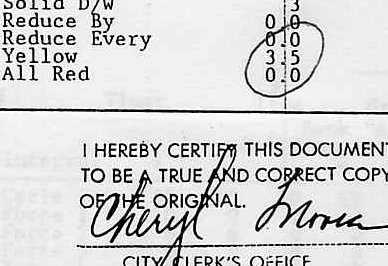
A public records request isn't the only way to find
out how long the yellow is. See More Reading, below.
Since the Vehicle Code and the table in the
Manual required a minimum of 3.6 seconds, all of the tickets issued
there between Jan. 1, 2002 and Sept. 26, 2002, including the two
tickets discussed above, were defective and invalid. The Sept. 26
cutoff was because on Sept. 27, Culver City adjusted the yellow
timing at Washington / Beethoven, Sepulveda / Green Valley, and
Jefferson / Cota up to the legal minimum of 3.6
seconds.
The court did not overturn the pre-Sept. 27
tickets.
On that same date, the City reduced the yellow at Washington/La Cienega, from 4.0 to 3.6 seconds.
(Note added 7-18-03: It is possible that sometime after
September, the Washington / La Cienega yellow was briefly increased
back up to 3.9 seconds. For more info about that reduction,
and the later (possible) change, see the Jan. 9, Jan. 17 and the
July 17, 2003 entries in the Culver City chronology on the Camera
Towns page.)
Complain!
Think the yellows at "your" intersection are too short - even though they meet California's legal minimum? (You're probably right.) If the intersection is on a numbered state highway or next to a freeway, call CalTrans! The City may run the cameras, but on most state highways CalTrans owns the signals and sets the timing. CalTrans doesn't get a share of the fine, so they are inclined to be fair, and logical, about signal timing - if a problem is brought to their attention. In some cities CalTrans engineers have increased the yellows above the minimum, after citizens complained. Examples are Willow/Bayfront in Menlo Park, 121/29 in Napa, and Mission/Mohave in Fremont. At each of those locations, violations dropped, a lot, after the lengthening. And they have stayed down. You can see the data, on those cities' pages here at highwayrobbery.net. Call CalTrans' main office at (916) 654-5266, and ask them for the phone number for the local district office. Also call your state legislators (senator and assemblyperson). Your local CalTrans people, and your legislators, might be interested to hear that some other states have longer yellows. (See the info about Oregon's yellows, in the discussion of AB 529, on the Action/Legis page.)
Another avenue. Complain to the county Grand Jury. It was effective in Napa - the Napa County Grand Jury ended up recommending that 1000 tickets be dismissed.
More Reading
For how to measure the yellow at "your" intersection, see the big yellow box in Step 2 of the "Handling Your Ticket" section on the Your Ticket page.
For more information about the effect of longer yellows, read FAQ # 6, Alternatives to Cameras.
For an
example of a too-short yellow and the big refund that resulted, see
the Costa Mesa section on the Camera Towns page.
Even though Section 21455.7 says that the minimum yellows are "mandatory," at least one judge has ruled that California's Truth in Evidence law requires him to admit the photo evidence despite a too-short yellow.
The paper, "The Red Light Running Crisis - Is It Intentional," by (now retired) Congressman Dick Armey, focuses on the length of the yellow. It's a "must read." A copy is available on the Links page of this website.
For more information on how to read the "Late
Time" or "Red Time" printed on your ticket, see the big purple box in Defect # 7,
below.
'CHEAT SHEET' AVAILABLE
If all these Code sections (and other numbers) are beginning to circle around in your head, I suggest that you go to the Site Index and print out the 'Cheat Sheet' available there. That way, you will have a ready reference to refresh your memory. I use it too!
Home/Defects Page (Expanded):
DEFECT # 3: NOW MERGED INTO DEFECT # 2
You are on the original ("Expanded") version of the Home / Defects page.
For a condensed version,
click: Home / Defects - Condensed.
Home/Defects Page (Expanded):
DEFECT # 4:
PHOTO ENFORCEMENT WARNING SIGNS TOO SMALL,
ABSENT, ETC.
You are on the original ("Expanded") version of the Home / Defects page.
For a condensed version,
click: Home / Defects - Condensed.
Vehicle Code Section 21455.5 requires the posting of warning signs.
From 1995 to Dec. 31. 2012 it gave a city the option to locate the signs at all the main entrances to town "including, at a minimum, freeways, bridges, and state highway routes" (in a city with a large airport, I think that the airport should have been considered to be a "main entrance") or at each camera-equipped intersection and "visible to traffic approaching from all directions." (At a typical intersection it required four signs even where there was only one camera monitoring one direction of traffic.) Most cities chose to post the intersections rather than the town entrances, and occasionally some forgot to post all four directions at the intersection.
On Jan. 1, 2013 Section 21455.5 changed. The option to post the entrances to town was deleted and a requirement to post a sign near each camera was added. The new requirement to always post a sign near each camera may sound like an improvement over the previous law which gave a city the option to post no signs at the intersection, but in my opinion it makes us less safe. How? See the discussion in SB 1303 on the Action/Legis page.
The revised version of Section 21455.5 says that 2013 will be a transition period, to allow cities time to change their signs to comply with the new law. Cities must complete the changes by Jan. 1, 2014.
More info: Read 21455.5(a)(1) and 21455.5(j) in the new law, in the big box in Defect # 10, below.
Subsections 21455.5(c)(2)(D) and 21455.5(d) say that the inspection and maintenance of the required warning signs may not be contracted out to the camera supplier.
The posting and maintenance of warning signs are "foundational" requirements -
Defects # 2, # 6 and # 10 are
others.
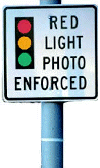
All signs must comply with CalTrans specifications: They must be at least 30" wide and 42" inches
high, the bottom edge must be at least 7 feet above the pavement level (5 feet in rural areas), and they must be
laid-out per this CalTrans design...

...and not like these real-life
examples (below).
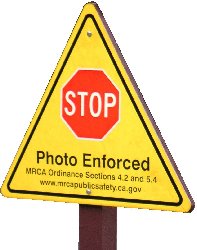
Sign used for Stop Sign and Speed (!) Enforcement
by MRCA and RedFlex in Franklin Canyon near Beverly Hills
(For more info see the MRCA section on the Camera Towns page.)
Please note that there is no requirement to post signs at right turns, telling you "stop before turning" or something like that. See Sign Requirements for more details.
This Issue In Other Cities and Before the Courts
Encinitas: During a 2008 trial the defendant pointed out that at least two entrances to town did not have signs. His
ticket was dismissed. (See the Encinitas section on the Camera Towns page for details.)
Bakersfield: According to news
reports, on Sept. 3, 2004 the Bakersfield police department, acting
on a phone call from a citizen, announced that it would be
overturning 613 citations issued between April 30 and May 14 at
Ming and South Real, because the proper warning signs were not
posted there during that period. (See the Bakersfield section
on the Camera Towns page for details.)
Inglewood: During the Aug. 20, 2004
trial of a ticket issued at Prairie / 111th in Inglewood the
defendant pointed out that while there were signs on Prairie, there
were no signs on 111th Street. Judge Birnstein dismissed
that case and all other pre-Aug. 20 tickets from that same intersection, when they came before her later.
(See the Inglewood section on the Camera
Towns page for details.)
San Diego: In the landmark
2001 mass trial where he later dismissed approximately 250 San Diego tickets, Judge Ronald Styn ruled:
"In the absence of any evidence that the [undersized] signs are not visible to drivers and are not sufficiently legible to
be seen by an ordinary, observant person, the Court finds that the signs used by the City of San Diego comply with the
requirements of Vehicle Code section 21455.5(a)."
From Section III(A) of the Aug. 15, 2001 trial court ruling in People v. John Allen.
...but he also ruled (citing from the appeal decision in Williams, a DUI case):
"Adams and its progeny were crafted to address anomalies or occasional
errors and innocent lapses in law enforcement. They were not meant to
provide a means for peace officers and their agencies to ignore clear,
easy-to-apply statutory law and administrative rules, for any reason,
including budget or personnel constraints."
From Judge Styn's Sept. 4, 2001 final ruling in P. vs. John Allen.
Please note that while Judge Styn was able to use this cite, you cannot!
That's because in 2002 the Williams appeal decision was partially rejected by the California Supreme Court.
For more info, see the P. v. John Allen page linked above.
In the Appellate Department: See the detailed discussions of warning sign locations, in the opening brief in the Schmidt case, and in the Petition for Writ of Certiorari in the David case (on the same webpage as the Schmidt case).
Home/Defects Page (Expanded):
DEFECT # 5: Xerox/ACS CAMERA
Defect # 5 is about problems where the cameras are run by ACS, which until 2017 was a division of Xerox. ACS provides cameras to the cities of San Francisco and Beverly Hills, plus more than 100 cameras located along the busways and tracks of the Los Angeles County Metropolitan Transportation
Authority/MTA/Metro. ACS (originally Affiliated Computer Services - not to be confused with ATS, a competitor) was a pioneer in the
photo enforcement Industry but was overtaken by other companies offering more modern equipment. For many years ACS did not win a new contract in California,
until it was awarded the Beverly Hills contract in 2014. Tickets from older ACS cameras have a distinctive black data box (0.5
by 1.25 inch) superimposed on the photos.
The data box includes the 'cat face' trademark
of Gatsometer,
the Dutch camera
manufacturer.
Many ACS installations still do not include a
video camera, while the Industry norm is to save a video clip of the
violation - essential if the city wishes to issue tickets for rolling right turns. Also, in many ACS installations, the only Limit
Line photo is taken by a camera facing the driver, thus does not show
the signal the driver was looking at (see first example below), while
the Industry norm is to take two photos - one facing the driver, the other a "forward-facing" photo (second example).
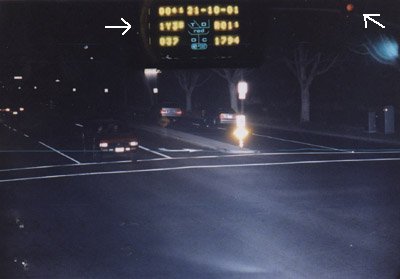
This ACS Limit Line photo shows only the signal
opposing traffic is looking at (upper right arrow).
Some ACS Limit Line photos show no signal at all.
highwayrobbery.net added the arrows.

Typical (non-ACS) "forward-facing" Limit Line photo, shows
signal the driver is looking at.
I.
The lack of a "forward-facing" Limit Line photo showing the signal may have delayed the discovery
of a major problem at an ACS camera at Whittier / Atlantic in East LA. Nearly 3000 tickets issued at that
intersection were reversed by the court, after it was discovered that the camera issued many tickets prematurely, possibly while
the light still was yellow. This problem could occur with an ACS
camera anywhere in the world. (More info about the Whittier /
Atlantic reversals is in the East LA section on the Camera Towns page.)
An ACS camera in your town could have this problem if either (A) or (B) exists.
(A) The "1Y..." or "2Y..." imprint (see arrow in first example above) on your top photo (assuming it is more legible than the example above) is not followed by:
(1) " 30 " or more in a 25 mph zone or for a left or right turn violation,
(2) " 32 " or more in a 30 mph zone,
(3) " 36 " or more in a 35 mph zone,
(4) " 39 " or more in a 40 mph zone, or
(5) " 43 " or more in a 45 mph zone.
(B) The camera has been aimed, as in
the first example above, so that the signal head (other arrow) is
visible, and the visible
light you see is yellow, not
red. It's best to
check a ticket with small "red time" - 1/10th or 2/10ths of a
second - " R001 " or " R002 " in the top
photo on the ticket. See also Defect # 7, below.
If your ticket is not in color, or isn't clear enough so that you can't perform the checks above, you can call the police department and ask them what the numbers are, or go in and look at their copy of the ticket. Their phone number should be on the back of the ticket. (Before you go visit the police, read II., below.)
II.
Following the May
2003 ticket reversals in East LA, some cities with ACS installations
added an extra camera to take a "forward-facing" photo. But some California cities did not. Several appeal court decisions (
Bohl, Moore, Graham, Salseda) have
addressed that issue.
If you go to cite-web.com to look at your ACS photos, the forward-facing photo may or may not be there - assuming one was taken. If you
really want to know, for sure, if a forward-facing photo exists for your citation, I suggest asking for Discovery.
A short (up to 0.4 sec.) Late Time, when combined with the absence of a forward-facing photo, raises the question of whether the red signal lamp was all the way on - or even visible at all - and should make it difficult for the prosecution to establish the Element of the Crime, "...facing a steady circular red...." See Defect # 7, below.
For more information on how to read the
"Late Time" or "Red Time" printed on your ticket, see the How to Read Your Late Time box in Defect # 7, below.
III.
An excellent
Philadelphia Daily News article (July 1, 2003) about ACS'
successful effort to gain advantage over its competitors for camera
contracts in Pennsylvania tells us a lot about the wielding of
political influence. It also discusses the wide scope of ACS'
other business operations nationwide. The link to the article
is in the News section of the Links page.
In early 2006 ACS was charged with bribing Edmonton (Canada) police officials to secure their
support for its photo enforcement contract with the City. In late 2007 the charges against ACS were dismissed, but the prosecution of one
Edmonton police sergeant continued until 2008, when he was found not guilty.
Home/Defects Page (Expanded):
DEFECT # 6: CITY DIDN'T ISSUE WARNING TICKETS FOR 30 DAYS
&
OTHER REQUIRED WARNINGS
You are on the original ("Expanded") version of the Home / Defects page.
For a condensed version,
click: Home / Defects - Condensed.
Added 8-8-03, updated 3-14-14
Defect # 6 applies when the installation of "your" camera was not followed by a 30-day period during
which warning tickets
were issued by that camera - and your ticket was issued during that period. This is most likely to happen if "your" camera was not the first one installed in town.
And there are two other required warnings.
Vehicle Code Sections
21455.5 and
21455.6 say, in part (with emphasis added):
|
21455.5(b) Prior
to issuing citations under this section, a local jurisdiction
utilizing an automated traffic enforcement system shall commence a
program to issue only warning notices for 30 days. The local jurisdiction shall also make a
public announcement of the automated traffic enforcement system at least 30 days prior to
the commencement of the enforcement program.
( The requirement above isn't new - it was first enacted, although not 21455.6(a) A city council or county board of supervisors shall
conduct a public hearing on the proposed use of an automated
enforcement system authorized under Section 21455.5 prior to
authorizing the city or county to enter into a contract for the use
of the system.
|
Section 21455.5 doesn't make it clear whether a city having a pre-existing system is required to issue warning tickets when it adds a new camera. As a result, while all cities issued warning tickets at the time they installed their first camera, many cities did not issue warning tickets from the cameras they added weeks or months later. Hawthorne, Inglewood, Santa Ana and Stockton are examples of cities that issued warning tickets at their first camera location only - but there are many more.
In those cities where Section 21455.5 was interpreted so that the sole
requirement for warning tickets was issuance at the time when the city
installed its first camera anywhere in the city, that left
the following motorists without notice:
(a) drivers who were new to the area (some systems were begun as much as ten years ago);
(b) in a large city like Los Angeles, drivers in a section that
didn't previously have a camera and was miles away from the nearest previously-existing camera;
(c) drivers who were not yet licensed to drive at the time the first camera was installed.
If we look at 21455.5 and 21455.6 together, the legislature's intent is clear. The authors included, in addition to the requirement for 30 days of warning tickets, three other requirements to warn motorists: The requirement to post large signs (see Defect # 4), the requirement to make a public announcement 30 days before beginning operation, and the requirement to conduct a public hearing. (In 2010, the City of South San Francisco had to refund and/or dismiss 7000 tickets because it failed to hold the public hearing required by Sec. 21455.6. Baldwin Park, Capitola, Citrus Heights, Highland, Victorville and Walnut failed to hold the required public hearing, but have not yet refunded or dismissed tickets. And there may be others.) The legislature wanted motorists to be warned to the greatest extent possible. The issuance of warning tickets each time a new camera is installed is the interpretation most consistent with their desire.
In 2005, twice in 2008, twice in 2010, and once more in 2011, appellate courts addressed the law, and two of the decisions (Park, and Gray) were ordered published.
One defendant won two of the appeals cases noted above.
In the 2005 case, People
vs. Fischetti (#1) the appellate court found that Costa Mesa
should have issued warning tickets for 30 days upon the installation
of each new camera
but didn't, and that it should not have allowed
a separate government agency (CalTrans) to set and control
the timing of the signals.
That decision didn't say if the "public announcements"
(notices in newspapers,
radio, TV, etc.) required by CVC 21455.5 have
to be repeated before each new installation. But I believe that
the decision supports the approach that would maximize the warning provided to motorists.
Articles in the Feb. 12, 2005 Orange County Register and the
Feb. 15, 2005 LA Times
reported that Costa Mesa suspended the operation of
three of its four cameras (all but the one
at Harbor and Adams) for 30 days.
Both 2008 cases, and both 2010 cases (People v. Anna V., P.
v. Fischetti (#2), P. v. Romero, P. v. Park), involved cameras in Santa Ana.
Well before the first Fischetti case was decided, at least one major
city, San Diego, had made it clear that it would be issuing warning tickets
for 30 days each time it installed a new camera. Beverly Hills also was doing so.
Now, years after the 2005 Fischetti decision, there is a "mix." Many cities have signed brand new contracts providing for warning tickets only from the first camera installed,

From the City of Highland contract, signed Mar. 2008 - also see the Bell Gardens contract, signed Oct. 2008
while, during the same period, other cities have
contracts providing for warning tickets from each new camera. (Moreno Valley, signed July 2007, Victorville, signed Sept. 2007, Napa, signed June 2008, Corona, signed Nov. 2008.)
In a 2009 decision from Santa Ana (Lori A.) there was a discussion
of warning tickets and also the required public announcement. As a result of that decision, the City of Santa Ana suspended ticketing during the month of Dec. 2009, so that it could issue warning tickets for 30 days. (See Set # 5 on the Santa Ana Documents page.)
The Supreme Court Decision
Because the two published appeal decisions (Park and Gray) conflicted, in June 2012 the California Supreme Court accepted the issue for review. In its Mar. 2014 decision in People v. Gray the Court agreed that a city must issue warning tickets when it adds a
new camera to its system, but it limited that protection to benefit only those violators whose violations occurred when the new camera first became operational - or to benefit no one at all! At page 10 of the decision we see the protection ...
"Therefore, if the city had issued a citation to a driver during the 30-day period when it should have been issuing warning notices under section 21455.5(b), that driver could have challenged the citation on the basis of noncompliance with the statute."
...while at page 11 we see this:
"To summarize, a city’s compliance with section 21455.5(b)’s requirement of a 30-day period of issuing warning notices before using a red light camera to issue citations is not a jurisdictional precondition to enforcement of the red light traffic law (§ 21453, subd. (a)), and therefore the prosecution need not prove a city’s compliance with the warning requirement to establish a red light traffic violation."
So, if "your" city installed "your" camera and did not issue warning tickets for 30
days after that installation, and your violation occurred during that period, this issue could possibly be raised
in court. If you are arguing this issue, be careful to make sure that the judge does not get
this warning ticket requirement mixed up with the separate requirement for a "public announcement" 30 days
in advance.
Issuing warning tickets may be a "foundational" requirement - Defects #'s 2 - 4 and 10 are others.
Home/Defects Page (Expanded):
DEFECT # 7: SIGNAL LIGHT BULBS TAKE A WHILE TO COME ON
...and So Do LEDs
AKA: The "Filament" Defense
You are on the original ("Expanded") version of the Home / Defects page.
For a condensed version,
click: Home / Defects - Condensed.
This defect is applicable only to tickets with small "Late Times" - 0.20 (two tenths of a second, or 200 milliseconds) or less. If you can't find your Late Time, or can't read it, see the big purple-ish box, below.
California Vehicle Code Section 21453, which
is the law you
have been charged with violating, says:
"A driver facing a steady circular red alone shall stop...." (Emphasis added.)
The defect is that LEDs
(light-emitting diodes), the fastest-acting light source used in
signals, can take slightly more than 0.1 second to light-up
(turn-on) after the power has been
applied. (Skeptical engineers: Please see The Scientific Details, below.) If you
have a ticket with a 0.1 Late Time, that turn-on delay may be longer than the Late Time you were cited for. And
the old-fashioned, but occasionally still-in-use incandescent bulbs, take about
twice as long. If your Late Time was very short (or you suspect that it was), compare the brightness of the red
in the first photo...
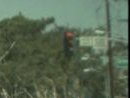
Portion of "First photo," taken when front
of car
was 1 - 2 feet behind limit line,
Late Time indicated as approx. 1/10 sec.
...to the brightness of that same lamp in the second photo.
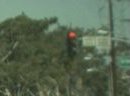
Portion of "Second photo," taken approx. 1 sec. later,
when car was in the
middle of the intersection.
If it is noticeably brighter in the second photo,
then you were not facing a
"steady" red at the time you were at the limit line - you have photographic evidence that you were facing a red that was still warming up.
For details on how to prepare that evidence so it will be convincing enough to show to the police or to a judge, see the paragraph headed "Your Defense," below. Additionally, the dim red light probably didn't come close to meeting the 90% brightness requirement discussed in The Scientific Details, below.
A yellow lamp will have the
same sort of delay. So, if it was an LED bulb and was fed
electricity for only the legally-required length of time, it would
have been visible for about 0.1 sec. less than the minimum legal
amount at the moment the camera computer sensed the application of
electricity to the red bulb and began counting off your "Late
Time." And if it was an incandescent bulb, it would have been
visible for about 0.15 to 0.2 sec. less than the minimum legal
amount.
Mixed Bulbs = "Mixed Signals"
In this blow-up of the signal head from a ticket with a 0.1 Late Time,
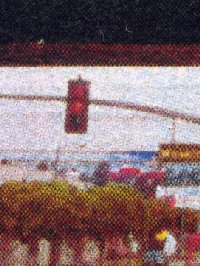
it appears that both the yellow and the red are at partial brightness.
Section 21453 says:
"A driver facing a steady circular red alone shall stop...." (Emphasis added.)
If you videotape (or take a series of stills of)
an intersection that has both incandescent and LED lamps in use,
and play the tape back a frame at a time, you will be able to see
the comparative slowness of the incandescent bulb.
The photo below shows what can happen when LED and incandescent lamps are mixed.
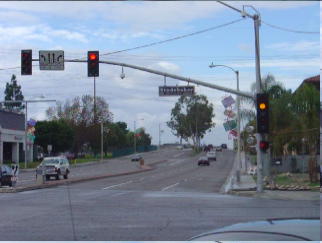
Here
(below) is the same corner, photographed by the red light camera for an
actual ticket with a 0.25 Late Time. While the colors aren't
clearly red or yellow, you can tell by the position of the lights - that one
light is red and the other is yellow.
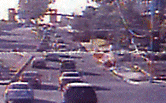
If you know there are two signal heads at the intersection, but the photos you were provided show only one
signal head, it could be that the photos were deliberately cropped to keep you from
comparing the signal heads to each other. If you want the full-size, full-resolution photos, file a Discovery request.
(If you don't remember how many signal poles there were,
you can visit the intersection by using Google Street View.)
For more details about this example, see the Cerritos Documents page, linked on the Camera Towns page.
Your Defense
Because "steady" and "alone" are written into the law (CVC 21453), they are Elements of the Crime, things that have to be proved before they
can convict you. If there is any yellow in the first still photo shown on your
ticket (also called the "before" photo, or the Limit Line photo, or Scene A), that should be enough to convince a judge that the red was not "alone." Or, to convince the judge that
the red was not
"steady," you could blow up the photos enough so that individual pixels can be seen, then put the "before" and "after" reds
right next to each other so that it is easy
to point out the un-lit/dim pixels in the "before" photo.
(For detailed instructions on how to make a
blow-up, click here.)

Blown up left turn arrow, before and after

The same left turn arrow, pixelated, before and after
The police understand the importance of the Elements of the Crime. If your ticket photos show that the red was not "alone" or that it was not "steady," I suggest that you contact the police, point out the absence of the Element of the Crime, and ask them to dismiss the ticket. Doing that could save you from having to make any visits to the court!
To see how the courts have ruled on these issues, see this 2009 appellate decision (Williams) and the Culver City chronology for Oct. 16 and Dec. 18, 2003, on the Camera Towns page.
For detailed instructions on how to make a blow-up, click here.
There is more below this box!
|
How to Read Your Late Time You may need a magnifying glass, a pocket calculator, or a crystal ball ! Late Time is how long the signal already had been red (actually, how long power had been applied to the red light bulb) when your picture was taken. The red light camera industry is so new that there's no standard terminology. Thus, Late Time is also often called "duration," "time into red," "red time," or abbreviated as "TR." There's also no standard as to the number of decimal places - Some red light cameras display the Late Time rounded down to tenths of a second, others display hundredths of a second, and some of the newest cameras have four digits to the right of the decimal place. In at least one city (Culver City) the number of digits varies from camera to camera. Pointing up the lack of standards, several cities' camera tickets don't display the Late Time at all, even though their Nestor systems clearly have the capability to do so. 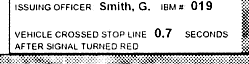
(From sample ticket at the end of a Nestor brochure.) A possible motive to leave it off could be so that they can cite for very short Late Times (like 0.1 sec.) without widespread criticism (including some from judges) about "Mickey Mouse" tickets. If you phone the PD to ask what your Late Time was, they probably will say that to get that information, you must come in to the police station. The visit to the police station serves to grind you down, make it harder for you to fight your ticket. See the Cerritos, Costa Mesa, Pasadena, Davis or San Bernardino sections on the Camera Towns page for more information. Many red light cameras imprint the Late Time right on the top[2] photo on your ticket - but the format has not been standardized. So here is how some of the more common cameras would display a Late Time of 1/10th (one tenth, or 0.1) of a second. The now almost-obsolete (but still used in some locations) ACS "wet film" 35mm cameras print 1/10th of a second as R001 . While it's not a 1/10th of a second ticket, the top photo in Defect # 5 above is a good example of a ticket from an ACS 35mm camera. The tenths digit is smaller than the rest and is always very hard to read; to be sure of what the tenths digit is, you may need to call the issuer of the ticket. On the example, the Late Time is 1.1 second, displayed as R011 (in the middle row on the right side of the data box). Early RedFlex cameras, such as Culver City's first seven installations, used 35mm "wet film" and displayed the data in bright, but fuzzy, red numerals in a strip across the top of the photos[2]. They would print a 1/10th second Late Time as Red T. 000.1 RedFlex's newer cameras, which are digital and take 12 seconds of video, display the data in tiny faint white letters on a black strip at the top edge of the photos[2] (best way to read them is by putting the ticket up on the window). They would print a 1/10th second Late Time ("duration," "TR," or "time into red") as either 0.10 or 0.1000. At court in Culver City I have seen some RedFlex "video" tickets with only the tenths digit displayed. The officer told the court that this occurs when they are having a problem with their live data link. Most brands of cameras (ACS, RedFlex, etc.) have an additional time counter, often called "elapsed time," which starts at zero at the instant the first photo is taken. It will tell you the time that elapsed between the first photo and the second. Sometimes using the elapsed time (subtracting it from the elapsed Late Time shown in the second photo on the ticket) will help you to figure out what the hard-to-read Late Time (in the first photo) is. For example, here are the data boxes from the first and second photos on a typical ticket - actually the same ACS one used in Defect # 5, above. 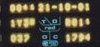 If you subtract the elapsed time of 0.89 (shown in the middle row, left side, below) from the elapsed Late Time of 2.0 ( " R020 " in middle row, right side, below) you get 1.11, which confirms that the Late Time shown in the first photo (middle row, right side, above) is 1.1 (after rounding off). 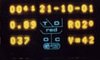 For more practice reading Late Times, see this page. If you are making time/distance calculations, see: The Math Page. [2] If two photos have a Late Time imprint, the applicable number will be the smaller one. |
Other Notes
RedFlex holds a patent on a method to alter/intensify portions of photos.
If
you want to figure out how far back you were at the moment the
power was applied, see: The Math Page.
If you have used a camcorder or a digital still camera,
you probably noticed that it could see in dim light much better than
your unaided eyes. Thus, even though the red signal
light shows in the photos taken of your car, that light may still
have been warming up (if it has an incandescent bulb) and not have
been bright enough, at that moment, for you to have seen it from
your car. And it may not have been bright enough, at that
moment, to meet CalTrans' minimum brightness specification.
For scientific information about the wavelengths and spectra (color) of traffic lights - including a comparison of incandescent vs. LED, see this page.
The Scientific Details
The slowest LED lamp module tested (see below) and found to "COMPLY" by CalTrans will have reached a "steady" (90%) brightness 10 ms (1/100 of a second) after a 0.1 violator's picture is taken. And an incandescent bulb will be much slower than that.
|
A Private Note for Electronic Engineers I know that LEDs ordinarily light-up many times faster than 0.1 second. Here is why that isn't the case with LEDs when used in a traffic light module. The power supply in the module contains capacitors which take a while to charge up sufficiently to fire the LEDs. The capacitors are needed because the LED modules are screwed into or connected to a light bulb socket formerly occupied by an incandescent bulb, and so are receiving 120 volt alternating current - "AC." The AC needs to be changed, or "rectified," into direct current - "DC" - which is the type of current the LEDs operate on - and then it has to be filtered (the role of the capacitors) to reduce ripple in the voltage and prevent the LEDs from flickering. But you knew all that. |
The LEDs
Most signals that I see now, especially where there is a red light
camera, have LED lamps. CalTrans says that at intersections they
control, they have replaced all red lamps with LEDs.
While CalTrans provides, in its
Standard Specifications publication, a number of size,
weight and durability specifications for LED signal modules, it has
not yet published a specification for turn-on time. In a
Nov. 4, 2003 letter to me they stated: "...since
2001, the Department has been collecting data to be used in future revisions of
the Standard
Specifications."
(Italics added.)
While CalTrans has not yet formally published their turn-on time
specification, they have disclosed it in a roundabout way. In
Nov. 2003 they sent me a blue notebook entitled, and
containing, "New Product Evaluation Test Reports for LED Traffic
Signal Modules." In one of those test reports (# 02-01-007)
of a sample (two) of red lamps that
averaged 141 ms turn-on time (individual results were 116 and 166
ms), we see the notation: "COMPLY, with following exceptions… The
module turn-on time should be below 90 ms." In another test report
(# 02-09-033), they have noted "COMPLY" (without any exceptions) for a
sample of red lamps where the average turn-on time was 91 ms, with
individual results of 72 and 110 ms. The lamps that received the "COMPLY" (without
exceptions) notation were then included in a "Pre-Qualified
Product List" at the back of the
notebook (and available on the Web). My conclusion:
Under this
averaging regime, 1/2 of all LED lamps approved and sold could have a
turn-on time exceeding the 90 ms CalTrans "specification," with
the potential (as demonstrated here in test #02-09-033) that as
many as 1/2 of all lamps approved and sold could have a turn-on
time exceeding 100 ms, or 1/10th of a second - which may be the
Late Time you were cited for.
There also is no federal standard for turn-on
time. The ITE (Institute of Transportation Engineers) specification for
LED signal module arrows is that they should take less than 75 ms to come
to 90% brightness
(see http://www.ite.org/standards/VTCSH_Part3.pdf , section 5.2.6).
Incandescent Bulbs
I don't have turn-on time figures for the incandescent bulbs, but
they are known to be much slower than LEDs. You can see it
for yourself. If you take video of a signal with incandescent
bulbs, and play it back a frame at a time (the method I recommend
for measuring the length of the yellow - see the Measuring the
Yellow section on the Tickets Page), you will see that it takes
two or three frames for the bulbs to come to full
brightness. Even some new cars come with LED brake
lights, the selling point being - probably valid - that by lighting
faster they give the driver behind you more warning of a panic
stop. ( On a car, the LEDs will light up over a hundred times faster than LEDs do
in a traffic signal, because the car's LEDs are powered by the
car's direct current - "DC" - power and no capacitors are necessary.)
I believe
that LED traffic signal modules simply stay completely dark during
most of their "warm up" period, then come up to full brightness
very quickly. Later, when the electricity is turned
off, both the incandescent and the LED lamps also take some time to
go dark - while the incandescent filament is cooling off, or
(for you engineers) the LED module's capacitors are
discharging.
Home/Defects Page (Expanded):
DEFECT # 8: TICKET MAILED LATE, OR TO
THE WRONG ADDRESS,
WITHOUT PROPER PROOF OF MAILING,
OR INCOMPLETE
Updated 8-22-07
You are on the original ("Expanded") version of the Home / Defects page.
For a condensed version,
click: Home / Defects - Condensed.
Most of Defect # 8 could apply to any violation,
anywhere.
(A) Many defendants are unaware that they ran a light. Many other defendants loaned their
car to someone else. So that defendants are able to remember
what they were doing on the date of the violation, or to whom they
had loaned their car, California law gives the police only a limited
amount of time (15 days) to deliver a genuine Notice to Appear to the registered owner's letterbox.
And, of course, the police need
to send it to the right address.
See more details, below the blue box.
(B) And since red light camera
Notices to Appear are not handed to you in person by a motor officer who
obtains your signature, the law requires the police to
obtain some evidence that the Notice to Appear was actually
mailed.
See more details, below the blue box.
(C) Some cities leave the court's phone number off the Notice to Appear, or provide an incomplete address for
the court (both of which are
required on the official form), in an
apparent attempt to make it harder for
defendants to have their day in court.
See more details, below the blue box.
The Law, and More Details
In
California, Vehicle Code Section
40518 says (in part, with
emphasis added):
|
40518. Whenever
a written Notice to Appear has been issued by a peace officer or by a
qualified employee of a law enforcement agency
on a form approved by the Judicial Council ...
and delivered
by mail within 15 days of the alleged
violation to the current address of the registered owner of
the vehicle on file
with the department, with
a certificate of mailing obtained as evidence of
service ...
|
(A) It Must be Mailed on Time, and to the Correct Address
The law says, "... Notice to Appear... delivered by mail within 15 days... to... the registered owner...."
If you are the registered owner and a genuine Notice to Appear was mailed to you, check the postmark date
on the envelope it came in.
Check the date the officer signed it and, if there is a "Proof of Service" or "Certificate of Mailing" printed on
it or attached to it, check the date on that, too. If any of these dates
is more than 11[4] calendar days after the date the violation
occurred, the service of the Notice to Appear could be defective and you may be able to make it
go away by "demurring" to it.
[4] Vehicle Code Sec. 23 says, "The giving of notice by mail
is complete upon the expiration of four days after deposit
of the notice in the mail...."
If the first you heard of your ticket was months later, from a collection agency, because the police mailed
the original ticket to the wrong address (through no fault of yours), you could demur to it.
Demurrer: A plea for the dismissal of a lawsuit on the grounds that even if the statements of the opposition are
true, they do not sustain the claim because they are insufficient or otherwise
legally defective. (Webster's New World Dictionary)
Demurring is done
"first thing" - at arraignment - before
entering any plea (guilty, not guilty, nolo contendere). It would
be difficult, and probably ineffective, demurring at a trial. For more details about demurring, contact me.
If a collection agency dinged your credit rating (for a ticket you never saw because it was mailed to the wrong address), read "Will Your Credit Rating Be Dinged?" in Set # 2 on the LA County Docs page.
If you're not the registered owner: Note that the 15-day requirement applies to the first
mailing of a Notice to Appear, which is usually to the registered owner of the car. If
he or she received a genuine Notice to Appear, then gave your name to the police, who then re-issued it to you, the
15-day requirement does not apply to the timing of the mailing to you. But if what the registered owner received was something other
than a genuine Notice to Appear (a Snitch Ticket), you might be able to demur. New law (SB 1303 of 2012 - read about it on the Action/Legis page) leaves this question cloudy.
The new law added the following to Vehicle Code Section
40518 .
|
40518(c)(1) This section and Section 40520 do not preclude the issuing agency
or the manufacturer or supplier of the automated traffic enforcement system
from mailing a notice of nonliability [[ a Snitch Ticket ]] to the registered owner of the vehicle
or the alleged violator prior to issuing a notice to appear.
|
See also the "Were You Snitched On?" paragraph on the Your Ticket Page.
(B) The Evidence of (Proof of) Service
The law says, "...with a certificate of mailing obtained as evidence of service...."
There's a variety of opinions as to what proper evidence of service is, for these tickets. I think that the evidence of service needs to be a U.S. Postal Service Certificate of Mailing (two camera companies agree with me, and so does one Industry veteran), but at least one judge - and one major camera company - don't agree.
1. Watch Out for Misleading or Defective Sworn "Proof of
Service" or "Certificate of Mailing."
Most California cities don't even pretend to send their Notices to Appear out
with an official U.S. Postal Service Certificate of Mailing. Their tickets
include a printed box like the one below entitled "Proof of Service" or (deceptively) "Certificate of Mailing," in which a camera company employee swears that he deposited the
envelope in a Postal Service letter box.
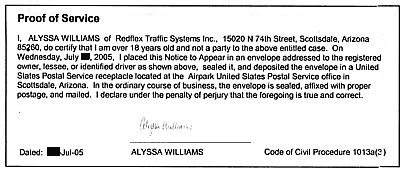
(Sometimes, deceptively, this box is entitled "Certificate of Mailing")
If you are bothered by the logical impossibility of the employee swearing he mailed the Notice to Appear before he
even printed it out, you could try demurring. (Defined above, in Subsection 'A')
One camera company prints this box...
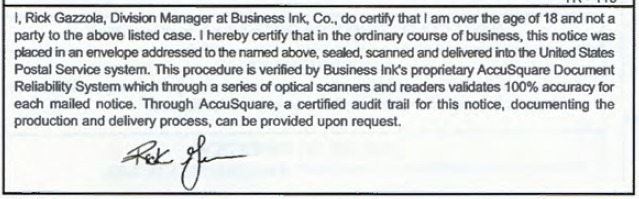
...which is missing many things such as the signatory's legal first name, his business address, the name of the city where the ticket was mailed, the date the ticket was mailed, and a perjury declaration.
If - as in the first example above - the Notice to Appear was
mailed from another state and the person
who mailed it finished their declaration by writing, "I declare under penalty of
perjury that the foregoing is true and correct" without
specifying that it was "under the laws of the
State of California," the service is defective and you could try demurring.
Demurring can make the Notice to Appear go away. Demurring is done
"first thing" - at arraignment - before
entering any plea (guilty, not guilty, nolo contendere). It would
be difficult, and probably ineffective, demurring at a trial. For details about demurring, contact me.
(It is possible that a city which imprints such a "Proof of Service" or "Certificate of Mailing" on their Notices to Appear could also be obtaining a genuine U.S. Postal Service Certificate of Mailing - and just isn't saying so. But most cities are not obtaining USPS Certificates of Mailing, at all.)
2. The U.S. Postal Service Certificate of Mailing
If there is no box or section labeled "Proof of Service" or "Certificate of Mailing" printed on your Notice to Appear, check to see if the police department has obtained a separate Certificate of Mailing.
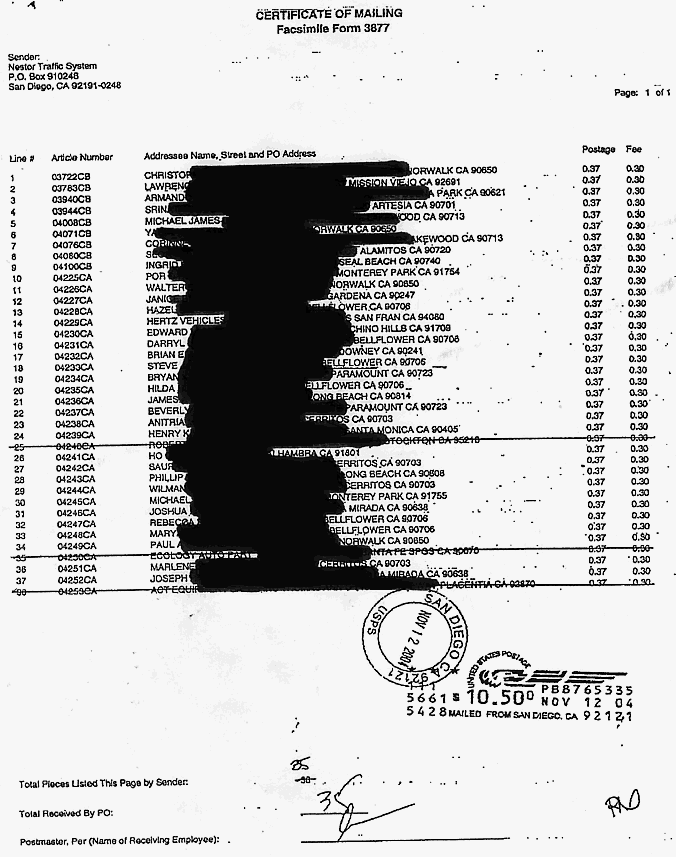
|
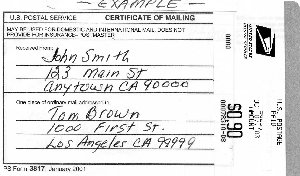
About Certificates of Mailing When you or I go to the Post Office and purchase a
Certificate of Mailing, it looks like this:
(Do not confuse Certificate of
Mailing with Certified Mail. A letter sent to you with a
Certificate of Mailing does not require you to sign
for it. In fact, there's no way to tell, by just looking at
the envelope, that it was sent with a Certificate of Mailing.
Certificate of Mailing costs only $0.39 when large quantities of
letters are mailed at once. On the other hand, a letter sent
to you by Certified Mail must be signed for, and will have a
Certified Mail sticker on the envelope. And Certified Mail
costs much more, $3.35 per letter.) However, since a city sends out hundreds of
letters at a time, the Postal Service will permit them to use a
"Firm Mailing Book," or a custom Certificate of Mailing form.
I don't have an example of a Firm Mailing Book,
but I believe that to be valid it would need to show (as does this example
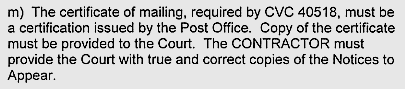
of a custom form): In another city, the contract between that city and their vendor
("contractor") is very specific about the Certificate of Mailing.
Watch Out for Fake "Certificate of Mailing" If "your" city is using a custom form
and presents it at court, examine it carefully - one California
city mailed thousands of envelopes while using a
custom form boldly titled "Certificate of
Mailing" and which bore
numerous signatures and official-looking rubber stamps. But
when that city's form was shown to the local postmaster, he said
that none of the signatures or rubber stamps was by Postal Service
employees, and that the city was not paying any Certificate of
Mailing fees. If you have any doubt as to the validity of
"your" city's Certificate of Mailing form, consult your local
postmaster. See also Misleading/Defective "Proof of Service,"
below, after this box. The Certificate of Mailing Issue Before the
Courts On Dec. 18, 2003 before a pro tem in Culver City, a defendant moved for dismissal under CVC Sec. 40518. The pro tem asked him how he received the Notice to Appear, then commented: "So they mailed it to you and you got it." When the defendant repeated his request for a Certificate of Mailing, the pro tem said that he would need to see some evidence of the requirement, and that he would have to find that the city's failure to obtain a Certificate of Mailing had caused some prejudice to the defendant's interests. Under prompting by the pro tem, Sgt. Corrales read (aloud) the definition of "certificate" from a legal dictionary, and argued that the city's proof of service (printed on the Notice to Appear) was the equivalent of a Certificate of Mailing. The pro tem agreed, and denied defendant's motion. On June 17,
2004 in Culver City, a lawyer argued the Certificate of Mailing
issue before Comm. Amado. Comm. Amado asked the lawyer:
"When you mail (official documents) from your office, you don't
have to obtain a Certificate of Mailing, do you?" The lawyer
replied: "There's no provision of law that requires a
Certificate of Mailing on a mailing from my office." Comm.
Amado replied: "The court rules require proof of service, and
the court rules are the law. Unless you can quote me specific
language requiring Return Receipt Requested, the legislation is
presumed to mean exactly what it says." The lawyer then
argued that the ordinary meaning of the word "obtained" meant that
the City was to get the Certificate of Mailing from someone else,
not create it themselves. Comm. Amado's final response
was: "I'll let you deal with the appeals court,
denied." An Arizona appellate court
decision, though not
having the force of law in California, reveals a higher court's
attitude toward Notices to Appear that are merely dropped in the mail. The Legislator's Intent The requirement for a Certificate of Mailing
comes from Senate Bill 1802 of 1994, which was sponsored by State
Senator Herschel Rosenthal, who died in 2009 at the age of 91. In
an attempt to discover Sen. Rosenthal's intent (as to the meaning
of Certificate of Mailing), I contacted a senior member of his
staff who had worked on the bill. He told me: "That's
my recollection [ that it be a U.S. Postal Service Certificate of
Mailing ] and I don't think we were intending anything else." |
(C) The Notice to Appear must Provide the Address and Phone Number of the Court
The law says, "...on a form approved by the Judicial Council...."
Some cities' Notices to Appear do not contain the full physical address of the court, or its phone
number.
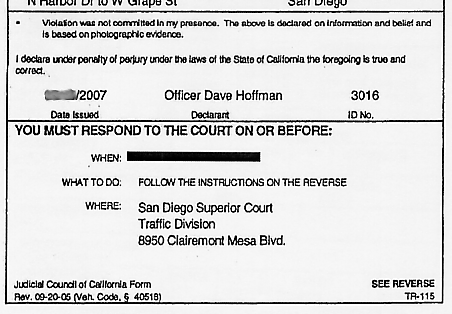
No city name, Zip, or phone number.
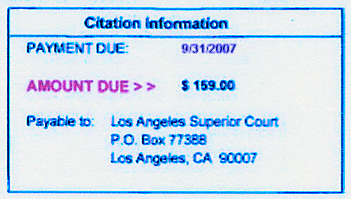
No street address or phone number for the court.
For an explanation of the $159 fine shown, see the LA City Documents page.
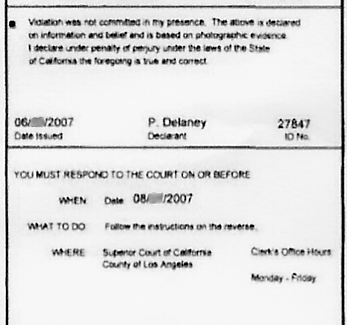
No address, no phone, no hours.
The official format requires
that this information be present - so that defendants are able to write to, call or visit the court if they wish.
There's also supposed to be
info about Night Court, if "your" courthouse has it (not all do).
There are separate instructions for the
ticket form and they get very specific:
"6.000 ...All language and data fields in unshaded areas on the forms are mandatory... Mandatory
text or data fields may not be re-worded or omitted... "
Some cities use non-sworn clerical staff members ("Police Services Officer" or PSO) to issue the tickets. This practice is controversial,
even in the Industry. See FAQ # 36.
If your
Notice to Appear is missing any or all of the information
required by the official format, see the demurrer information in Section (A) above.
Please be sure to familiarize yourself with the "It's Not Me!" and the "Snitch Ticket" sections on the Your Ticket page.
'CHEAT SHEET' AVAILABLE
If all these Code sections (and other numbers) are beginning to circle around in your head, I suggest that you go to the Site Index and print out the 'Cheat Sheet' available there. That way, you will have a ready reference to refresh your memory. I use it too!
Home/Defects Page (Expanded):
DEFECT # 9: "CHURNING"
Quotas, Enforcement on Left or Right Turns, Signals which Change Too Quickly, Cameras
at Confusing Intersections, Federal Guidelines
You are on the original ("Expanded") version of the Home / Defects page.
For a condensed version,
click: Home / Defects - Condensed.
"Traffic rules account for most of the contact by average citizens with law enforcement and the
courts. Enforcement of laws which are widely perceived as unreasonable and unfair generates
disrespect and even contempt toward those who make and enforce those laws."
The Appellate Department, in People vs. Goulet
Nonsequitur, by Wiley Miller. Shop at www.gocomics.com/nonsequitur/
A. Ticket Quota$
Section 11.14 of the Feb. 2009 contract between the City of Walnut and RedFlex penalizes the City if:
"...the City or Police waives more than 10 percent of valid violations forwarded to the Police for acceptance...."
The contract between Los Angeles County MTA ("Metro") and ACS requires:
"The Contractor shall be required to maintain, at a minimum, the existing rates of citations issued by location...."
Article.
In Apr. 2011 a jury awarded $2 million to two LAPD motorcycle officers who alleged that their supervisors retaliated against them for complaining about traffic ticket quotas. Article, LA Times, 4-12-11
In June 2011 the mainstream media revealed that the LA County Superior Court was not reporting ignored red light camera tickets to the DMV. By the following month, payment of tickets had dropped in half. To bring their ticket revenue back up, some cities began to issue a lot more tickets. Baldwin Park, Commerce, Covina, Culver City, Hawthorne, Lynwood, Santa Clarita, South Gate, Walnut and West Hollywood - more than half of the red light camera cities in LA County - increased ticketing by more than 50%. For more info, see Set # 2 on the LA County Docs page. Ticketing also increased 50% or more in many cities outside of LA County: Corona, Garden Grove, Highland, Los Alamitos, Oakland, Redding, Riverside, San Bernardino, San Mateo, Santa Ana, South San Francisco, Stockton and Victorville.
Ticket quotas are illegal in California - see CVC 41600 - 41603.
B. Churning Right Turn$
"There is nothing so useless as doing efficiently that which should not
be done at all."
Prof. Peter F. Drucker
"Basically they're [the camera company] saying we're going to make money off that intersection if we put it there. It's a half million dollars in fines that we would not normally have collected."
Emeryville Police Chief Kenneth James, in 2011. Source.
Sgt. Sharon Kaufman, Menlo Park: "My only question is since most of the violations are right turns, how long would that be sustainable?"
RedFlex rep Mark Riggs: "I can say that most intersections that have right turns enforced continue to produce consistent numbers."
2013 email exchange about proposed new camera in Menlo Park
"Mr. Saunders [President of RedFlex] suggests jurisdictions refrain from issuing a [rolling right] ticket except when a pedestrian is in
the crosswalk."
Interview of Saunders in Dec. 26, 2014 Wall Street Journal column headlined, "Can the Red-Light Camera Be Saved? - Money-hungry
politicians discredit a hopeful safety innovation.”
A Federal study said:
"In conclusion, there are a relatively small number of deaths and injuries each year caused by RTOR [right turn on red] crashes. These represent a very
small percentage of all crashes, deaths and injuries. Because the number of crashes due to RTOR is small, the impact on traffic safety, therefore, has also been small."
There has been a shift away from ticketing people who run straight thru intersections, towards ticketing
drivers who "roll" a right turn. Two past events prompted this shift.
1. In 2001 the State Legislature
passed SB 667,
which
for the first time mandated minimum yellow light lengths. The longer yellows reduced the quantity of straight-through violations.
2. Around 2007, video cameras were added to newer camera systems, allowing police to see if a turning vehicle came to a full
stop, or just slowed, in between the two ("before" and "after") still photos. Having that video
made it possible for cities to issue and prosecute rolling right turn tickets.
Rolling rights then became the profit center in many cities, and in 2007/2008 some of the new contracts (between cities and red light
providers) acknowledged the economic importance of rolling right enforcement by making it a contractual obligation.

Clause found in the Nov. 2007 San Carlos and Feb. 2008 Belmont contracts.
The San Carlos and Belmont contracts merely required those cities (both have since shut down their camera systems) to enforce on rolling rights, without
specifying exactly what would have happened if the cities had refused to
do so. On the other hand, the Dec. 2007 Citrus Heights contract, the Jan. 2008 Bakersfield contract, the June 2008 Napa
contract, the Oct. 2008 Bell Gardens contract, the Nov. 2008 amendment of the Ventura contract, the Dec. 2008 Lynwood contract, and the Feb. 2009 Walnut contract all provide for a monetary
sanction against the city.
Why did RedFlex find it necessary to force cities to enforce rolling rights? We need look no further than Ventura. Prior to 2008 Ventura was not contractually required to ticket rolling rights, and chose - correctly - to give it very little emphasis. By 2014, the continued low ticket volume, combined with 'cost neutral' adjustments allowed by the contract, caused the City to owe RedFlex a "balance carried forward" of $2.7 million - a debt that RedFlex
was forced to forgive, as part of 2015 negotiations to extend its contract with the City. See Set # 2 of
Ventura Documents
.
Some Notes about Right Turns
(1) The price - In early 2016 there was a bill in the California Legislature to reduce the fine on rolling rights. Unfortunately, it did not pass. Previous attempts to reduce the fine were in
2010 and 2012. See the Legislation section on the
Action page.
At least one city used to do what the three bills proposed: Until Aug. 2008 the City of LA cited
its rolling right turns under Subsection (b) of CVC 21453, instead of
(a), which resulted in a much-lower fine.
A few judges in other cities offer reduced fines to
defendants with rolling right tickets.
For perspective: New York City charges $50 for all its camera tickets, and in Oct. 2009 the Lafayette, Louisiana City-Parish Council reduced the fine for rolling rights to $25, from the previous $125. In Naperville, Illinois, RedFlex told the City that there would be no technical bar to reducing the fine. (Naperville presently charges $100 for
all camera tickets, and the reduction mentioned for rolling rights would
be to $50.) Tribune article, 8-10-09.
(2) At right turns, a city is not required
to post signs telling you "stop before turning" or something like that. See FAQ # 27 and
Sign Requirements for more details. But if you were cited for a turn at a corner having a sign saying "no turn on red," please contact me about it.
(3) Jan. 2005 changes to the
CalTrans Manual (the MUTCD) made it clear
that for a turning movement (left or right), the yellow can be set to as little as 3.0 seconds, even on a high speed street, if the turn is controlled by a green arrow. However, in Nov. 2014 a new amendment to the Manual recommended that engineers pay "particular attention" to the length of yellows at those locations where the turn lane exceeds 150 feet in length. For more info about that recommendation, see Defect # 2, above.
If the turn is not controlled by a green arrow, the length of the yellow should be set according to the speed of the through traffic. (See the discussion in page 13 of the 2015 appeal decision in the Rek-- case.)
(4) Because
the public has one attitude about drivers who run straight through a light and another very different attitude about
rolling rights, I think that when a reporter interviews the police, the reporter
should ask them, "You are bragging about issuing 1000 tickets last month. How many of them
were for rolling right turns?" I believe that the single-month record for the
most right turn tickets at a single intersection in California
belongs to Riverside, which in the month of Oct. 2009 issued 2472 tickets at Indiana and Arlington, nearly all for right turns. Close runners-up would be Riverside's Tyler/91 camera with 2441 tickets in Apr. 2009, Hayward's cameras at A/880 with 2341 tickets in Mar. 2010, and Oakland's 27th/Northgate cameras with 2208 tickets in Nov. 2009. Others are Elk Grove, which in Feb. 2008 issued 1601 tickets at Franklin & Laguna, Emeryville, which
in Oct. 2008 issued 1202 tickets at 40th and Horton, and Napa, which in May 2010 issued 940 right turn tickets
at the Hwy. 29/121 intersection. It should be noted that in Mar. 2011 the Napa County Grand Jury asked the City of Napa to refund 1000 of the tickets from that intersection.
Update: By mid-2014 all but Napa and Elk Grove had closed their programs, and Napa had dramatically reduced its reliance on rolling right tickets. In May 2014 the new single-month record holder emerged; Millbrae issued 621 rolling right tickets that month from a camera which during the previous twelve months had averaged 39 tickets a month.
(5) There are at least two good ways to tell to what extent a city is emphasizing enforcement on right (or left) turns.
(a) In Aug. 2014 we received the first of the annual reports required by Senate Bill 1303 of 2012. Those reports break down the quantity of citations issued into straight, right, and left. The reports revealed that in four cities (Elk Grove, Newark, Rancho Cordova, San Leandro), 88% or more of the tickets were for right turns.
(b) The number of violations (not necessarily citations issued) in each lane, and how
long the light was red ("Late Time," or "Time into Red") is shown in bar charts like this:
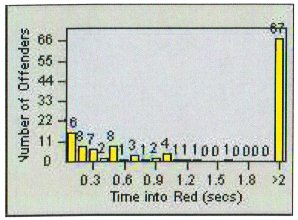
A large number of long Late Time violations (2+ secs.) indicates heavy ticketing on right turns.
Bar charts (or the equivalent) for the following cities are available on their Documents pages:
Bakersfield
Baldwin Park
Bell Gardens
Belmont
Beverly Hills
Burlingame
Capitola
Citrus Heights
Commerce
Corona
Covina
Culver City
Daly City
Davis
Del Mar
El Cajon
Elk Grove
Emeryville
Encinitas
Escondido
Fremont
Fullerton (Set # 4)
Garden Grove
Gardena
Glendale
Grand Terrace
Hawthorne
Hayward
Highland
Laguna Woods
Loma Linda
Long Beach
Los Alamitos
Lynwood
Marysville
Menlo Park
Modesto
Montebello
Moreno Valley
Murrieta
Napa
Newark
Oakland
Oceanside
Oxnard
Poway
Rancho Cordova
Rancho Cucamonga
Redding
Redwood City
Riverside
Rocklin
Sacramento
San Bernardino
San Carlos
San Francisco
San Juan Capistrano
San Mateo
San Rafael
Santa Clarita
Solana Beach
South Gate
South San Francisco
Stockton
Union City
Ventura
Victorville
Vista
Walnut
West Hollywood
Yuba City
Yucaipa
(6) A good discussion of rolling rights can be found in "Red Light Cameras Catch Right Turns and Lots of Revenue / Red Light
Cameras, Clicking for Safety or
Revenue?" a May 19, 2008 LA Times article (Archived Copy) by Rich
Connell. Also see FAQs # 1 and # 27 and, no matter what city your ticket came from, the
Hawthorne section on the Camera Towns page (don't miss Set # 5 of Hawthorne Documents).
C. Churning Left Turn$
Jan. 2005 changes to the CalTrans Manual (the MUTCD) made it clear that for a turning movement (left or right), the yellow can be set to as little as 3.0 seconds, even on a high speed street, if the turn is controlled by a green arrow. However, in Nov. 2014 a new amendment to the Manual recommended that engineers pay "particular attention" to the length of yellows at those locations where the turn lane exceeds 150 feet in length, and in 2015 there was pressure to require longer yellows for turns, nationwide. For more info, see Defect # 2, above.
A small change in the length of the yellow can have a huge effect on the quantity of left turn
violations:
When the City of Mesa, Arizona increased its left-turn yellows from three
seconds to four, the
number of left-turn violators dropped by 2/3, and the number has stayed down in the years
since the change. (Flipping
the numbers over, we would expect that if Mesa re-set those yellows
back to three seconds, there would be a three-fold increase of
violations.) To see Mesa's actual month-by-month figures, go to City of
Mesa, Arizona, Documents.
In Menlo Park, after CalTrans lengthened the yellow for the westbound Bayfront/Willow left turn to 3.5 seconds, up from 3.0, violations dropped by about 80%. Flipping these numbers over, we can see that the missing half second increased ticketing fivefold.
For other examples, see FAQ # 6.
The economic effect of increasing the yellow time is so significant that some red light
camera contracts (Bell Gardens, Citrus Heights, Corona, Hawthorne) appear to provide for a monetary sanction against the city if city traffic engineers lengthen the yellows.
Are Left Turns a Big Safety Problem?
Drivers who run left-turn arrows are an irritation to other motorists, but they're a very minor safety problem - they hardly ever cause accidents.
One city explained why it wasn't using photo enforcement on left
turns: "We only handle the
through approaches because we felt that the right angle approaches
resulting in traffic
collisions are the ones that were injuring and killing citizens
here in Los Angeles."
(LAPD Sgt. Steve Foster, in
testimony at the Los Angeles City Council's Public Safety Committee
meeting of April 12, 2004. Transcribed from the official
audiotape.)
There is a way to tell when a city is emphasizing enforcement on left (or right) turns. See note (6) in the Churning Right Turn$ section, above.
Most cities emphasizing enforcement on left turns are reluctant to admit it. But in Aug. 2012 the Corona police included
this graph in a report they prepared for the city council.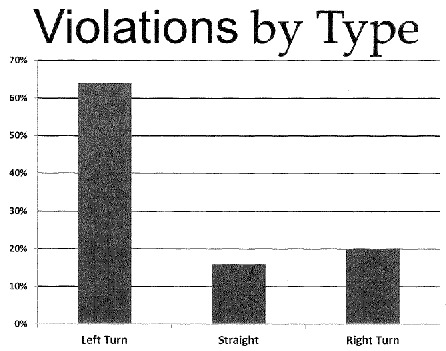
An example of an
intersection where the accident history does not justify the enforcement on left turns is Culver City's Jefferson / Overland
intersection. A ten-year accident history for
the intersection (see Set # 12 of Culver
City Documents) shows a total of 41 accidents, but
only one of those ( 9 years ago ) was caused by a driver running the
left turn light.
Hawthorne's Rosecrans/Hindry intersection, with photo enforcement exclusively on left and right turns and which as of June 2012 was the top left turn ticket generator in the State (about 600 tickets per month), is another intersection where there is little justification for the use of the cameras. In Set # 5 of Hawthorne Documents you can look at the official 10-year accident history for the intersection, and decide for yourself.
Costa Mesa's former photo enforcement on left turns
from southbound Newport Boulevard (at 17th) was another
example of heavy photo enforcement with scant safety
justification. The ten-year accident history shows a total of
150 accidents there, with only one being the fault of a driver
running the southbound left turn. The accident history also
shows a near-doubling of rear end accidents after the camera was
installed. (See Set # 10 of Costa Mesa Documents.)
Cities Taking Advantage of Special Situations
Where a left turn pocket is unusually long, or the turn has a wide radius, or the posted speed limit is high, cars can approach the limit line at higher
speeds, and the yellow should be set longer than 3.0 - even though the present rules say the city can keep it that short if the turn is controlled by a green arrow. (New rules which go into effect in Aug. 2015 recommend longer yellows when the turn pocket is longer than 150 feet.) When the left-turn yellows at Menlo Park's Bayfront/Willow intersection (turn lanes 1500' long) were lengthened to 3.5 seconds, ticketing dropped by about 80%. Other examples of cities
which have abused motorists by leaving their left-turn yellows
too short are San Diego and its infamous Harbor/Grape
intersection (turn lanes 1200' long), the City of Commerce and its Atlantic/Telegraph intersection (20 deg. left turn), and the entire cities of Corona and Santa Clarita (high speed limits).
Most photo enforcement on left turn
arrows is a form of
Churning.
If cities wish to reduce left turn running, they should lengthen the yellow, make sure
the green arrow is long
enough - and demand-activated - and that the turn pocket is large
enough for the demand.
In 2003 a Sacramento defendant took the
specific issue of the length of the left turn yellow to the
appellate court. While he lost, his trial transcript and
appeal brief are very interesting: Sacramento Left Yellow
Brief (Neill).
Take Political Action
If you have a left or right turn ticket, call your State legislators, and your auto club, and complain
about the heavy ticketing on turns, and the way out-of-proportion fine. For phone
numbers see the Legislation section on the
Action page.
D. Churning - 'Fast Change' Signals
You probably have noticed some signals that
cycle much more quickly than average. Often they go red even
though there is no cross traffic waiting. They may have been
set to do that to slow traffic down, or to reduce a heavy volume of
traffic impacting a residential neighborhood. Sometimes
your green can be as short as 15 seconds. There seems to be
no law specifically against a city doing this, but it seems
inappropriate and predatory when combined with a red light camera -
the frequent cycling of the signal can present up to twice as many
drivers with the need to make a sudden stop at the signal, and can
proportionately increase the number of tickets issued by a camera
there. I have called this unfair enforcement situation
"Churning" because of its similarity to the unsavory practice of
some stockbrokers.
The short green can also surprise drivers who are not familiar with the neighborhood, lengthening their reaction time by 1/2 second. For example:
| A driver is traveling at 25 mph on a major boulevard and is 733 feet from the next signal. It will take him 20 seconds to cover the distance (25 mph is 36.7 feet per second). Visibility is good and looking ahead, he sees the light turn from red to green. He assumes that it is a typical signal and will stay green 30 to 60 seconds, plenty long enough for him to cross, so he (slightly) relaxes his guard and continues down the road. The signal, which has been programmed to have a 17 second green, turns yellow just 3 seconds before he gets to the intersection. At that moment he is 110 feet from the limit line. Per the stopping distance chart, the shortest stopping distance from 25 mph is 85 feet, including normal reaction time. But because our driver is slightly surprised, it will take him an extra 1/2 second to react, during which time he will cover an additional 18 feet - for a total stopping distance of 103 feet. If at the moment he sees the signal go yellow he is able to correctly compute his situation and quickly decide to stop for the signal, he should be able to stop with 7 feet to spare, even with the additional reaction time - but only if both his car and the road surface are in top shape, capable of attaining the 0.7 G deceleration rate upon which the chart is based. On the other hand, if he lifts his foot off the gas for a moment but then decides to proceed through, he will not make it to the limit line before the signal (programmed with the 3.0 second minimum yellow the CalTrans chart specifies for a 25 mph zone) goes red. If there is a camera, he will get a ticket for being approximately 0.1 to 0.4 second late. |
E. Churning - Putting Cameras at Confusing Intersections
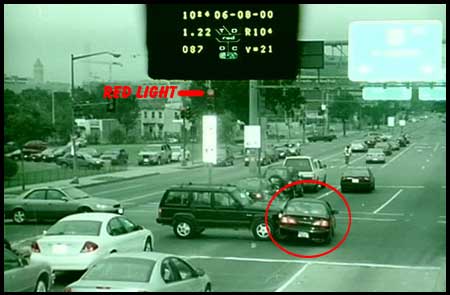
Source: http://mpdc.dc.gov/mpdc/cwp/view,a,1240,q,547893,mpdcNav_GID,1552,mpdcNav,|31885|.asp (Annotations in red were added by the police.)
Note that the Late Time was approx. 10 seconds - an indicator that the motorist was confused by this triple intersection.
Some cities install cameras at confusing intersections - places where there's a double signal (or even a triple one - see my Metro/MTA section for multiple examples), a curve in the road, an underpass, or another oddity. Do they sincerely believe that the installation of a camera will stop unfamiliar motorists from getting confused and blowing the light? Before cities install a camera on an unusual intersection they should try all possible engineering countermeasures. See the Federal Guidelines, below, and FAQ # 6.
F. Federal Guidelines Spell Out
Inappropriate Sites
From Chapter V. of
the Federal Highway
Administration's
Red Light Camera Systems Operational Guidelines (2005).
The publication was issued in March 2003, and extensively
re-written in Jan. 2005. The 2005 re-write "gutted" many
of the Site Selection guidelines. Both the new and the old text of those guidelines are presented below (section-by-section), for easy
comparison). Notes ( in [[ ]] ) and emphasis have been added. A full copy of
the old (2003) publication is available here.
Please note that these are guidelines and compliance is not mandatory. In the Introduction to the Guidelines, it says, "Although not a regulatory requirement, the guideline is intended to provide critical information for State and local agencies on relevant aspects of red light camera systems in order to promote consistency, proper implementation, and operation..."
| Federal Guidelines, Current (2005 Edition) |
Federal Guidelines, Former (2003 Edition) |
|
[[ This first section wasn't changed very much.]] Sites selected for the installation of red light camera systems should be based on accurate crash and red light violations data. As discussed earlier, data regarding the total number of crashes may be used, although intersections with high numbers of collisions may not have a high number of crashes related to red light running. Violation data needs to be applied with some caution. Likewise, locations where it is known that there are high numbers of red light violations may not have corresponding high numbers of crashes related to the red light running. Heavily traveled intersections where there are heavy left turn movements operated on protected left turn phases are often intersections of this type. Traffic volumes, except when used as a factor to determine the incidence of crashes or violations, are not a suitable measure for selecting locations for the installation of red light camera systems. |
Sites selected for the installation of red light camera systems should be based on crash and, when properly used, red light running violations data. As discussed earlier, data regarding the total number of crashes may be used, although intersections with high numbers of collisions may not have a high number of crashes related to red light running. Violation data needs to be applied with some caution. Locations where it is known that there are high numbers of red light running violations may not have corresponding high numbers of crashes related to the red light running. Heavily traveled intersections where there are heavy left turn movements operated on protected left turn phases are often intersections of this type. Traffic volumes, except when used as a factor to determine the incidence of crashes or violations, are not a suitable measure for selected locations for the installation of red light cameras. |
|
[[ This re-write of the second section blurred the requirement for a prior engineering study.]] The installation of a red light camera system at a signalized intersection identified as having a red light running problem should be done when an engineering study of the intersection determines photo enforcement is an appropriate countermeasure to reduce the incidence of red light running. |
The installation of red light camera equipment at a signalized intersection identified as one with a problem with red light running should be done only after the results of a engineering study of the intersection determines that engineering improvements or other measures [[ such as lengthening the yellow ]] cannot be implemented or would not be effective in reducing the incidence of red light running. If other alternatives are not available or cannot be deployed in a timely or cost effective manner, the use of a red light camera system should be considered. |
|
[[ This re-write of the third section removed a requirement for prior community review.]] Other criteria for red light camera system site selection may include recommendations from law enforcement and traffic safety professionals, citizens' complaints, and input from community groups. These criteria should be considered in conjunction with crash data and violations or citations data. |
Other criteria for the location of red light cameras include suggestions from law enforcement and traffic safety professionals and input from community groups including complaints regarding red light running. These criteria should be applied in conjunction with crash and violations or citations data. A means for community review of any planned or proposed locations, such as by posting on the agency web site or announcements through the broadcast media, should be done before locations are finalized and design work begins. |
|
[[ The fourth section of the 2003 version was deleted entirely from the 2005 version.]] |
[[ The fourth section of the 2003 version was deleted entirely from the 2005 version. The 2003 section: ]]
Typically, red light cameras are located at intersections based on these criteria: · At "high risk" or historically dangerous intersections, based on the number of crashes or, where available, on an analysis of the number of crashes attributable to red light running; citation data, or complaints; and/or · At intersections where an engineering study has concluded that engineering improvements, driver education initiatives, or other countermeasures cannot be implemented or would not be effective in reducing the number of crashes attributable to red light running. |
|
[[ The fifth (and last) section of the 2003 version became the fourth section of the 2005 version, but was
not re-written. The 2003 and 2005 versions:]]
Undesirable characteristics that will also affect decisions regarding the installation of red light cameras include: · Driveways that restrict camera pole or auxiliary flash placement; · Approaches that are more than three lanes wide and double left turn lanes where views are more frequently obstructed; and · Wide crossing streets where second photographs may not be taken at the pre-determined location due to motorists speeding up and slowing down as they traverse the intersection. |
|
| [[ This fifth section of the 2005 version is entirely new.]] When red light camera systems are in operation, law enforcement officials should place an emphasis on routine enforcement of traffic laws and regulations that require visible and unobstructed display of license plates. |
G. Intervention by Higher Authority
Sometimes (still rarely) a higher level of government will force the issue. In 2009 the Ventura County Grand Jury recommended that the City of Ventura lengthen the yellow at one of its intersections. See Set # 3 on the Ventura Documents page.
In 2010, CalTrans lengthened the yellow at one of Menlo Park's intersections. See Set # 3 of Menlo Park Documents.
In both locations, the longer yellow caused the number of tickets to drop to approximately 25% of the previous level. These interventions occurred because motorists complained to those higher authorities.
DEFECT # 10: PROBABLE CAUSE, FOUNDATION, CONSTITUTIONALITY, HEARSAY, CONFRONTATION
You are on the original ("Expanded") version of the Home / Defects page.
For a condensed version,
click: Home / Defects - Condensed.
Some Foundational Requirements: Calibration & Maintenance, Warning Signs, Warning Tickets, Long-Enough Yellows, and Written Guidelines
At a trial, Foundation is the introductory evidence necessary to establish the admissibility of other evidence.
There was no witness to the crime. The case is based solely upon physical evidence - the
photos and the data the computer recorded. But the police can't use evidence
if it was gathered illegally. Vehicle Code 21455.5 (in box, below) specifies things the
City must do and must not do in order to legally gather red light camera evidence.
To make this concept clear, here is an extreme example: Suppose
you're accused of shooting a convenience store clerk, and the police
have produced a gun that matches the bullets found in the clerk; the
gun also has a full set of your fingerprints on it. It is almost
perfect evidence - just
like the photos the red light cameras take - except for one problem.
The police obtained the gun illegally, by breaking into your
house without a warrant. So, they will not be able to use the gun
in court, and will have to depend upon other evidence, and eyewitness
testimony, to make
their case.
At your red light camera ticket trial, the officer will testify first, and he is supposed to begin his
testimony by "laying the foundation."[5] Most officers will give a brief
foundational speech (sometimes very brief) saying that the camera was calibrated and operating properly (required by CVC 21455.5(c)(2)(C)), that they posted warning signs
(Defect # 4), gave public notice / announcements 30 days before starting up the system, gave
warning tickets for 30 days (he may call it a "grace period" - Defect # 6), have long enough
yellows (Defect # 2), etcetera.
[5] Think of the evidence as a house; houses collapse if they have no foundation.
When it's your chance to cross-examine him, you could ask
the officer:
what technician calibrated and checked the camera,
did the city provide public notice 30 days before firing up your camera,
did they issue warning tickets for the first 30 days
of operation (of your camera - see Defect # 6),
did they have signs posted at
your intersection at the time you were ticketed,
did they contract out the maintenance of the signs to the camera supplier (see Defect # 4), and
do they have written guidelines.
The Requirement to Have Guidelines
The city is required to have three kinds of guidelines, plus procedures to enforce
those guidelines. (The guidelines are part of CVC 21455.5(c) and are highlighted in bold type in the box below.)
1. They're required to have "uniform guidelines for screening and issuing violations," so that, among other things, a ticket is not issued to a registered owner when there's an obvious mismatch between his DMV file photo and the photo of the driver.
2. They're required to have guidelines "for the processing and storage of confidential information."
3. They're supposed to establish "guidelines for [the] selection of location." That requirement for location guidelines was put into the law after it was revealed, in a
landmark court case (People vs. John Allen), that the City of San Diego
had allowed its camera vendor to choose the camera locations.
They are also supposed to
have "procedures to ensure compliance with those guidelines." (Presumably for quality control.)
And, the guidelines are not to be written by the vendor.
So, ask him for the
guidelines (all three kinds), and the "procedures."
If he can't come
up with written[7] "screening" guidelines, written "confidential information" guidelines (dated on or before the date of
your citation), written "location" guidelines (dated before your camera was
started up), and written "procedures to ensure compliance," make a motion
to exclude the camera evidence, because it was gathered illegally.
Without the camera evidence, the judge will have to dismiss your
case.
[7] CVC 21455.5 doesn't say the guidelines, etc., have to be written, so you may need
to convince the judge that "verbal" (something in the officer's head) is
not good enough, especially in a large organization where, over time, many people get
cycled through a given job, or jobs are shared. Point out
21455.5's use of the word "uniform."
A couple of judges have provided what I think are some of the strongest
arguments (besides the law's use of the word "uniform") for written guidelines.
One judge said, "There should be a place where they [defendants] can
go and find the guidelines." (Inglewood trials, Oct. 15, 2004.)
Another judge pointed out that 21455.5(c)(1) says that the city is
supposed to be "establishing procedures to ensure compliance with those guidelines," then questioned how a city could
establish procedures to comply with something that is not written.
Another argument for written guidelines would be that they would help to prevent "profiling" - or
favoritism - by the officers who decide which tickets
are to be issued and which are not. (Also see FAQ # 22.)
And another argument would be that if the guidelines are not in writing, how can we make sure
that the city, rather than the camera company, wrote them, per the
no-contracting-out requirement in 21455.5(d) (in box below).
If the officer does offer some document(s) in response to your
question about guidelines, ask the judge for a short recess so that you
can look it (them) over. Check the date (don't accept a document
that was written or revised after the required dates), and make sure the document was not written by
the camera company (per 21455.5(d)).
Make sure the document(s) offered covers all four guideline issues - "...screening and issuing," "selection of location," "processing and storage of confidential information," and "procedures to ensure compliance."
An example of what I believe are completely inadequate written guidelines are on the Inglewood Documents page, at Inglewood "guidelines."
For a longer but (I believe) still inadequate example of
written guidelines, see the West Hollywood Business Rules.
More Foundational Requirements
If the officer can prove that all four signs were posted, that he has adequate guidelines, that 30-day
notice was given, and that warning tickets were issued before the startup of
"your" camera (or if you're not able to convince the judge, even after
citing Fischetti and Anna V., that such noticing and warning is required with the
start-up of each new camera), there are still a
number of other things that they may have forgotten to do, or did
wrong. Here is one.
Home/Defects Page (Expanded):
Defect # 10, Subsection B:
Foundational Requirement: Pay-Per-Ticket
("Cost Neutrality") Contracts are Prohibited
Vehicle Code Section 21455.5 prohibits "pay per ticket" contracts. 21455.5(h)(1) says:
(h)(1) A contract between a governmental agency and a manufacturer or
supplier of automated enforcement equipment may not
include provision for the payment or compensation to the manufacturer or supplier based on the number of citations generated,
or as a percentage of the revenue generated..."
( Full text is in the big box, below. )
The author of 21455.5 wrote:
"Paying red light camera vendors [suppliers] based on the number of tickets
issued undermines the public's trust and raises concern that
these systems can be manipulated for profit."
(Official comment by Senator - then
Assemblywoman - Jenny Oropeza, published in 8/27/03 legislative
analysis of
AB 1022 of 2003.)
Many cities are ignoring that law. An example is
Marysville, where the contract signed Dec. 21, 2004 says:
"Fixed fee of $6,030 Per Month Per Designated Intersection Approach..."
"City shall be obligated to pay the cumulative balance invoiced by RedFlex,
in accordance with the terms set
forth above, to the extent of gross cash received by the City from
automated red light violations."
"Payment will only be made by Customer [the City] up to the amount of cash
received by Customer from Yuba County through the collection
of red light citation [sic] up to the amount currently due."
"Cost neutrality is assured to Customer using this methodology as Customer will never
pay RedFlex more than actual cash received." (Bolding added.)
In other words, contrary to the misleading "fixed fee" language, RedFlex will get less money if
there are fewer tickets, and more
money if there are more.
They've known all along that it's illegal:

From Davis Police Chief Hyde's staff report presented
at the Aug. 1, 2005 council meeting.
A "worked example" of that cost neutrality proposition is the City of Ventura, which,
because of past years' low fine revenue has paid RedFlex millions less than the so-called "fixed fee."
This "Performance credit" entry,

from a RedFlex invoice to the City of San Mateo, may be a
cost neutrality adjustment.
Some cities - including Bakersfield, Highland and Stockton - have designed accounting spreadsheets to keep track of how much they owe under cost neutrality. Capitola does a "reconciliation" every six months. See those documents on those cities' Documents pages.
In Jan. 2011 Yuba City - which later removed its cameras - revealed that it owed RedFlex $330,577.08, due to cost neutrality adjustments. Some cities have cost neutrality in their contact, but don't take advantage of the potential it offers to pay less money to the camera company. For example, Santa Ana's contract with RedFlex provides for a bi-annual review of revenue vs. cost - but there is no record that any reviews have been conducted.
Appeal Victories
In early 2007 an Orange County Superior
Court Commissioner dismissed a Los Alamitos ticket and issued a written decision (P. v. Nagai) opposing
the contract between that City and RedFlex.
Defendants won appellate
court decisions in 2008, 2009, 2010 and 2011. In one of those cases (P. v. Franco) the appellate judge wrote:
"...the possibility that fees could be negotiated 'down' if it is determined fees paid to NTS [Nestor, the vendor] exceed 'net program
revenues being realized,' indirectly ties fees to NTS to the amount of revenue generated from the program. If insufficient
revenue is generated to cover the monthly fee, the fee could be 'negotiated down.' As such, NTS has an incentive to
ensure sufficient revenues are generated to cover the monthly fee."
Published Appeal Victory!
The Sept. 2011 decision in People (City of Napa) v. Daugherty
found that cost neutral contracts are illegal, thus providing any city having a cost neutral contract an opportunity to cancel
their program, immediately, without paying an early-termination
penalty. (In Oct. 2011 Napa announced it would ask for dismissal of 500 tickets.)
The known examples of illegal or cost-neutral contracts are Bakersfield‡, Baldwin Park‡, Bell Gardens‡,
Capitola‡, Cathedral City‡, Cerritos‡, Citrus Heights‡, Commerce‡, Corona‡, Costa Mesa*‡, Covina‡, Culver City*‡, Daly City‡, Davis*, Emeryville*‡, Encinitas*‡, Escondido*‡, Fairfield‡, Fullerton, Gardena‡,
Glendale*‡, Grand Terrace, Hawthorne‡, Hayward‡, Hemet‡, Highland‡, Inglewood‡, Laguna Woods*‡, Lancaster‡, Loma Linda‡, Long Beach‡, Los Alamitos, Los Angeles County, Lynwood‡,
MRCA*‡, MTA/Metro, Marysville‡, Menlo Park‡, Millbrae*, Modesto‡, Montebello‡, Moreno Valley, Murrieta‡, Napa*‡, Newark*‡, Oceanside‡, Oxnard‡,
Paramount‡, Rancho Cucamonga, Redding‡, Redlands, Redwood City‡, Riverside‡, Rocklin‡, Roseville, San Bernardino*‡, San Juan Capistrano*,
San Leandro‡, San Mateo*‡, Santa Ana‡, Santa Clarita‡, Santa Maria,
Solana Beach‡, South Gate*, City of South San Francisco‡, Stockton‡, Union City, Upland, Ventura‡, Victorville‡,
Walnut‡, Whittier‡, Yuba City‡, and Yucaipa.
* This city recently amended its contract, or signed a new one,
changing the pay to its camera vendor to "flat rate."
For more details, see the city's entry on the Camera Towns page.
‡ This city's contract is available in the city's entry on the Camera Towns page or in the city's Documents page.
This list of cities with cost neutral contracts may not be up-to-date - there could be an amendment that has not come to my attention.
Check the contract in "your" city, available on the city's Documents page here on highwayrobbery.net. If the quantity of tickets (or the city's revenue from fines) has any effect upon the amount paid to the camera supplier, re-read the Daugherty decision (link above) and then consider making a motion to exclude the camera evidence, because it was gathered illegally. (The language about compensation to the vendor will often be in "Exhibit D" at the end of the contract. Or, it could be hidden elsewhere.)
Foundational Defenses: Examples
The
Hawthorne entry of Aug. 24, 2004 and the Inglewood entry of Oct. 15, 2004, in their respective chronologies accessible from the
Camera Towns page, are
examples of foundational defenses.
You should also read about California's Truth in Evidence law
and the Best Evidence Rule.
Defect # 10, Subsection C:
Motion to Strike Evidence and Challenge Constitutionality
In association with the National Motorists Association (NMA), an attorney prepared a 20-page defense brief (Fairfax) asking a
court in Fairfax, Virginia to strike the evidence and rule the underlying ordinance unconstitutional.
While
some of the brief would
apply only to a ticket in that city, many sections of it might be
useful in California. Those sections are -
2. Unconstitutional denial of right to confront and cross-examine adversarial witnesses
3. Use of obviously altered/manipulated evidence
4. Lack of foundation for the entry of the photos into evidence
5. Lack of established scientific reliability and acceptance of mechanical device used to create evidence
6. Unconstitutional infringement on the Fifth Amendment rights of the accused
8. Unconstitutional/improper conclusive presumption and unconstitutional/improper shifting of the burden of proof
10. Improper certification of evidence
12. Improper delegation of police powers
See the Links page for more information about the NMA.
Defect # 10, Subsection D:
HEARSAY / CONFRONTATION
Ordinarily, when someone wants to use a document, letter or photo as evidence
in court, they need to bring in a live person to testify as to the document's
authenticity and accuracy. And the opposition gets to cross-examine - "confront" - that person. Without that "live" authentication, the
document could be ruled to be "hearsay," and excluded from
evidence. There is an exception to the hearsay rule, for
documents created by a government employee - but many of the documents
the police present in court have been created by a private company's
employees who are not government employees, thus have no official duty to report accurately. A common example of a document created by the technicians of a camera company, thus vulnerable to a hearsay objection when offered into evidence at a trial, would be a certificate of the calibration and proper operation required by CVC 21455.5(c)(2)(C). (In cities where such hearsay objections have become frequent, the city may ask a camera company representative to attend trial sessions, to testify as to the authenticity of the company's documents. A few cities attempt to avoid such objections by having the police officer running the program testify that he personally, and frequently, verified the calibration and proper operation of each camera.)
Numerous recent
decisions by California Appellate Divisions and the US Supreme Court have addressed this hearsay/confrontation issue, and in Sept. 2012 Gov. Brown signed a new law diminishing a defendant's ability to object on hearsay grounds. See SB 1303 of 2012, on the Action/Legis page.
RedFlex holds a patent on a method to alter/intensify portions of photos.
Also see the Getting Records / Discovery page, read about California's Truth in Evidence law, and
the Best Evidence Rule.
Defect # 10, Subsection E:
PROBABLE CAUSE
Some cities issue a real ticket to the registered owner of the vehicle, even when it is obvious (an age and/or gender mismatch) that he or she was not the driver at the time of the violation. In 2014 there was a trial court decision about that lack of Probable Cause, in People v. Tho--. An earlier decision is in Section III(B)(2) of Judge Ronald Styn's Aug. 15, 2001 ruling in People v. John Allen. Also see Set # 16 on the Culver City Docs page.
The Law
|
Text of
California Vehicle Code Section
21455.5, effective Jan. 1, 2004, with the significant changes effective Jan. 1, 2013 (due to SB 1303 of 2012 - see the Action/Legis page) shown in Italic and (a) The limit line, the intersection, or a place designated in Section 21455, where a driver is required to stop, may be equipped with an automated traffic enforcement system if the governmental agency utilizing the system meets all of the following requirements: (1) Identifies the system by signs posted within 200 feet of an intersection where a system is operating that clearly indicate the system's presence and are
visible to traffic approaching from all directions in which the automated traffic enforcement system is being utilized to issue citations. (2) Locates the system at an intersection, and ensures that the system meets the criteria specified in Section 21455.7. [[See Defect # 2.]] (b) Prior to issuing citations under this section, a local jurisdiction utilizing an automated traffic enforcement system shall commence a program to issue only warning notices for 30 days. The local jurisdiction shall also make a public announcement of the automated traffic enforcement system at least 30 days prior to the commencement of the enforcement program. (c) Only a governmental agency, in cooperation with a law
enforcement agency, may operate an automated
enforcement system. (1) Develop uniform guidelines
for screening and issuing violations and for the processing and
storage of confidential information, and establish (2) Perform administrative functions and day-to-day functions, including, but not limited to, all of the following: (A) Establishing guidelines for selection of a location. Prior to installing an automated traffic enforcement system after January 1, 2013, the governmental agency shall make and adopt a finding of fact establishing that the system is needed at a specific location for reasons related to safety. (B) Ensuring that the equipment is regularly inspected. (C) Certifying that the equipment is properly installed and calibrated, and is operating properly. (D) Regularly inspecting and maintaining warning signs placed under paragraph (1) of subdivision (a). (E) Overseeing the establishment or change of signal phases and the timing thereof. (F) Maintaining controls necessary
to (d) The activities listed in subdivision (c) that relate to the operation of the system
may be contracted out by the governmental agency, if it maintains overall control and
supervision of the system. However, the activities listed [[ and in bold type, above ]] in paragraph (1) of, and
subparagraphs (A), (D), (E), and (F) of paragraph (2) of, subdivision (c) (e) The printed representation of computer-generated information, video, or photographic images stored by an automated traffic enforcement system does not constitute an out-of-court hearsay statement by a declarant under Division 10 (commencing with Section 1200) of the Evidence Code.
(1) Notwithstanding Section 6253 of the Government Code, or any other law, photographic records made by an automated enforcement system shall be confidential, and shall be made available only to governmental agencies and law enforcement agencies and only for the purposes of this article. (2) Confidential information obtained from the Department of Motor Vehicles for the administration or enforcement of this article shall be held confidential, and shall not be used for any other purpose. (3) Except for court records described in Section 68152 of the Government Code, the confidential records and information described in paragraphs (1) and (2) may be retained for up to six months from the date the information was first obtained, or until final disposition of the citation, whichever date is later, after which time the information shall be destroyed in a manner that will preserve the confidentiality of any person included in the record or information. [The prohibition of cost neutral contracts, formerly Subsection 21455.5(g), is now at 21455.5(h).]
(1) A contract between a governmental agency and a manufacturer or
supplier of automated traffic enforcement equipment (2) Paragraph (1) does not apply to a contract that was entered into by a governmental agency and a manufacturer or supplier of automated enforcement equipment before January 1, 2004, unless that contract is renewed, extended, or amended on or after January 1, 2004. (3) A governmental agency that proposes to install or operate an automated traffic enforcement system shall not consider revenue generation, beyond recovering its actual costs of operating the system, as a factor when considering whether or not to install or operate a system within its local jurisdiction. (i) A manufacturer or supplier that operates an automated traffic enforcement system pursuant to this section shall, in cooperation with the governmental agency, submit an annual report to the Judicial Council that includes, but is not limited to, all of the following information if this information is in the possession of, or readily available to, the manufacturer or supplier: (1) The number of alleged violations captured by the systems they operate. (2) The number of citations issued by a law enforcement agency based on information collected from the automated traffic enforcement system. (3) For citations identified in paragraph (2), the number of violations that involved traveling straight through the intersection, turning right, and turning left. (4) The number and percentage of citations that are dismissed by the court. (5) The number of traffic collisions at each intersection that occurred prior to, and after the installation of, the automated traffic enforcement system. (j) If a governmental agency utilizing an automated traffic enforcement system has posted signs on or before January 1, 2013, that met the requirements of paragraph (1) of subdivision (a) of this section, as it read on January 1, 2012, the governmental agency shall not remove those signs until signs are posted that meet the requirements specified in this section, as it reads on January 1, 2013. ---- [6] Note by highwayrobbery.net: The 2004 - 2012 version of 21455.5(f) said, "Notwithstanding subdivision (d)..." when it should have said "(e)." Had it not been vetoed, AB 517 of 2004 would have corrected that typo. If you look at the successive amendments of AB 1022, you can see where the error occurred. |
Disclaimers / Notes
You are on the original (now called "Expanded") version of the Home / Defects page.
Please be sure to read the Disclaimers/Notes section at the bottom of the Condensed version of this page,
at: Home / Defects - Condensed.
Back, to Top
of Expanded Home page
---------------------------------
RED
LIGHT CAMERAS
www.highwayrobbery.net
www.highwayrobbery.net