Links/Resources - Red Light Cameras & Photo Radar
|
RED LIGHT
CAMERAS
w w w . h i g h w a y r o b b
e r y . n e t
|
|
Quick links to info on other highwayrobbery.net pages:
Legislation/Speed Cameras Coming?
Contact/Email Address
Fake/Snitch Tickets Issued by Police
No Ticket Yet? Be Prepared
Journalists/Bloggers/Webmasters
Industry PR - and Ours
Alternatives to Cameras
Library of Transcripts, Briefs, Decisions
Search
Boycott !
Popular links from this page:
FAQ Frequently Asked Questions
The Links / Reference / FAQ page
highwayrobbery.net is a free-of-charge public service.
If you've just arrived at highwayrobbery.net, please start by reading the What's Hot box on the Home page.
On this Links page - scroll down, or click on these links:
1. Info from Other Sites - Free, and Paid
2. Contacting Government Officials, The Court
3. Reference Materials for Research
4. FAQ - Frequently Asked Questions
5. Letters / Editorials (Traffic School!) / News / Class Actions
6. Info about Cameras in Other States
( Including Materials about California, Arizona, Delaware, Louisiana, Maryland, Minnesota, Missouri, Ohio, Pennsylvania, Texas, Washington DC, Washington State, Canada )
7. Humor
8. Speeding Tickets
( Including Info from Inside and Outside of California )
9. Moving Violations Cited (Illegally) Under Local City Ordinances
10. Parking Tickets
Links/Ref/FAQ Page:
- 1 -
Red Light Camera Info from Other Sites

http://www.dot.ca.gov
The California Department of Transportation (CalTrans) website includes
an electronic edition of
their Traffic Manual - in fact, it is the online
edition that is the official version of the manual.
CalTrans' phone number is (916) 654-5266.
CalTrans Encroachment Permits
Some cities choose to locate their cameras on CalTrans right-of-ways (State highways, or adjacent to freeways), so must apply to CalTrans for an encroachment permit. HighwayRobbery.net has obtained encroachment permit documents for some cities (Belmont, Fremont, Hayward, Menlo Park, Millbrae, Napa, Oakland, Redwood City, Riverside, San Francisco, San Leandro, San Rafael, South San Francisco, Yuba City), and those documents are available at links on those cities' Documents pages.
In Mar. 2012, CalTrans denied Yuba City's
request for an encroachment permit to place a camera at the
intersection of Route 20 (Colusa Avenue) and Plumas Street.
A June 2012 staff report revealed (see bottom of page 2-3) that CalTrans has refused to renew the encroachment permits in the cities of Riverside and Victorville.
Over the years CalTrans has modified its requirements for the issuance and maintenance of an Encroachment Permit
for a red light camera. The 2015 version relaxed and delayed the requirements.
Requirements Effective June 2009
Requirements Effective Feb. 2014
Requirements Effective Jan. 2016
Congressman Dick Armey's Report:
"The Red Light Running Crisis - Is It Intentional"
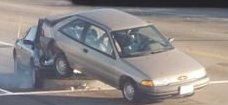
(From Chapter 6)
Retired Congressman Dick Armey's
official website contained a big section about red light cameras,
including the above-entitled 20-page position paper, and links to
official studies, reports, and other documents. It was last updated in late 2002.
Armey's Site (Replica)

is updated daily and is the place to look for recent articles, court decisions,
and up-to-date studies about automated enforcement. The site mentions Snitch Tickets, but not prominently; to find
the single article, you must
either search for "fake ticket," or search for "California" then scroll through seventeen "California" index pages, to the
bottom of the last page.
For the studies, click on Key Documents, then Statistics.
The July 2002 Red
Light Camera Report by the
California State Auditor
110-pages
http://www.bsa.ca.gov/pdfs/reports/2001-125.pdf
A short critique of the
California report, by a member of Cong. Armey's staff, is at:
http://www.politechbot.com/p-03801.html
Fight Your Ticket ("FYT")
An Important Book - Available at Every Local Library
Cover, 11th Edition Cover, 12th
Edition Cover, 13th Edition Cover, 14th Edition Cover, 15th Edition
The book Fight Your Ticket and Win in California by Attorney David
W. Brown (Nolo
Press) is an old friend, and an
important resource. FYT
is the best
guide available to the general traffic court procedures that are the same for all kinds of tickets, not just red light camera
tickets.
Over the years, my friends and I
have used FYT, very successfully, to deal with our radar
speeding tickets, but FYT is still coming up to speed on red light camera tickets:
The 13th Edition (July 2009), the 14th Edition (July 2011), the 15th Edition (July 2013), and the
16th Edition (July 2015) devote several more pages (at pages 254, 276, 262, and 246, respectively) to red light camera tickets than did the 12th
Edition; they also
warn about Snitch Tickets.
FYT is available at every public library - there will be circulating copies, plus a non-circulating copy behind the
reference desk with the other Nolo Press books. It is available from Amazon.com for about $20 (but don't buy an edition
before the 15th), and at nearly every book store, usually for the list price of $29.99. If you need a
copy tonight, some county libraries have it available as an electronic download, or you can purchase it as an E-book
for around $17.99, at Nolo.com . (At Nolo.com, the best way to find FYT is to type "Fight Your Ticket"
into the search box. But please note: The 16th Edition is the last of the series.) ) Avoid Nolo's similarly titled Beat Your Ticket.
I have written a FYT Addenda page, which
includes many useful index
entries not found in the printed book.
National Motorists Association

The NMA is an auto club which actually stands up for motorists.
Their website proclaims, "We are the organization largely responsible for the repeal of the 55-mph national speed limit... "
The website of the NMA contains a wealth of information about traffic
law across the USA, many links, and a section about red light camera tickets.
The NMA site contains a prominent warning about Snitch Tickets.
Much of the NMA's detailed
info on how to fight a red light camera ticket is "limited
access," but non-NMA members can get access for 24 hours, instantly, for $5.95. Or, you can join, for $35. The
NMA and the books Fight Your Ticket (above), The CalAware
Guide (below), and Smile for the Speed Camera (below), are the only paid products or
services endorsed
by highwayrobbery.net .
The NMA also operates the Speed Trap Exchange - see the bottom of this page for a link.

BanTheCams.org
has info about red light camera ticket programs throughout North
America, including a blog with recent articles.

The website of the privately-operated (and free-of-any-charge) Highway Safety Group
includes a detailed (four-part) history of the early days of red light cameras.

is a free-of-charge website which goes into
great detail about the general procedures for fighting a traffic
ticket, including questions the author suggests that you ask
in court. (The editor of highwayrobbery.net recommends that like
a good lawyer, you not ask any question that you don't already know the
answer to! So, you will still need to do your own
research.) The site includes two
pages about red light cameras, which
can be accessed directly at:
helpigotaticket.com/stra/redlight.html
The site warns motorists about Snitch Tickets.
S W I T R S
Statewide Integrated Traffic Records System
for
ACCIDENT STATISTICS AND REPORTS
Are you having trouble believing the amazing accident reduction claims made by the guys running your local red light camera program? Do you want to see for yourself?
SWITRS reports from the Statewide Integrated Traffic Records System are available to cities and individual citizens, at no cost, from the Information Services Unit of the CHP. If you want details of all the accidents going back a number of years at an intersection in your neighborhood, go to their website at http://iswitrs.chp.ca.gov.
Please note that SWITRS will automatically send the city a copy of whatever they have provided to you.
For examples of SWITRS reports, see
Set # 5 of Hawthorne Documents and
Set # 12 of Culver City Documents.
 
The image on the left is from the 2005 website of a company which offers to fight
your ticket for you.
Please note that highwayrobbery.net does not guarantee
results!
Other traffic ticket websites. Paid, and free, including forums.
Links/Ref/FAQ Page:
- 2 -
Contacting
Govt. Officials, The Court
Contacting the City
To find the website for "your" city, type "City of _________" into a Google search.
Contacting the Legislature
To contact your State
legislator, see the Legislation section on the Action page of this website.
Contacting the Court
In every county there is a website for the courts. It will contain the names of the judges, some extra phone numbers you
may be able to use, and the Local Court Rules. To get the URL,
use this official site, or type
the name of the court into a Google search. Example:
"Los Angeles County Court." The URL's for the courts of some of the larger counties are below.
http://www.alameda.courts.ca.gov
List of judges: http://alameda.courts.ca.gov/Pages.aspx/Judicial-Directory
http://www.lacourt.org, formerly lasuperiorcourt.org
List of judges: http://www.lacourt.org/judicialofficers/ui/index.aspx
http://www.occourts.org (Orange County)
List of judges: http://www.occourts.org/directory/judicial-officers/
http://www.riverside.courts.ca.gov/
List of judges: http://www.riverside.courts.ca.gov/judrost.pdf
http://www.sdcourt.ca.gov (San Diego County)
List of judges: http://www.sdcourt.ca.gov/portal/page?_pageid=55,1057194&_dad=portal&_schema=PORTAL
http://www.saccourt.com (Sacramento County)
List of judges: http://www.saccourt.ca.gov/general/judicial-phone.aspx
http://www.sb-court.org/ (San Bernardino County)
List of judges: http://www.sbcounty.gov/courts/pdfs/misc/schedAssign.pdf
http://www.sfsuperiorcourt.org/
List of judges: http://www.sfsuperiorcourt.org/Modules/ShowDocument.aspx?documentid=2511 (or, click on "Contacts")
http://www.sanmateocourt.org/
List of judges: http://www.sanmateocourt.org/general_info/judges/
Links/Ref/FAQ Page:
- 3 -
General Reference
(Powerful tools for
all kinds of political and/or legal research)
Fight Your Ticket
David Brown's book Fight Your Ticket is in Section 1, above.
Looking Up California Codes & Rules of Court
http://leginfo.legislature.ca.gov/faces/codes.xhtml
Official State of California site (click on link above) allows you to look up any section of
the Vehicle Code or other California code, such as the Public Records
Act (Govt. Code 6250) or the rules for peremptory challenges (Code of
Civil Procedures 170.6).
To look up the Rules of Court, go to: http://www.courts.ca.gov/rules.htm/
And be sure to read about West's Annotated Codes, below.
West's Annotated California Codes
The State site (above) contains only
the text of the codes. If you would like to see information on
how
a particular Code section has been applied ("case law"), go to any large public
library, or the small law library found in many courthouses, and look
at the same code section in West's Annotated California Codes (WACC) -
a large set of dark blue books. The librarian will show you how
to use it. If you find a case mentioned in WACC and you want to
read the whole court decision, write down the case citation
(example: People v. Williams, 28 Cal.4th 408) and
get it using FindLaw.com (see below). (The West's books are not re-issued every year, so be sure to
check the updates in the "pocket part" that will be
tucked into the back cover.)
WACC is available on the Internet, but only to those who pay West for a monthly subscription.
"Tracking" Bills in the California Legislature
http://leginfo.legislature.ca.gov/faces/billSearchClient.xhtml
Official State of California site allows you to
"track" bills in the legislature - both current ones, and old bills,
1993 and later.
(See the Legislation section on the Action page for more information about camera
bills under
consideration during the legislature's current session.)
The
State's official site sometimes has a day or two of "lag" so may not
have very recent amendments to bills, or warn you of
meetings/votes that sometimes are
held with notice given only the day (or evening) before. For the
crucial up-to-the-minute info, you will need to use the telephone.
California Ballot
Propositions Database
http://library.uchastings.edu/library/california-research/ca-ballot-measures.html
Has information about all statewide ballot propositions including Prop.
8 of 1982 ("Truth in Evidence") and Prop. 115 - full
text,
ballot arguments, the vote tally.
(Note: After you click on "search," nothing will come up until
you click "display search results.")
Case Law at FindLaw

http://www.findlaw.com
Has the complete text of
State and Federal court cases, and much more. It is free, but you
will need to register, set up a password, and accept cookies.
To look up a California State court case:
On FindLaw's opening page go to the uppermost right-hand corner and click: "Visit our Professional Site."
On the left side of the next page find the heading "Browse Research Materials" and click: "California."
On the left side of the next page find the heading "California Research" and click: "Judicial Opinions."
On the next page, scroll down to the "State" heading on the left side and click: "California Supreme Court and Appellate Court Opinions since 1934."
On the next page, enter the case citation into the box or, if the only info you
have is the name of one of the parties to the case, enter that name in the box provided.
Once FindLaw has found the case for you, it won't display the written decision until you log in.
L A W Y E R S
Use this Bar Association site to look-up info
about any California lawyer. I also recommend doing a Google on their name.
The CalAware Guide - Getting Government Documents
( Sorry, there's no link - this is a book! )
This book tells you how to get access to
public information, whether that information is contained in hidden
government documents, or coming from a government meeting that should
be open to the public, but isn't.
This book is a secret weapon !
It is The
CalAware Guide to Journalism Law in California, by Terry Francke,
General Counsel of Californians Aware (www.CalAware.org ,
(916) 487-7000).
The title may be misleading. It might cause you to assume that
all the Guide contains is
instructions for journalists on how to cover city council and other
government meetings. It does cover that subject, in great
depth, but it also has a whole chapter on the California Public Records
Act, which is the State law that allows you extensive access to government
documents (if you know your rights, and how to ask for access - also
see highwayrobbery.net's Getting Records page).
From the Guide's "Detailed Table of Contents," here are some of the questions covered.
DETAILED TABLE OF CONTENTS
CHAPTER 1
ACCESS TO STATE AND LOCAL GOVERNMENT INFORMATION UNDER THE CALIFORNIA PUBLIC
RECORDS ACT
• What is the California Public Records Act?
• Does the CPRA apply to federal records?
Making the Access Request
• Does the CPRA apply to all important records in state and local government?
• Must I have a “need to know” in order to have access to records under the CPRA?
• Must I make my CPRA access request in writing?
• Must I identify myself in making an access request?
• Must I reveal my purpose in making an access request?
• How well must I describe what I’m looking for?
• Can I require the agency to compile a list or report?
• Must the agency help me make an effective request?
• What can I be charged a fee for: Inspection? Copying?
• How soon must my request get a response?
Exemptions from Disclosure
• Does an exemption from disclosure mean that the agency cannot provide me with access?
• May the agency provide public access selectively - to certain favored persons but not me?
• If part of a record is exempt, may all of it be withheld?
• Are draft documents exempt from disclosure as such?
• Are litigation-related records exempt permanently?
• What kind of information can be withheld to protect personal privacy?
• Are the exact earnings of named government workers public or private?
• Are records of complaints and discipline against public employees exempt from disclosure?
• What about access to police and sheriff’s officers’ personnel records?
• Which law enforcement information is exempt from disclosure?
• If someone was robbed and raped, for example, does the fact of the rape allow withholding of the person’s name as the victim of a robbery?
• Must I sign something or provide proof that I am a journalist in order to get access to law enforcement information?
• Are the CPRA exemptions the only legal bases for withholding information?
• Can a record be withheld if it is not made expressly confidential by some statute?
• What is the deliberative process privilege?
|
|
Every journalist should have a copy of the Guide next to his computer. The best journalists do, but the Weekly Bugle
reporter covering the machinations of your local city council may not have even
heard of it. You may want to suggest that he or she get a copy. Or, you could give him or her a copy!
Every councilmember and school board member should be handed a copy on the day they're sworn into office. The public
information table at their meetings should have a copy for the public to read.
Every public library should have a few copies of this book. Most don't have any. If you want to
make a contribution (inexpensively, and tax-deductibly) to open
government (a.k.a. "Sunshine") in your town, buy your library a copy or two of this book. If you do that, let me know what
library it is in, and I will publish the address here.
Every high school and college government/political science instructor should have a copy.
Every City Clerk should have a copy on
their public counter, and another on their own desk.
The Guide is over 300 pages of well-written,
solid information (not even one cute cartoon). The Table of Contents is
organized in Q&A format (see sample, above), and there is a table of cases
in the back. Also included are the full language of the CPRA, the Brown Act and the Bagley-Keane Act, as well as
perforated pages with request
forms and other useful tools. It is available
in some college bookstores and public libraries, or can be ordered direct from CalAware at (916) 487-7000 or
at http://www.CalAware.org . The direct-order cost is $22.50 per
copy, including postage and tax, with a discount available on 10 or more copies. And, if you would like
to join Californians Aware, you don't have to be a journalist.
Individual members of the public are welcomed.
Links/Ref/FAQ Page:
- 4 -
FAQ

(Frequently-Asked Questions)
FAQ # 1: I got a ticket for a rolling right turn. In the picture, it
looks like my brake lights were on. That proves I stopped, doesn't it?
Answer: Not necessarily. Reflection of the camera's flash can make
your brake lights look "on." Look at your third stoplight - is it on? You
may have been braking to
slow down for the corner, but didn't make the required full stop at the corner.
In most towns, the cameras take a 12-second-long video of the incident - and that video is up on a website so that
you can look at it. Go to the site and have a look. If the
video shows you made a full stop, or very close to one, ask the
officer to dismiss your ticket.
If the video seems to show that you did not stop, but you don't believe it, here is an alternate way
to determine if you stopped, or not.
If the ticket is from a RedFlex camera, it will have a black "data strip" along
the top edge of the before-and-after photos. The numbers in the data strip should enable you to tell how much time elapsed
between the 'before' and the 'after' photos. ( You may have to subtract the time in
the 'before' photo from the time in the 'after' photo. If you are having trouble figuring out which numbers are which, have
a look at the big "How to Read Your Late Time" box in Defect # 7 on the Home page. And, if the
white-on-black numbers are too faint to read, put the ticket up on a window,
so that the light from outdoors comes through the paper. ) Once you know the elapsed time, do the
following easy experiment. Get a stopwatch and go to a corner that
is similar to the one your ticket is from. Make a full stop, then start the stopwatch, hit the gas,
and time how long it takes you to get the
same distance around the corner as was shown in the 'after' photo. If the time it takes you is
roughly equal to, or smaller than, the elapsed
time calculated from your ticket, maybe you made a full stop, or very close to one!
Also see FAQs # 15, 27, 37 & 40.
Click for Bigger Image
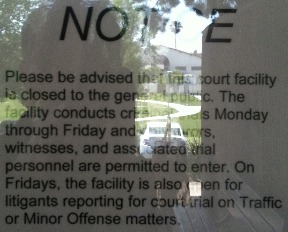
FAQ # 2: In Culver City, the Commissioner deliberately kept the monitor (used to
display the photos) turned so that during trials the public could not see the
photos. Are the courts in other towns limiting to public's ability to observe red light camera trials?
Answer: It is to your advantage to have members of the public observing your trial. That's why we have the Sixth Amendment ("In all criminal prosecutions, the accused shall enjoy the right to a speedy and public trial..."). Let me know
if "your" court is hiding the photos or doing anything else to interfere with the public's ability to attend and observe red light camera trials. See also
Set # 3 of Culver City Documents. For more about the notice shown above (we have been told that it has been taken down), read this
article.
FAQ # 3: It's not me pictured on the ticket. Am
I required to disclose the identity of the person in the photo?
Answer: No! Why not? See the "It's Not
Me" section in the middle of the Your Ticket page.
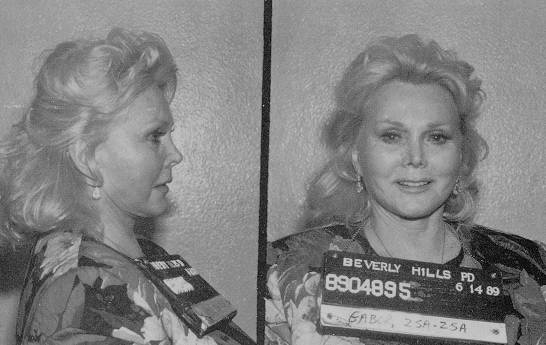
Zsa Zsa (1917 - 2016) did 180 Hours of Community Service for Slapping a Beverly Hills Traffic Cop.
FAQ # 4:
If I take Community Service, how many hours will I have to do?
And, can I take traffic school too?
Answer:
Some judges will allow Community Service only if you are a full-time
student or are on disability. Others have no set rules as to who
qualifies, but will try to discourage you from taking
it - probably because their experience has been that many people won't
do the hours required. Some judges require 51 hours, but it can
be as low as 16 hours, depending
upon who is your judge. See the Feb. 7, Feb. 18 and Sept. 4, 2003
entries in the Culver City chronology on the Camera Towns page. And yes,
some judges will let you take both Community Service and traffic school.

FAQ # 5:
I'm thinking about fighting my ticket and want to get some of the City's documents or
records. How do I do that?
Answer: You can do a "Discovery." It's
easy. See: Getting Records.

FAQ # 6: Engineers who have studied red light running - those who do not stand to gain financially from
the use of red light cameras - suggest that cities try alternatives
to cameras before installing cameras. What are these alternatives?
"According to City of Fremont Staff, other safety features to improve safety and discourage red light violations were not considered prior to the installations of the ARLE systems at either study intersection. To date, the City is satisfied with the operational benefits of the current ARLE system and have not explored other possible countermeasures."
From 2016 independent study commissioned by Fremont. See Set # 9 on the Fremont Docs page.
Answer: Two alternatives are lengthening the yellow, and improving pavement markings. Details,
including a discussion of whether violations will "rebound" after the yellow is lengthened, are here: Red light camera studies.
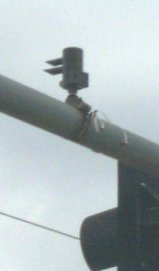
An Opticom Receiver on a Signal Arm
FAQ # 7:
I have seen small devices, high up on signal arms
around town. Are they some kind of red light camera?
Answer: There are more and more devices mounted on poles around town, for all kinds
of purposes. Plus, there is no standardized look to red light camera equipment, as there are at least four companies
competing in the field.
The device you
saw could be an Opticom receiver, which picks
up the white strobe flashes from emergency vehicles and then changes the
signal to halt cross traffic. Opticoms have been around for more than 40 years, and most cities have them. On
major routes through town, you will find Opticom receivers at every intersection.
Or, if what you saw looked more like a camera, and it was pointed downward
at a steep angle (or almost straight down), it might be there - in place of loops in the pavement - to detect cars
and control the signal cycle, or to
measure the speed of cars to trigger a (separate) red light camera.
Red light camera systems can be recognized by their bulk. They will have
multiple devices, either in a single large cabinet or in separate, smaller enclosures. Most red light camera systems, but
not all, will also have a flash
unit with a large silver reflector. Some may use "non-visible" (to humans) infrared light, provided
by multiple light-emitting diodes (LED's), for camera light.
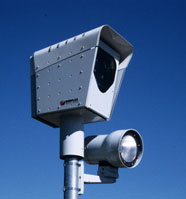
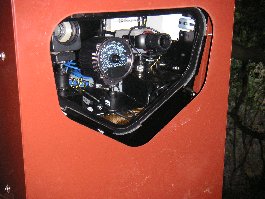
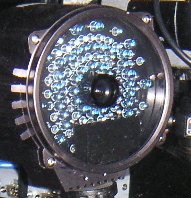
RedFlex Cam with a Visible-Light Flash RedFlex Cam with a
Non-visible (LED) Flash Close-up of LED Non-visible Flash
Another way to tell if a city has red light cameras is to Google the name
of the city ("City of ____") plus the words
red light camera. If the city has red light cameras or if the city council has discussed having them, Google will
bring up newspaper articles.
If you're still not sure of what the device is, you could call the police department, or the public works
department, and ask them.
FAQ
# 8: If you enter
an intersection when the light is yellow, how far across the intersection
do you have to be, when the light turns red, to NOT receive a red light camera
ticket?
Answer: In California, if any part of your car (or even the winch on your front bumper)
is beyond the closest edge of the first limit line (or, if there is no limit line, the closest edge of the first line of the crosswalk)
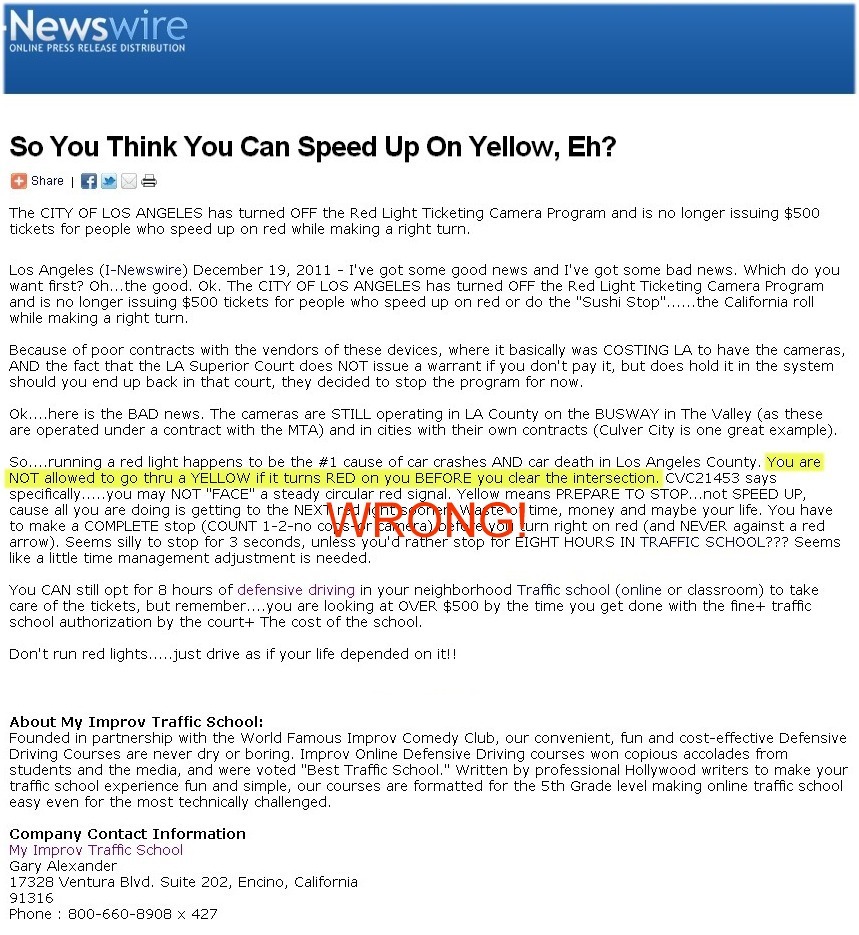
before the light becomes steadily red, it's legal for you to finish crossing the intersection, even if the light becomes steadily red long before you get to the other side. See Cal. Veh. Code Sec. 21453(a), and also FAQ # 32 and Defect # 7 on this site. And
please note that in the rules may be different in other states - see
Photos # 5 & 6 on this page.
A lot of people don't understand this law, including the columnist and the traffic school below.
Misleading newspaper column.
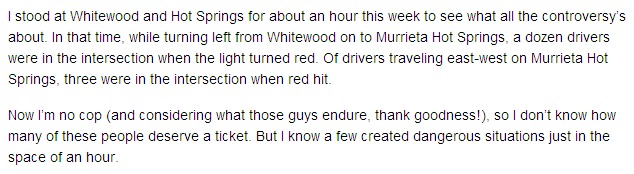 Misleading column by Carl Love,
Riverside Press-Enterprise, 4-20-13
Misleading column by Carl Love,
Riverside Press-Enterprise, 4-20-13
Incorrect information (highlighted in yellow). From a traffic school !
 Incorrect information (highlighted in yellow). From a traffic school !
Also incorrect: The number # 1 cause of car crashes and car death is drunk driving, not red light running.
FAQ # 9: I
entered an intersection tonight when the light was yellow and as I went
through I saw a flash from the camera. Now I'm worried about
receiving a ticket. How long before I can relax when I go to my
mailbox?
Answer: The
camera could have been flashing a car just behind you. If it was you they were flashing, they have
only 15 calendar days to send the ticket to you. California Vehicle Code
Section. 40518 says:
40518. (a)
"Whenever a written notice to appear has been issued by a
peace officer or by a qualified employee of a law enforcement agency
on a form approved by the Judicial Council for an alleged violation
of Section 22451, or, based on an alleged violation of Section 21453,
21455, or 22101 recorded by an automated traffic enforcement system pursuant
to Section 21455.5 or 22451, and delivered
by mail within 15 days of
the alleged violation to the current address of the registered owner
of the vehicle on file
with the department, with a
certificate of
mailing obtained as evidence of service, an exact and legible
duplicate copy of the notice when filed with the magistrate shall
constitute a complaint to which the defendant may enter a plea."
If you are the registered
owner of the car and you have reliable mail service, you can relax if a ticket is not in your
mailbox by about 2-1/2 weeks from the date of the violation. But if you can't relax and are thinking about contacting
the Superior Court to see if they have a ticket in your name, and your violation occurred inside LA County, read Set # 2 on this site's
LA County Docs page before you make any contact with the court. Also keep in mind
that some courts are overloaded with these tickets, and so may not have your ticket entered into their computer
until a month (or more) after the date of
the violation.
If you are not the registered owner: The 15-day requirement applies only to the first mailing of the ticket, which is
usually to the registered owner of the car. If he or she gave your name to the police, who
then re-issued the ticket to you, the 15-day requirement does not apply.
If you did get a ticket in the
mail, be sure to read Defect # 8 on the Home Page.
FAQ # 10:
What about class action suits?
Answer: There's some here in California, and a number of others around the country. See the index to cases.

FAQ # 11: What
about GPS-based warning devices? Or license plate covers, sprays, removing the front
license plate, or even wearing a mask,
so the camera can't get a clear photo of your plates or your
face?
Answer: Reflective sprays and covers are illegal in California with a $250 fine for sellers, under
CVC 5201, and in any case there's a real question as to whether they work. A legibility test conducted by the Mythbusters television show (S5:E19, air date 9-5-07) showed that the cameras could easily read plates with covers or spray. Nevertheless, I can report that
in my 10+ years of operating this website, I have never had someone tell me that they got a ticket despite
using a spray or a cover.
At least one high-ranking police officer must believe that the covers work. In Sept. 2011 New Orleans Police Chief Ronal Serpas announced that
NOPD Captain Mike Glasser was under investigation for using a questionable license plate cover on his take home police unit.
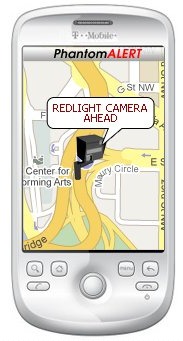
A number of manufacturers are marketing GPS-based hardware (TomTom, Garmin, Magellan) capable of warning you when you're approaching a location known to be
equipped with a camera. And, there are "apps" for smart phones. The effectiveness of these warning systems will depend heavily
upon the developer
maintaining a very up-to-date data base of GPS coordinates - and users remembering to make a monthly
download of the updates. If these systems
become popular, some states may try to ban the use of them.
Even if you never speed or run red lights, it may be a good idea to purchase hardware or software to warn you when you're approaching a camera enforced location. Why? The drivers in front of you will be exhibiting unexpected behavior, like slamming on their brakes on a brand new yellow, or because they have "local" knowledge that there's a speed camera there, or because their system has just warned them of an upcoming camera. The warning from your nav system will save you from rear-ending them - an accident for which the law would automatically hold you responsible.
Most newer red light camera installations take pictures of both ends of the car, so unbolting the front plate won't make a difference.
A fundamental problem with all the protective measures above is that the average person who gets a red
light camera ticket is not a speeder or aggressive driver, but is
older, drives at moderate speeds or with "the flow" and has a clean driving record, so has never thought he would get
a camera ticket -- thus making it unlikely that he would purchase and install protective measures "just in case."
If you decide to wear a mask, be sure it doesn't cover your eyes or
restrict your peripheral vision. That's unsafe, and illegal, too.
If you would like to read more about sprays and warning devices, try the "Photo Enforcement" forum in the "Other
Enforcement and Countermeasures" Section at
RadarDetector.net.

FAQ # 12: Is it
true that a ticket never gets mailed to you in the first place if the
picture of the driver is unclear?
Answer: This varies from city to city. In one
local city I've seen lots of tickets where you can't tell if the image
behind the windshield is a person's head, or a small evergreen
shrub. And most people who get one of those, plead guilty and pay
it! Either because they don't know that there has to be a picture
of your face, or because they're afraid that if they go to court
(assuming they can afford to post the $490 bail) and fight the ticket
and lose, they'll be denied traffic school - which happens about 20% of
the time
in that city.
See Defect # 1 on the Home page, the Snitch Ticket section on the Your Ticket page, and the class action information in
the News section, below.
FAQ # 13:
Are speed cameras coming?
Answer: Bills to legalize photo radar were introduced in the California legislature in 2005, 2006, 2008, 2009, 2010 and 2011. All failed to pass, but they could try again in 2017. For info
about any current bill,
see the Legislation section on the Action page.
A little history: Until 2007, there were some speed cameras
already working - illegally - in California. There's a little
discussion about the illegal cameras in the Humor section below, and in the Los Angeles, MRCA, and San Jose sections
on the Camera Towns page. There's a book about speed cameras, in the Speeding Ticket section, below.
FAQ # 14:
I need it, but attended traffic school less than 18 months ago. What
do I do?
Answer: See the "Alternatives" box in the Handling
Your Ticket section on the Your Ticket page).
FAQ # 15: Why is the fine
so high in California ? Are there exceptions?
Answer: When defendants raise that question in court, the judges explain
that the State legislature set the fine so high (current
fine is approx. $490, not including the approx. $100 cost of attending traffic school) in order to strongly deter drivers from
running red lights. They also usually quote figures, provided by
the local police, which say that accidents in the city are down 10 - 40% as the
result of the cameras. But on the East coast, where the fines are as low as $50 (and the tickets don't carry a "point"),
the police there have been publishing similar accident reduction
figures. Evidently, at least on the East coast, a much smaller
penalty has been equally effective in getting drivers to behave.
Draw your own conclusion as to why, absent a greater deterrence value,
California's penalty needs to be so many times harsher.
Until recently, the City of San Francisco had, on its website, an explanation
of how and why the fine grew from the initial $104 (in 1996). That explanation is archived.
It's been a while since the California Legislature has increased the fine. The newest surcharge (an additional $20) went into effect on June 10, 2010 (enacted by 2010 Executive Session Bill ACX 8-3), and in the governor's 2010 budget proposal there was a new $40 surcharge which, had it been enacted (it was not), would have gone into effect on Jan. 1, 2011 - see the Legislation section on the Action/Legis page.
Once upon a time there was an exception to the sky-high fines. Until Aug. 2008, the City of LA cited its rolling right
turns under Subsection (b) of CVC 21453, instead of (a), which resulted in a much-lower fine - $159 including all fees (about $250 when today's higher surcharges are included). For info about LA's
formerly-reduced fine see the LA City Documents page. For info about the unsuccessful legislative attempts to reduce the rolling right fine, and more info about the difference between Subsections (a) and (b), see the page about AB 909 and the big blue box there.
Around the state, a few judges offer lower fines to
defendants with rolling right tickets, but most often it is just a $100 reduction.
Also see FAQs # 4 & 16.
FAQ # 16: Who gets the
fine money?
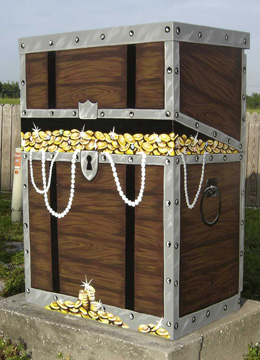
A signal control box in Tampa, Florida.
In Summer 2005, seventeen traffic
signal control boxes
were decorated in
various themes,
as part of a City-run public art project.
The Treasure Chest design was sponsored by Sterling Payment Technologies, LLC.
Answer: Approximately $150 goes to the city - and the city will use most of that to pay the rent for the cameras. The rest goes to Sacramento. One city's description of how the money is split up is on pages 5 and 6 of this report.
If you would like a more official answer, you can look at this very
complex official publication: Uniform Bail and Penalty Schedule.
FAQ # 17: How much do cities pay for the cameras?

Answer: Some cities pay three times as much as others! In their initial contracts, nearly all California cities agreed to pay about $6000 per camera per month. (California law prohibits cities from paying on a per-ticket basis.) But now all of those initial contracts have expired and cities have had the opportunity to negotiate a lower rent upon renewal. Some cities have
negotiated hard, and now pay
significantly less than $6000, often less than half! Examples:
Covina and Garden Grove $2200, Del Mar $1578, Elk Grove had been paying $5870 under a two-year extension agreement (which would have heavily penalized the City if it did not agree to a further extension!) but in 2014 re-negotiated to the sliding scale shown in this table from their new contract:
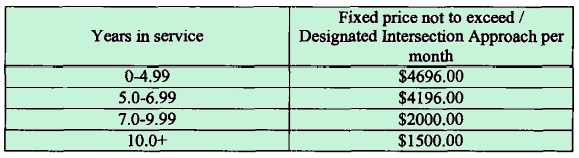 Table from Exh. D to the 2014 contract between RedFlex
and Elk Grove, California
Table from Exh. D to the 2014 contract between RedFlex
and Elk Grove, California
More examples: Gardena (closed) was paying $3500 and was offered $60,000 not to cancel the program (go to their Documents page to see how they negotiated), Laguna Woods (closed) $1750 (was paying $3000 but in June 2012 was offered a big discount after the City threatened to cancel the program), Solana Beach $2364, and Ventura $2190. These cities were less likely to go into the red when yellows were lengthened in Aug. 2015, as required by a change in the CalTrans Manual. (See the expanded version of Defect # 2 for more information about that change.)
(This list of cities with low rents has been here since Feb. 2011, although it has been updated and expanded since then.)
Other cities have agreed to continue paying much more than they should, sometimes close to $6000! Because red light camera contracts can involve multiple cameras over a term of 60 months or more, the penalty to a city for "failure to negotiate" (or failure to look around to see what other cities pay) can amount to more than a million Dollars. Here are some of those cities, along with the rent they agreed to pay for each camera each month (and, in parentheses, the total they will overpay - compared to a $3000 target rent or the Elk Grove prices - during their current renewal period):
Bakersfield $3370 ($1,266,000), Capitola $5100 ($372,000), Citrus Heights $4563 ($544,000), City of Commerce $3733 ($374,400), Culver City $3211 ($928,728), Daly City $5520 ($604,800), Encinitas $3700 ($428,400), Fremont $4995 ($2,445,600), Hawthorne $2800 ($462,000), Los Alamitos $4576 ($221,472), Lynwood (closed) $3400 ($100,800), LA MTA/Metro $1913 ($4,124,000), Menlo Park $4950 ($497,184), Millbrae $5395/$4195 ($450,396), Newark $4700 ($421,200), Oxnard (closed) $2772 ($13,992/month), Rancho Cordova $5750 ($280,960), Redding $4375 ($700,800),
San Francisco $2661 ($563,784), San Leandro $5200 ($1,056,000), and San Mateo $3985 ($238,200).
Each $1000 overpaid by a city represents an extra ten tickets that the city must issue in order to break even on the rent (assuming that 2/3 of the tickets issued are paid and that the city receives an average of $150 from each paid ticket).
Some cities negotiated the ability to quit with little notice, often free of any penalty. As of early 2017 those cities were Bakersfield, Beverly Hills, Elk Grove, Fremont, Hawthorne, Los Alamitos, Menlo Park, Montebello, San Francisco, San Mateo, and Solana Beach.
In June 2012 RedFlex offered the City of Riverside (closed Sept. 2014) a $300,000 discount when their Public Works Director recommended the cancellation of the program. (We don't know if the City eventually received the discount, or forgot about it.) This contrasts with the vigilance shown in another instance, where Riverside staff caught an error in the monthly billing which could have cost the City $48,000 annually.
RedFlex gave the City of Baldwin Park a $350,000 credit towards past camera rent, and a $75,000 credit during each year of the renewal term. (In May 2015 the City allowed the contract to expire, without renewing it.)
Some cities have agreed to contracts which provide that unless the city submits a formal cancellation notice months (or even a year!) before the expiration date, the contract will automatically renew for more years. If a city misses the deadline to cancel, automatic renewal can be
an expensive pitfall (see paragraphs 8 - 10 of this article, and this article). Some of the cities that have agreed to automatic renewal are Capitola, Commerce, Daly City, Garden Grove, Millbrae, Newark, and Rancho Cordova.
The contracts for all these cities are available on their respective Documents pages, here at highwayrobbery.net.
Why Do Some Cities Pay So Much and/or Agree to Disadvantageous Terms?
It could be bribery. In 2013 a former RedFlex Executive VP alleged that there was bribery in thirteen states - see FAQ # 34.
Another explanation for the failure of so many towns to negotiate a good price could be that the police who do the negotiation have grown too close to their counterparts at the camera company - many of whom are retired cops. A local newspaper obtained emails
(archived copy) revealing that in one city, the deputy chief responsible for negotiating the city's red light camera contract was asking the camera company about employment at the same time she was negotiating the contract, and the sergeant who ran the program was offering to assist the company with lobbying and marketing.
In 2014 it was revealed that in one California town, the camera company spent thousands of Dollars on meals for the government personnel running the local camera program. The meals were inexpensive, nothing fancy, but there was over 250 of them!
FAQ # 18: A
friend pointed out to me
that an article about my City states that the company operating the
cameras is paid per ticket, and from what I know California lawmakers made that illegal on
Jan. 1, 2004. Seems too unbelievable that such information would
slip past the City. If the writer is correct, lots of
tickets are going to be dismissed.
Answer:
There's a loophole in the law. Reporters never seem to catch it,
but cities that are operating under a contract that they
signed prior to Jan. 1, 2004 may continue to pay the camera company on
a per-ticket basis. They're grandfathered. The presence of the loophole
caused a gold rush in late December 2003 -
cities were signing contracts like crazy (and some made disadvantageous
deals). See Subsection 'B' of Defect # 10 on the Home page, and the discussion of AB 1022 on the Action page.
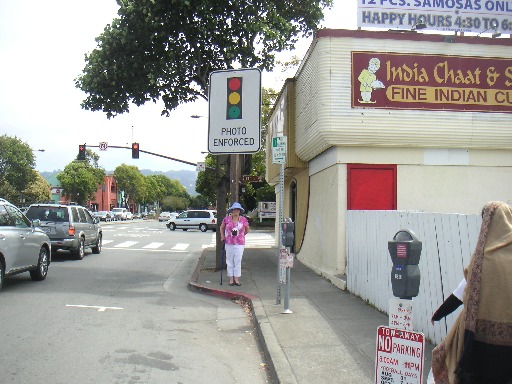
Giant Photo Enforced sign in Berkeley, removed in late 2013. Will rearenders be down, post-2013?
FAQ # 19: What about all those studies saying that photo enforcement is good for us? Have red light
cameras really increased the incidence of rear-enders? And is the claim that cameras decrease
serious accidents valid?
Answer:
It is now generally accepted that cameras do increase rear-enders. But I am a guy who has
to "see it for himself." I reviewed ten
years of accident reports at Newport /
17th in Costa Mesa, and found a near-doubling of
rear-enders since the camera went in (my count of rear-enders there
appears in the third paragraph of the letter in Set # 10 of Costa
Mesa Documents).
A 2013 report prepared by City of Encinitas engineering staff showed that rear-enders there increased after the cameras were installed. (The staff report is linked in Set # 5 on the Encinitas
Documents page.)
See also the Dueling Studies section on my Industry PR page.
FAQ # 20: I am looking at
the photo they sent me and I don't believe the signal really is
red. It looks orange!
Answer:
I have noticed that the red signal light often looks very orange (or yellow) on the
photos that are printed on the tickets. It happens more often in
cities that use video-based ticketing (as opposed to the older 35mm
"wet film" cameras). So how can you tell if it is a red, or a
yellow, that you are looking at?
Most often, you can tell by the position
of the light on the
"backboard," the rectangle of flat black metal that surrounds most
lights. If the light is near the top (or above the center) of the
rectangle, it's a red. If it's in the middle, it's a yellow.
If you can't see the edges of the backboard because there is something
dark in the background behind it, you may be able to use a nearby
object as a reference point. For example, in the photos
below, the red
arrow is just above the top edge of the square white sign, and the
yellow is well below that top edge. (It
may be necessary
to go out to the intersection, stand near where the camera is, and see
what lines-up; you may want to take a small stepladder with you -
but don't block the red light camera's lens with your head as you could
be accused of obstructing justice.)
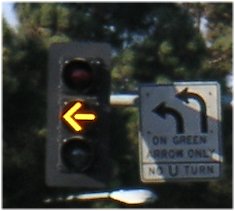
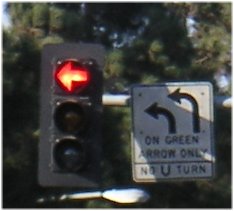
I used my own camera
to take these photos (above) of the signal at eastbound Jefferson /
Overland in
Culver City; as a result, the backboard stands-out from the dark
trees much more than it does on a real ticket, and the colors are
truer. Here (below) is my attempt to simulate what these same
photos
would look like on a real ticket mailed to a motorist.


(Actually, this came out better than how they look
on a real ticket.)
But sometimes you may be right - it really IS yellow. Look at this photo.
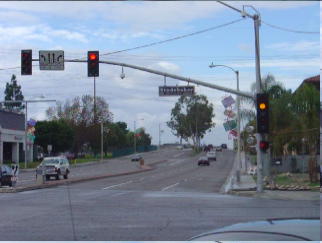
(For more information about the lamps, and this photo, see Defect # 7. And, for scientific information about the wavelengths of
traffic light lamps - including
a comparison of
incandescent vs. LED, see this page.)
FAQ # 21: I heard that some motorists were convicted of perjury on
a camera ticket. And jailed!
Answer: That's true. Here's some examples.
1. During a Long Beach, California red light camera
ticket trial in December 2003 the driver told the traffic court
commissioner that there had been some teenage
carjackers chasing him, and that's why he ran the light. He
brought along a friend who testified he had been a passenger in the car, and the friend confirmed the driver's
story. Unfortunately for the driver and "passenger," the video of the violation showed
that there was no one in the passenger seat of the violator's
car. The commissioner, believing he had been lied to, referred
the case to the district attorney's office for criminal
prosecution. In Oct. 2004, after a one-day trial where the
commissioner testified against them, both men were convicted of felony
perjury and were sentenced to 120 days (driver) and 90 days (passenger)
in jail.
2. In 2010 an English taxi driver was sentenced to eight months in jail for "perverting the course of justice," after she used fake car repair documents in an attempt to prove
that a problem with her taxi's brakes was to blame for her red light tickets.
Article.
3. In 2011 Vicky Pryce, the estranged wife of Chris Huhne, British Member of Parliament (MP) for Eastleigh and Her Majesty's Principal Secretary of State for Energy and Climate Change, told a newspaper reporter that in 2003 MP Huhne had pressured her into
taking responsibility for a speed camera violation that he had committed. After that accusation leaked to authorities, both MP Huhne and Pryce were prosecuted and in 2013 sentenced to eight months in prison. They each served two months. Wikipedia article.
The moral (or irony) of these stories is that even though the police seem to feel free to perjure themselves (see the 2014 decision in People v. Tho--) and so far are avoiding jail for doing it, you must not follow their lead.
You are on the Links/Ref/FAQ page

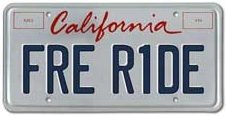
License plate by Rick Ngoc Ho, OC Register
FAQ # 22: "You know, one beautiful thing about cameras,
they don't care if you're an off-duty cop, (or) anything like that, everyone is equal
under the law." [From an Internet post.]
"In a way, cameras can be a democratizing technology. The automated systems won't be sweet talked out of giving a ticket by an influential local figure, or be prone to racially profiling drivers." [From an Aug. 25, 2014 article
(archived copy) in the Washington Post, by reporter Andrea Peterson.]
Answer: The post-er and the Post suggest that the cameras don't play favorites - that the police
give out tickets equally to all, including
rich guys, connected bureaucrats, law enforcement officers off-duty or on, the mayor, their friends and family, and local voters.
I disagree. I think cameras make favoritism the "default" condition, and make racism nearly impossible to detect.
Favored by default: Bureaucrats and govt. "insiders." An April 2008 Orange County
Register article
(archived copy) ("Special License Plates Shield Officials from Traffic Tickets") pointed out
that in California there were nearly one million private vehicles having "confidential"
license plate numbers protected from easy or efficient look up, making those vehicles' owners effectively invisible to agencies attempting to process
parking, toll, and
red light camera violations. Then, in 2009 the
Register published an update
(archived copy) reporting that
the legislature was extending the "confidential" privilege to even more people. In the 2015-2016 legislative session there was a bill which would have extended the privilege to even more categories of employees. (More info about current bills is at the top of the Action/Legis page.)
For comparison, the State of Arizona has 22,539 cars on its protected list, Illinois has 5867, Maryland has 8303, Pennsylvania has 8200, and Texas has 18,323.
Source.
In Feb. 2010 a bill was launched in Sacramento to address the problem, but it failed to pass. In 2011 it was re-launched, but an amendment made it into a bill highwayrobbery.net could not support - and it too failed to pass. (The official analysis of the 2011 bill revealed that by then the number of confidential registrations had risen to 1.5 million.) In 2012 there was another try. And in 2013 there was AB 487 - see the Legislation section on the Action/Legis page.
Further reading:
In a 2001 State Senate hearing they discussed several instances where our State legislators were flashed but never received tickets (see page 14 of the transcript or page 16 of the pdf).
On Nov. 9 and 11, 2010 the Sacramento
Bee wrote and editorialized about the protected plates.
On Dec. 12, 2010 Thomas Peele and Josh Richman of the Contra Costa
Times wrote
(archived copy) about toll scofflaws in the Bay Area.
In Feb. 2010 Reason Magazine published a Steven Greenhut article
(archived copy) entitled "Class War - How Public Servants Became Our Masters."
To see the list of the 28+ occupations eligible for protected plates, see
CVC 1808.4,
CVC 1808.2, and
CVC 1808.6.
On May 19, 2011 Los Angeles City Controller Wendy Greuel published an audit (see page # 28) showing that 30% of the parking tickets issued to cars with protected plates never were paid. An estimated 11,250 unpaid tickets, in five years.
The City of Fremont disclosed that as of July 2016, 181 City employees had confidential drivers' licenses and 316 of their privately owned vehicles had confidential registrations.
To see the DMV's "Request for Confidentiality of Home Address" form - which is one of the very few DMV forms not available on the DMV's website - click Form # INV32.
Text Continues Below
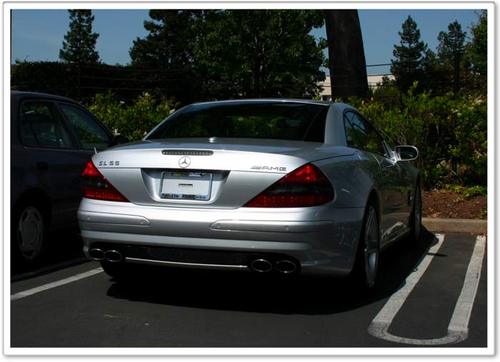
Steve Jobs' Car, No Plates
Favored by default: Drunks. If a "live" cop sees a motorist run a red and the motorist has been drinking, the motorist will go to jail for DUI, while a red light camera will let him off with a fine, and nothing will be done about his habit of drinking and driving until he causes an accident or kills someone.
Favored by default: The uninsured and unregistered. When a "live" cop pulls someone over, he will check for insurance and registration, and confiscate the car if there is none. But with a camera ticket there is no demand to prove that you are insured and registered. Why is that?
Also see FAQ # 38.
Geographic profiling: Here in California, no city issues a ticket to 100% of the people photographed - the average is
well below 50%. There is a selection process, done by humans. ( While I am
not suggesting that either of
the following cities profiles, their statistics demonstrate the potential to do so. For example, in 2004 San Francisco photographed 29,335 cars but issued only 7943 tickets. Los Angeles, in 2003, photographed 8678 cars but issued 3981 tickets. These figures - from the Camera Towns page - are old. But they remain typical. ) We would hope that the police personnel doing the selection would throw out only the tickets where the photos are too blurry, but what is to stop them from giving a free pass to the mayor and the "locals," people who live (and vote) in town?
"Locals" have a further advantage - they know where the cameras are.
In June 2013 the City of Belmont disclosed that 85% of its tickets went to visitors.
In June 2015 the City of Cathedral City disclosed that 69% of its tickets went to visitors.
In May 2016 RedFlex disclosed that 70% of Citrus Heights' tickets went to visitors.
In February 2014 the City of Commerce disclosed that 98.5% of its tickets went to visitors.
In January 2016 the City of Covina disclosed that 75% of its tickets went to visitors.
In January 2016 Daly City disclosed that 78% of its tickets went to visitors.
In September 2014 the City of Del Mar disclosed that 92% of its tickets went to visitors.
In May 2016 RedFlex disclosed that 69% of Elk Grove's tickets went to visitors.
In July 2018 the City of Encinitas disclosed that 80% of its tickets went to visitors.
In June 2013 the City of Fremont disclosed that 69% of its tickets went to visitors.
In August 2015 the City of Garden Grove disclosed that 79% of its tickets went to visitors.
In April 2014 the City of Highland disclosed that 94% of its tickets went to visitors.
In August 2015 the City of Los Alamitos disclosed that 76% of its tickets went to visitors.
In March 2014 the City of Lynwood disclosed that 77% of its tickets went to visitors.
In May 2016 RedFlex disclosed that 86% of Marysville's tickets went to visitors.
In August 2013 the City of Menlo Park disclosed that 90% of its tickets went to visitors.
In August 2014 the City of Napa disclosed that 75% of its tickets went to visitors.
In March 2013 the City of Poway disclosed that 88 - 98% of its tickets went to visitors.
In May 2016 RedFlex disclosed that 72% of Rancho Cordova's tickets went to visitors.
In May 2016 RedFlex disclosed that 57% of Redding's tickets went to visitors.
In May 2013 the City of San Rafael disclosed that 78% of its tickets went to visitors.
In March 2014 the City of South San Francisco disclosed that 80% of its tickets went to visitors.
In March 2015 the City of Victorville disclosed that 73% of its tickets went to visitors.
Racial profiling: In 2012 the Marin County Grand Jury found, "Cameras are incapable of racial profiling and therefore not subject to lawsuits alleging racial bias," but did not offer evidence or discussion to support their finding. On the east coast ("owner responsibility" states), the camera tickets do not require a photo of the driver's face, but out here in the west ("driver responsibility" states) there has to be a good photo of the driver, and that "face photo" provides the opportunity for racial profiling.
A 2018 study of ticket distribution in Washington DC found that ticketing was much higher in predominately black neighborhoods.
Wealth profiling: Every ticket shows the year, make and condition of the vehicle.
Age profiling: The average age of those ticketed is 47, and very few are under the age of 26. Yellows set at the minimum legal length are a test of one's athleticism - which declines with age. Ticketing older drivers is a lucrative business plan - older drivers are concerned about their insurability so are more likely to pay up without a fight, and also are more likely to have the money or the ability to borrow it.
Perhaps the Legislature foresaw the possibility of profiling or favoritism when they wrote the CVC 21455.5 requirement that cities shall develop
"uniform guidelines for screening and issuing violations." See Defect # 10 - A on the Home page for more about guidelines.
The legislature did not specify the content of the guidelines, but I suggest that there should be a requirement that the
name, address and face photo of the driver not be visible to the city
personnel making the final decision whether
the ticket is to be issued, or not.
I also suggest that there be a mechanism to assure that the insiders on the protected list get their fair share of the tickets. In 2010 there was a bill in California's legislature to do just that. It failed to pass, was re-launched as AB 3 in the 2011 session, which failed to pass, and then again as AB 2192 in the 2012 session. Which also failed to pass. There was a new bill in 2013, which also failed to pass. Read about it near the top of the Action/Legis page.
Although it is not profiling - it is due to the limitations of the equipment - a large proportion of violators never even get flashed. See FAQ # 27.
FAQ # 23: What's the difference between a trial and an arraignment?
Answer: The terms are not interchangeable. Read about them
in the big green Terminology box on the Your Ticket page.
FAQ # 24: Can I argue (in my defense) that this was a speed trap?
Answer: I don't think much of the speed trap defense - that
they measured your speed over some loops or were using radar - against a red light camera ticket. I have never
seen the simplistic "the camera uses loops, or
a radar, therefore it is a speed trap" defense work, on any red light ticket. When judges hear that defense they
say that they don't need the (possibly illegally-obtained) speed reading to
convict you, and will ignore your speed, because they have a photo
(or a video) showing your car behind the limit line when the light was red. "Truth in Evidence" (see section on
this website) allows them to do such things.
In the landmark San Diego case People vs. John Allen, the judge explained why he would not accept the speed trap
defense. Read that May 29, 2001 ruling here.
The speed trap defense is pushed by other Web advisors, and I realize that no matter what I say, you may
decide to throw "speed trap" into your defense along with whatever other
defenses you have. But please
consider that the judge has probably heard the "canned" speed trap defense from many other defendants before you, and
may have developed a knee-jerk reaction when he hears the familiar wording (or sees it in a TBD). So, if you are going to use
this defense, and
have picked-up the text somewhere on the Internet, at least change the wording some.
There is a portion of the "Speed Trap" law that could work, on a red light camera ticket. If you feel
that the Posted Speed on the street where you were cited is way too low, read Defect # 2 on the Home page.
And, if you got a speeding ticket, and radar was used, you definitely want to look at the Speed Trap law. See the Speeding Ticket
section near the bottom of this page.

FAQ # 25: What if I had to run the signal, because of a tailgater, road-rager,
sirens, medical emergency, etcetera?
Answer: This is a legitimate defense, but doesn't work very often. It is
called a "necessity defense." Vehicle Code
Section 21462 says, "The driver of any vehicle... shall obey... any official traffic signal... unless otherwise directed by a police or
traffic officer or when it is necessary for the purpose of avoiding a
collision or in case of other emergency...."
A lot of people tell the judge that there was a siren behind them. Because they have heard that excuse so much, the
judges won't take anyone's
word for it. I suggest that you try to get proof. See if the emergency vehicle or the tailgater is visible in the still photos or video of the violation. (You may be able to obtain more than the twelve seconds of video they normally make available. Some cities have access to 24/7 video from their red light cameras, for 90 days or so. To get, for example, the one minute of video surrounding your alleged violation, you could do a public records request. Or, you may need to use a subpoena to get it.)
Or, try to figure out what city's fire department would
have been on that street (could be an ambulance from a neighboring city, heading to a hospital or regional trauma center), and then contact
that fire department and ask for records of runs. Sometimes the color of the fire trucks will help you figure out
what city they were from. Get a printout, or a letter from them. You will have a far
better chance of winning than someone who brings no documentation with them.
I have seen just
a few cases where a necessity defense was successful.
1. There was a police chase, and the defendant
had proof (Culver City, 11-14-02).
2. A woman was being followed from a mall by people with whom she had had words (Culver City, 12-5-02).
3. The
engine was sputtering / about to quit, immediately
after visit to nearby car dealer's repair facility (Hawthorne, 12-14-04).
There is a discussion about necessity defense, at
http://answers.google.com/answers/threadview?id=34826 .
A famous case (although the defendant lost) is People v. Ausen, 40 Cal.App.2d
Supp. 831.
FAQ # 26: I paid my ticket months ago and now I hear they are throwing them out.
Answer: The court is probably dismissing current tickets, either at arraignment, or at trial. It is rare for them to reach
back into time and voluntarily (without you asking for it) reverse old tickets that have already been
paid off, but here are some examples: 3018 East LA tickets in 2003, 569 Costa Mesa tickets and 613 Bakersfield
tickets in 2004, 3000 Union City tickets in 2005, 1000 San Bernardino tickets in 2008, 411 San Carlos tickets in 2009.
Napa (in 2011) gave us an example of a city dismissing only the unpaid tickets.
But you could
try to re-open your case, make the same argument that is getting the current tickets dismissed,
and get your money back. There's a catch, though. It is harder to re-open a case once it's been closed for more than six
months. Your case would have closed on the date that you turned in the traffic school certificate (or, if you did not
attend TS, the date you finished paying your fine). If it has been more than six months since then, I don't even
know what the re-opening process is. I just know that it is more complex. But if it has
been less than six months, you make the request by filling-out a one-page form ("Bail Forfeiture Set Aside Motion to Re-open Case"), at
the clerk's window.
Some more info about re-opening is on the Bakersfield Documents page, Set # 7. Note that this simple process would not
apply to a case where you went to trial and were found guilty.

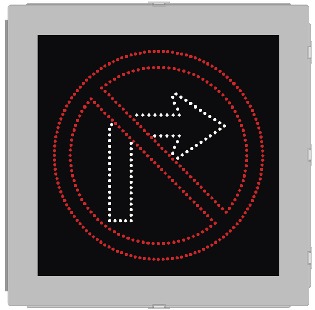 LED "Blank Out" Sign - Used by LA MTA (Metro) along its
light rail lines. See Set # 6 on the Metro Docs page.
FAQ # 27: Two frequent questions about right turns!
Question A: I got a ticket for a right turn, but there was no sign there
saying I couldn't turn right.
Question B: I went back to where I got my ticket and lots of cars weren't getting flashed when they rolled around the corner. Why me?
Answer A: At most intersections in California you're allowed to make a right turn at a red signal, but only if you come to a full stop first. There is no requirement for the city
to post signs at right turns saying "Stop Before Turning" or something like that. If the authorities want to prohibit right turns on red, they will put up a sign saying "No Right Turn on Red," or they will equip the signal to display a lighted red right-turn arrow.
See Sign Requirements (at the bottom of that page) for more details.
Answer B: To my knowledge, the red light camera makers have not devised a good way (reliable, cheap,
not too technical for a judge to understand) to measure a right-turning car's speed right at the limit line. Since the
camera computer doesn't know for sure if you made a full stop at the limit line, or were doing a couple mph as you crossed the line, the computer has to use other information in order to make its decision to flash you, or not. What most systems
do is measure your speed at a measuring point (usually a couple of rectangular "loops" in the pavement) about five feet before
the limit line, and use that speed to predict
whether it will be physically possible for you to stop in the short amount of road remaining.
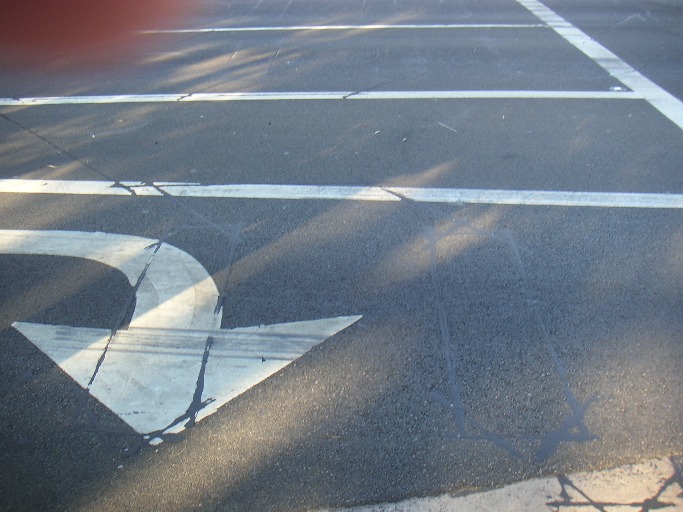
Rectangular "Loops" in Pavement in a Right Turn Lane
They know that if at the
measuring point you are going faster than
a certain "trigger speed" (my term) or "threshold speed" (their term) - set by them somewhere between 10 and 18 mph - you will have no choice but to roll the corner. Unless you have great brakes and wide, sticky tires. The
motorists who don't get flashed are the ones going slower than the trigger speed
at the previously mentioned measuring point. They may roll past the limit line and around the corner at a speed equal to yours, or greater, but if their approach to the area was
slow - below the trigger speed - they will not trigger the camera. Here's another depiction of the same idea:
Car
|
Speed 50 ft. before
intersection
|
Speed over measuring
loops
|
Speed at Limit Line
|
Flashed?
|
X
|
Doesn't matter
|
Trigger Speed or more
|
Doesn't matter
|
Yes
|
Y
|
Doesn't matter
|
Less than Trigger Speed
|
Doesn't matter
|
No
|
For one city's report discussing trigger speed, see the bottom
paragraph on page 2.6.3 of this report. Also, have a look at FAQs # 15, 22, 37 & 40.
FAQ # 28: Will I lose my "right to a speedy trial" if I
enter my not guilty plea by mail, phone, Internet, or at the clerks' window?
Answer: Yes! CVC
Section 40519, the statute which permits pleading by mail, says, "Any person using this procedure shall be deemed to
have waived the right to be tried within the statutory period." And in 2010, Section 40519 was amended to make things even clearer. They added: "A plea of not guilty under this section must be made in court at the arraignment." In
Fight Your Ticket, David Brown says, "In avoiding a separate court date for
arraignment, you give up your right to insist on a trial within 45 days afterward." So, my recommendation is that if
you want to be 100% sure
of retaining your right to speedy trial, you should enter your not guilty plea in front of a judge.
If you do a Trial by Declaration, you effectively give up your right to a speedy trial, including on any
Trial de Novo. See: People v. Benhoor.

Don't panic, it isn't true! See FAQ # 29.
FAQ # 29: If I fight my case, won't I lose the right to
attend traffic school?
Answer: Defendants who go to trial and lose can still ask for traffic school (either kind), although
the granting of it after trial is at the discretion of the judge.
If the phone attendants at the
courthouse or the central phone bank are telling callers that there is no traffic school after trial, call back, ask for the Senior
Court Manager, and complain.
If at the beginning of the trial session the bailiff in the courtroom is telling defendants that there is no traffic
school after trial, or discussing traffic school in any other way that you feel is arm-twisting or coercive, complain at
the bailiff's office in the courthouse. Bailiffs should not be doing the judge's dirty work!
If at the beginning of the trial session your judge announces to everyone that there is no traffic school after trial, or indicates that
while there is a chance of getting it, the chance is very, very small, do a Challenge. See the Editorial
below (in box) for details.
FAQ # 30: Tonight, as I was looking for a particular business, I drove a little
past the line on a red light camera intersection where the
light was red. I stopped before the back tires went over the line and backed up but the lights
all went off. I'm wondering
if I'll still get a ticket and if there's a way to fight it since I didn't
actually go through the intersection.
Answer: Technically it is a violation. Legally, it does not matter that you didn't intend to run the
light, as "specific intent" is not required. But if the pictures show that you stopped
and backed up, maybe the cop who decides which tickets get mailed out (and which ones don't) will give you a break.
If he does mail you a ticket, you could phone him and see if you can convince him to withdraw it. (Before you phone him, make sure
that it is not a Snitch Ticket - see the Your Ticket page.)
If talking to the cop doesn't work, you could plead not guilty, go to trial, and see if the judge will give you a break.
FAQ # 31: I wanted to try to request an extension and searched online, as well
as called the automated phone service - but I couldn't find my citation number. It didn't
pop up! I even searched thru
my driver's license, and an old ticket only came up.
Do you think that I am in the clear - that they have no record of my ticket? And that I don't have to pay for this?
Answer: I can think of two possibilities.
1. It could be a Snitch (Fake) Ticket, as described on my Your Ticket page.
2. The court could be backlogged, due to the influx of so many new (automated) tickets, and simply hasn't had a
chance to get it into their computer. At least one court (see the Bakersfield Documents page, Set # 4) has publicly
admitted being swamped. But the courts always seem to catch up, so I don't recommend ignoring the ticket - unless the violation
occurred in LA County, in which case you may have the option to ignore the ticket. (See Set # 2 on the LA County Docs page.)
You could try phoning one of the live operators, see if they can find your ticket. Or, though I haven't personally tried it, I
suppose you could mail them a request for the extension. Just be sure to
do it by certified mail, return receipt requested.
FAQ # 32: In the first picture (on the ticket) my front bumper is right at
the limit line. Because of the angle the picture is taken from, it's possible that my bumper may have been over
the limit line. So
why did they ticket me?
Answer: The cameras are set up to always take the first photo with the car close to the limit line, without regard to how long the
signal had been red. So, the photo you see could have been taken when the signal had been red for 0.1 second, or
even 4.0 seconds. You can't tell from the photo how late you were. Most cities indicate, somewhere on the ticket, your Late Time.
But a few choose not to, even though their system is capable of doing so and may have done so in the past. In
those cities, you won't be able to
tell how late you were unless you contact
the police (they sometimes insist that you come in to view the photos), OR file a discovery which would force them to
send the information to you.
See also FAQ # 8, and the big purple "How to Read Your Late Time" box in Defect # 7 on the
Home page.
FAQ # 33: They have a picture of my license plates - isn't that
enough to prove it was me, and
convict me?
Answer: No, not in California! In this state they have to have a picture of
your face. They have to convince the judge that YOU personally did the crime. Someone else could have been
driving your car. See Defect # 1 on the
Home page.
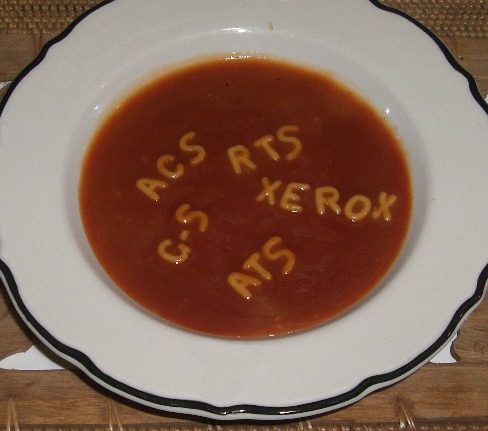
FAQ # 34: Who are all the camera companies? It
looks like alphabet soup!
"A promising industry betrayed by the behavior of its customers - that's the story of the
red-light camera business."
Holman W. Jenkins, Jr. in his Dec. 26, 2014 Wall Street Journal column
(archived copy), "Can the Red-Light Camera Be Saved?"
Answer: There's four of them active in California, and they are -
ATS
Of the four, ATS (American Traffic Solutions, atsol.com) has the second smallest "installed base" (number of cameras) here in California, but it has been very successful outside of California and may be the largest operation nationwide. ATS is headquartered in Arizona. In Sept. 2008 Warren Buffett, owner of many businesses including Geico (known to have donated radar guns to the police), See's Candies, Benjamin Moore Paints, Duracell, Ben Bridge Jewelers, Fruit of the Loom, Helzberg Diamonds, Berkshire Hathaway Home Services (real estate brokers), and Johns Manville, invested $5 billion
in Goldman-Sachs which, later that month, invested $58 million in ATS, for a 1/3 share. In Apr. 2017 ATS was acquired by Platinum Equity, LLC of Beverly Hills, California and became part of a new NASDAQ traded company, Verra Mobility.
The Sept. 2009 articles about
ATS' purchase of rival Nestor indicated that before purchasing Nestor, ATS had contracts with 170 communities in 17 states. Among the Nestor customers ATS inherited was the City of Santa Maria; in Nov. 2009 the City announced that ATS had - "...against the
City's wishes..." - terminated the contract, and
would be removing the cameras within 30 days. As of 2019 ATS had contracts with three California cities, Capitola, Covina, and Millbrae.
In May 2011 ATS was in the news twice, once because of its heavy-handed use of Astroturf lobbying, which led to the suspension of one of its vice presidents. Then, that same month it fired another VP and filed suit against him for (allegedly) "diverting opportunities away from ATS," while working for ATS. Article. In 2012 ATS was in the news again as the company was suspected of funding a lawsuit, fronted by a Murrieta resident, to force a grass roots anti-camera initiative off that City's Nov. 2012 ballot.
In 2014 we found out about (alleged) Prevailing Wage violations by ATS.
ATS has a lot of lawyers, and they are smart and aggressive. Any city council considering signing a contract with ATS should ask itself: "Do we feel lucky? Is our city attorney as smart as their attorneys? Does our police chief understand these contracts as well as ATS does? Will they sue us like they are suing those other cities?" For more reading about ATS and its lawyering, read this 2015 article (headline: "Palm Coast... Won't Scrap Program for Fear of ATS"), see the Murrieta and San Bernardino Documents pages here at highwayrobbery.net, and also Google ATS and Houston, Texas and Bellingham, Washington.
In June 2012 it was reported that thieves have been stealing components of ATS' camera systems.
In Aug. 2013 ATS failed to win the contract to run the 384 red light cameras in Chicago, Illinois. The City awarded the contract to Xerox/ACS (now Conduent Inc.).
RedFlex
RedFlex Traffic Systems, Inc. (Redflex.com) is an Australian company traded on the Australian stock
exchange as RDF.AX. RedFlex operates the majority of the camera systems in California, from offices in Culver City and Phoenix.
As of late 2014 the company was losing money and considering getting out of the photo enforcement business.
"The company, once an industry leader in automated camera enforcement, has all but abandoned its red light camera business in the U.S. and dismissed much of its workforce."
From Aug. 30, 2016 article
( archived copy ) in the Los Angeles Times.
The Bribery
The public first heard of bribery by RedFlex when in Oct. 2012 the Chicago Tribune revealed that RedFlex had paid the $910 hotel bill of a City of Chicago official. But the corruption was not limited to Chicago. On page 22 of the financial report it issued in Mar. 2013, RedFlex warned:
"Further, the current investigations may identify other instances of similar dealings with the City of Chicago and/or other jurisdictions."
Then, in an Oct. 2013 formal response to a suit the company filed against him (see link below), a former RedFlex vice president alleged that bribery occurred in at least thirteen states, which he named, and "dozens of municipalities," which he did not name.
Details about Chicago
Chicago reacted to the revelation of the hotel bill bribe by disqualifying RedFlex from bidding to install and operate a proposed speed camera system.
Then, in Feb. 2013, a new investigation revealed that the illegal payments were as much as $2 million. RedFlex fired the vice president associated with the illegal payments, and later sued him. The City disqualified RedFlex from bidding to renew its existing contract running Chicago's 384 red light cameras - and in Aug. 2013 the City awarded the contract to Xerox/ACS (now Conduent Inc.). The disqualifications caused RedFlex stock to lose over half of its value and its Market Cap to drop as low as $88 million, less than 1/3 of the $304 million purchase offer by the Carlyle and Macquarie Groups that RedFlex shareholders rejected in 2011.
In early 2013 Karen Finley, who had been president of RedFlex' US operation since 2005, resigned along with four other top officers of the company: The general counsel and the CFO, both in Arizona, and the chairman of the board and a director, both in Melbourne.
In May 2014 federal prosecutors filed bribery charges against John Bills, a City of Chicago employee who had managed Chicago's red light camera program, and in Aug. 2014 they filed charges against former RedFlex president Finley as well as Martin O'Malley, a longtime friend of Bills who RedFlex hired to serve as the conduit, or bagman, for the bribe money flowing from RedFlex to Bills. All three initially entered pleas of not guilty, but O'Malley and Finley soon changed their pleas to guilty. In 2016, O'Malley, age 75, was sentenced to six months in jail and to pay a $98,837 fine, and Bills - who may also lose his $110,000/year City pension - was tried, found guilty, and sentenced to ten years in prison and to re-pay $2.03 million. In Oct. 2016 Finley, who testified against Bills and others in exchange for a five-year cap on her prison time, was sentenced to fourteen months for her crimes in Ohio (see Bribery in Ohio, below). Before that sentencing, Finley sent the Ohio judge a plea for leniency in which she called RedFlex "a toxic and soul su--ing place to work." Three weeks later a Chicago judge sentenced her to 30 months for her crimes in Chicago, to be served concurrently with her 14-month sentence.
In August 2015 the City of Chicago sued RedFlex for fraud. In their suit the City asked for approx. $300 million, about eight times the company's Market Cap ($40 million as of Oct. 2016). In its financial statements for the year ended June 30, 2016, the company wrote:
"At this point in time it is not possible to reliably estimate the timing for completion of the US Department of Justice investigations nor the Chicago legal actions and any quantum or recoveries in relation to these matters, while potentially significant, is not capable of being measured." "If the matters noted above resulted in negative judgements and damages, or loss of revenue, in amounts (individually or in aggregate) that could not be funded by the company based on the level of financial resources available to it at such time, there is significant uncertainty as to whether the group could continue as a going concern." (From Note 21.)
In Dec. 2016 federal prosecutors announced that RedFlex had signed a non-prosecution agreement, closing the corruption case in Chicago (and Columbus, Ohio, too). In Feb. 2017 RedFlex settled Chicago's fraud suit for $20 million, to be paid over a number of years.
Bribery in Ohio
"It appears that it's about shady money, it's about dirty money, it's about bribery money, it's about public officials taking money in return for doing favors for red light camera companies so that their own taxpayers and citizens can be fleeced."
June 2015 comment by Ohio State Senator Bill Seitz, sponsor of an Ohio law requiring a police officer to be present at every intersection where a red light camera is operating.
Article (archived copy)
Ohio was not one of the thirteen states named by the former RedFlex VP, but in June 2015 federal prosecutors revealed that former RedFlex president Finley had entered into a plea agreement and had pled guilty to bribery in Columbus, Ohio. John Raphael, the Ohio lobbyist to whom RedFlex sent the money, pled guilty and in June 2016 was sentenced to fifteen months in jail. (It must be noted that Raphael only admitted guilt to extorting money from RedFlex - the government never attempted to prove that the money Raphael gave to local politicians on behalf of RedFlex was a bribe.)
In Late 2016 RedFlex agreed to pay $100,000 restitution to the City of Columbus, and federal prosecutors announced that RedFlex had signed a non-prosecution agreement, closing the corruption case in Columbus (and Chicago, too).
More About RedFlex
In 2014 we found out about (alleged) Prevailing Wage violations by RedFlex, in twelve California cities.
In late 2014 we saw this, in a Dec. 26 Wall Street Journal interview
(archived copy) of James Saunders, who at that time was president of RedFlex: "Mr. Saunders suggests jurisdictions refrain from issuing a [rolling right] ticket except when a pedestrian is in
the crosswalk." The headline was, "Can the Red-Light Camera Be Saved? - Money-hungry
politicians discredit a hopeful safety innovation.” (A Jan. 22, 2015 column (archived copy) in the Dallas Morning News confirmed the statement The Journal had attributed to Saunders:
"When I asked Redflex spokeswoman Jody Ryan about her boss’ comments urging cities to lighten up on rolling reds, she answered, “It only makes sense that Jim is going to say, ‘Look, we need people to be thoughtful about how they are implementing these programs and how they are issuing citations.’ It wasn’t that shocking.”)
There is a website FireRedflex.com exclusively about RedFlex and its misdeeds.

Illustration by CameraFraud.wordpress.com
ACS/Xerox/Conduent
In 2001 ACS (Affiliated Computer Services, then listed on the NYSE as ACS) purchased
the red light camera systems then operated by Lockheed. In early 2010 Xerox bought ACS for
$6.4 billion. Then in 2016 Xerox spun off its computer services division (including red light cameras) and formed Conduent Incorporated. (As of May 19, 2017 the market cap of Conduent was $3.5 billion - roughly half of what Xerox paid for ACS in 2010. In early 2018 it was reported that Xerox - minus the red light cameras, of course - is being acquired by Fujifilm.) The red light camera section of
the new Conduent website is at https://www.conduent.com/solution/transportation-solutions/road-safety/ .
On this website we will continue to refer to the Conduent/Xerox/ACS/Lockheed camera operations as Xerox/ACS, or just ACS. ACS is also discussed in Defect # 5 on the Home page. In California, ACS has long-time (and large) contracts with the Los Angeles MTA/Metro (100+ cameras adjacent to busways and light rail lines) and the City of San Francisco. In Oct. 2014 ACS took the Beverly Hills contract away from rival RedFlex. Until 2015 the company ran the cameras in West Hollywood, but lost that contract to Gatso.
In Aug. 2013 ACS won the contract to run the 384 red light cameras in Chicago, Illinois, after that City kicked RedFlex out.
After the County of Los Angeles shut down their cameras (in 2012) it took ACS three years to remove their poles and boxes. In 2014 County staff sent highwayrobbery.net the following email:
"Unfortunately, it has taken us quite a long time to convince Xerox to remove their equipment. But after continually resisting, they finally agreed to remove their equipment once we sent them a letter indicating that we would bill them for the cost of removing their equipment."
In June 2015 the Baltimore, Maryland city council released a report (backup copy) which blasted Xerox/ACS' performance in that city.
Gatso
Gatso invented the red light camera more than fifty years ago, but it wasn't until 2015 that the company won a contract in California - West Hollywood.
Nestor and Transol
Nestor Traffic Systems (nestor.com), of Providence, RI, was taken over by a court-appointed receiver in June 2009, and then in Sept. 2009 was
purchased by ATS, for $7.1 million cash. The articles about the sale said that at the time
of the sale, Nestor had contracts with about 25 municipalities in nine states. The Providence Journal reported that
the other bidders for Nestor were the Nestor management team, called B2H3, and RedSpeed USA (not related to RedFlex).
TranSol (Transportation Solutions) was acquired by Nestor in Aug. 2005.
Regional Draw: The Overstock.com Coliseum, in Oakland. Until 2014 Two Cameras were Nearby at 66th & San Leandro
Info Overload: Reseda Blvd. crossing Oxnard Street, the Orange Line
Busway, a bike path, and Topham Street - all in 200 feet - site of a camera operated
by the LA County Metro/MTA
(The Orange Line has many similarly crowded crossings.)
FAQ # 35: What are the most common camera locations?
Answer: Most camera tickets go to visitors to town (see Geographic Profiling, in FAQ # 22). Be on guard when visiting regional draws such as CostCo's, other big box stores, auto malls (don't buy a
car in a camera town!), colleges and universities, stadiums, airports, convention centers, large medical centers,
museums and historical sites, amusement parks, and race
tracks (see the Inglewood section). The cameras will be concentrated on the route from the freeway to the draw, and back - sometimes right at the foot of the freeway ramp.
Cameras often will be on right turns and left turns, as there aren't enough "straight through" violations to make cameras pay. An increasingly popular location for enforcement is the turns to get on or off the freeway.
Cameras are more likely at unusual, complicated, or confusing intersections - where there is what engineers call "high information
load" - your attention is divided
between looking at the signal and figuring out the intersection. Examples would be where the roads come together in a "T" or a "Y," or on
a curve in the road, or where a freeway offramp is merging onto the road,
or where there's several signals in a row, close together. There often will be a lot of pavement markings and official
signs adding to the distraction.
FAQ # 36: Will the officer who signed
my ticket be the one who appears at my trial?
Answer: Not necessarily. It may not need to be the same officer. In fact, it might not need to be a sworn officer - it can be a clerk! (And in some cities, it may have been a clerk, not a sworn officer, who issued the ticket in the first place!)
From a 2001 ruling in the famous case that shut down San Diego's first red light camera system:
"Penal Code Section 960
provides that "no accusatory pleading is insufficient, nor can the trial, judgment, or other
proceedings thereon be affected by reason of a defect or imperfection in matter of form which does not prejudice a
substantial right of the defendant upon the merits." This section saves the defects relating to Penal Code section
959.1. The information presented at trial remains the same whether the accusatory pleading is sworn or not. The
defendant has the opportunity at trial to respond to the evidence, and the police officer who testifies may not be
the same police officer who reviewed the citation. In effect, the police officer who testifies at trial is testifying
as an expert witness and interprets the factual data which is evidenced by the photographs and the digital information
imposed on the photograph. Therefore, there is no prejudice to a substantial right of the defendants on the merits and
any defect and failure to comply with Penal Code section 959.1 does not justify dismissal."
From Section III(C) of the Aug. 15, 2001 ruling in People vs. John Allen.
The P. v. John Allen ruling is far from the last word, though. Recently, in 2009 and 2011, we have seen US Supreme Court decisions arguing that it is a violation of one's right to confront your accusers when the people who make the evidence against you aren't actually in court to be cross examined. See Defect # 10 - D.
In a few cities, the tickets are issued and signed by a clerk, although it will usually be a sworn officer who comes to court for trial.
CVC 40518 allows a ticket to be issued by "a peace officer or by a qualified employee." The practice of using clerical staff to approve tickets is controversial, even in the Industry, and until an amendment was to be outlawed by a 2010 bill in the State Senate. (The 2012 "reform" bill, SB 1303, did not outlaw the use of clerical staff. See the 2012 Legislation section on the Action/Legis page.)
In one city, some tickets were signed by an officer who was not even alive at the time! In early 2011 WBAL-TV in Baltimore revealed that 2000 tickets had been signed by an officer who had died in a car accident some months before.
FAQ # 37: I was making a right turn, and the second photo, where I am in the tightest
part of the turn, shows the same speed as I was in the first photo, when I was approaching the turn. How can that be?
Answer: RedFlex prints a speed figure on both photos, but the speed printed on the second photo is just a duplicate of the speed
reading made by the pavement loops your car passed
over at the place where the first photo was taken. For some reason they have not programmed their equipment to leave the old speed reading
off the second photo.
Also see FAQs # 15, 27 & 40.

FAQ # 38: Can cameras catch uninsured drivers? I have seen some articles (originating in Chicago) suggesting that. What do you think?
Answer: The red light robots obviously have the ability to take pictures of license plates, but no ability (yet!) to climb down from their poles and capture the suspect before he leaves the area! To catch uninsureds, most cities are using automated number plate recognition equipment installed in a patrol car. That way, when the "ANPR" system identifies an uninsured/unregistered/stolen car, the police in the car can pull the car over - or if it is parked, have it towed. A stationary camera can't do that - it only mails out a letter asking the car owner to come to court - and an uninsured (or a car thief) simply won't show up!
Also see FAQ # 42.
FAQ # 39: I'm from out-of-state. Will this ticket show up on my license?
Answer: Probably, unless you live in Georgia, Massachusetts, Michigan, Tennessee or Wisconsin. Here is an
page about "reciprocal agreements" (or "interstate compacts") for the exchange of info between states.
Plus, the collection agency used by the court will send threatening letters to your home.
FAQ # 40: I got three tickets in one week! What do I do?
Answer: At least once a week I hear from someone who changed their commute route to a street having a camera, and committed multiple rolling right violations by the time the first ticket arrived in the mail.
Some judges will bargain multiple rolling rights down to just one fine, and many of our legislators have signaled the courts that they want a reduction in the penalty for rolling rights - see SB 986 in the 2016 Legislation section on the Action/Legis page.
To maximize the number of opportunities to get your tickets reduced down to just one, I suggest that before going to court, you should start by talking to the PD - escalating it all the way up to the chief if need be. (Also see FAQ # 41, below.) If that does not work, try a councilmember, or go and speak at a council meeting. Then if that does not work, that would be the time to go to an arraignment and bargain with the judge there, as described above. And if that does not work, go to a trial session and bargain there. Also see the Alternatives box, in the Handling Your Ticket section of the Your Ticket page.
Also see FAQs # 4, 15, 27 & 37.
FAQ # 41: I asked the police to dismiss my ticket, like you told me to. When I phoned them, they told me they cannot dismiss tickets!
Answer: The cop was untruthful about his inability to dismiss. If he has the ability to bring the charges, he has the ability to get them withdrawn. They do it all the time. Yes, technically the cop is not the prosecutor, his role in the matter is just as a witness and as such he should have no authority to dismiss the ticket. But in most traffic courts, the city prosecutor or DA is not present and the cop functions as both the witness and the prosecutor. So, he has the ability to ask the court to dismiss, "1385," and they do it, regularly.
Penal Code 1385:
(a) The judge or magistrate may, either of his or her own
motion or upon the application of the prosecuting attorney,
and in
furtherance of justice, order an action to be dismissed.
See also FAQ # 40, above.
FAQ # 42: What about collision avoidance systems, like Marysville installed in late 2011?
Answer: Collision avoidance systems aren't anything new. They've just never caught on, probably because most potential customers identify them as a sales gimmick.
Collision avoidance equipment may possibly protect you from drivers running the light a fraction of a second late (who are little threat anyway), but only at intersections equipped with it. Further, it can do nothing about the impaired or distracted drivers running the red multiple seconds late - and those are the ones who will hurt you.
Don't drop your guard when you're driving in Marysville. Continue to drive, and walk, defensively.
Other cities with Halo systems are Commerce and Ventura.
Also see FAQ # 38, the Marysville Documents page, and Baloney from RedFlex, on the Industry PR page.
FAQ # 43: I'm having trouble copying and saving the photos from
the camera company's website.
Answer: Near the right end of the upper row of keys on your keyboard (assuming you have a PC, not a Mac) there is a key that says "Print Screen." Pressing that key saves an image of your entire screen, into your paste buffer (temporary memory). So all you have to do is go to the ticket company's website, get the photos on your screen (blown up as much as you wish), hit Print Screen, then open up your Paint or Photoshop program and paste (Control-V) the screen image as a new image in your Paint/Photoshop program. There is a more detailed explanation in the box on this page.
FAQ # 44: The cops claim that the camera can't flash you if the light is green. Is that true?
Answer: No. We obtained a copy of an email in which the camera company admitted, "On occasion our system does pickup incorrect triggering on green."
Links/Ref/FAQ Page:
-
5 -
Letters / Editorials / News / Class Actions
A Note from a Local
Citizen
Email received Mar. 18, 2003:
Great website! I have lived in Culver City for seven years
and it's a
mini police state. The density of photo-lights must be around ten times
surrounding communities. Every major route into the city has one or
more
photo lights; why don't they just put up tollgates?
I think our traffic law enforcement by live officers is also 10x more
intense than in Los Angeles. Citizen preferences for less or more law
enforcement never come up in elections here, implicitly or explicitly,
so basically not even the local electorate gets to choose our level of
law enforcement, and clearly visitors from other municipalities face
taxation without representation.
I got one [Culver City] photo ticket that showed me 0.1 second into the
red, but when you really looked at the traffic light in the photo, the
yellow was still on. I went to trial but the ticket was dismissed at
the
beginning of the session so I never got to argue my case. I suspect
that
questionable tickets are mailed out in hopes that the recipient won't
recognize the deficiencies and will simply pay up. But surprisingly I
triggered the camera at [a Culver City intersection] without ever
receiving a ticket. In that instance traffic was fast and heavy and the
light went yellow at the worst possible moment for me. I didn't dare
stop behind the intersection for fear of being rear ended, so I ended
up
a considerable ways into the intersection. Without the camera I would
have proceeded and cleared the intersection, but in this case I did not
proceed in order to make it clear that I had never intended to run the
light. The fact that the car behind me ended up straddling the
crosswalk
may have been persuasive to the person reviewing evidence, but that was
pure luck. I had no way of knowing that the car behind me would
actually
have trouble stopping, just a hunch that he might.
I suspect automated traffic lights are only one symptom of more
fundamental problems with Vehicle Code enforcement which are probably
rooted in its potential to subsidize careers and generate
revenue.
I think your suggestion that people avoid shopping in Culver City is
right on target. It's only sensible to stay away from a town that
basically balances its budget on the backs of unfortunate motorists,
and
there's an excellent chance things will change when the business
establishment gets hit in the pocketbook.
[ ] = Edit to
protect identity of correspondent.
Added
10-3-03, updated 8-9-09, 7-24-11, 1-6-14:
Editorial
by
highwayrobbery.net
Denial of Traffic School:
Is the Public Being Served?
On Jul. 1, 2011 a new law went into effect making "Second Offender"
12-hour traffic school unavailable for offenses occurring that date or later.
Even when "2TS" was freely available, one local judge almost never granted permission to
attend it. And
during a trial session he said, just after granting "regular" 8-hour traffic school to a
defendant who requested it immediately after the conclusion of the officer's
testimony: "Pretty soon we're gonna stop doing this." Evidently,
he would like to make even regular traffic school harder to get.
Another
court formerly sent out a notice* containing the following statement.
(Don't panic, it isn't true!)*
In 1976 the appellate court* told traffic judges that their "discretion to grant or deny a request for traffic violator school
[does] not encompass a blanket refusal... to all defendants...." So now, instead of telling defendants
who have come in for a trial that their chances of being granted
traffic school after the trial are zero, or that school is "not an option," some judges tell defendants that their chances
are very, very low. Some mean it, some don't!
When the court
denies traffic school to defendants, is the public being served?
One
argument goes that denial of traffic school reduces court
congestion: Knowing that they might lose
their chance to go to traffic school, fewer defendants will take their
ticket all the way to a trial. But the reality is that the court is not even
close to being congested; in the court in which I have observed the most, the
entire trial session typically lasts just over an
hour. Most courts freely allow traffic school, and still get their work done.
An enlightened policy was expressed by one judge pro tem, who
said: "It
(traffic school) won't be denied just because you asked for a trial -
that would
be discouraging your right to a trial."
There's also concern that bad drivers repeatedly attend traffic school
just to
keep points off their record. Supposedly, the public will benefit
from the court's denying traffic school to those defendants in that the
eventual accumulation of points will
cost those bad drivers their license and get them off the road. Actually,
license suspension is rare in California, one driver out of 500. And many of those
suspended continue to drive, only now without insurance. Refusing
to grant traffic school is particularly inappropriate with red light
camera defendants. Some of them have a
point on their record, but many are older yet have never before had a
ticket; thus, as a group they are very unlikely to progress to
license suspension.
One judge denies
traffic school to many defendants
because, he says, they "won't learn
anything from
it." How does he know they won't learn anything? The
writer of this editorial believes himself to have an above-average
understanding of driving and the laws, yet he has
learned something each time he has been to traffic school. But
even supposing that a particular traffic school attendee
has a closed mind and learns
nothing else, he will certainly learn that if he runs a signal he
will have to spend 8 hours in school. For
a wealthy driver, the
loss of those hours of freedom may be the only meaningful punishment he
receives.
Just one point on one's
record can cause cancellation of
insurance, or a jump in rates. To remain
insured, a driver has to pay more. For the
non-wealthy majority, that extra
insurance expense can take away from the funds available for
maintenance of the brakes, tires or
engine, exposing everyone to increased air pollution and threat of
accidents. And if the cost of insurance goes up so much that the
driver can't afford it at all, one more uninsured driver is
added to the streets.
To best serve the
public, and the economy, judges should freely grant permission to
attend traffic school.
For Judges...
"Let us remember that justice must be observed even to the lowest."
Cicero, Roman lawyer, politician, philosopher, 106 - 43 BC
"One way to measure the health of a society is to examine the quality of its
justice -- to look at how it exercises its power over the least of its citizens."
Judge Tom Ross,
Rehnquist Award Acceptance
Speech, Sept. 13, 2000
*If you got a court notice saying "Traffic school is not an option after trial" or were
told "No school after trial" by one of the phone attendants at the court or if the bailiff or the judge announced it to
everyone in the courtroom, see Challenges and the Long Beach Docs page.
For the official rules about traffic school, see Traffic
School Law.
|
Class Action Suit in California
See this page.
Links/Ref/FAQ Page:
- 6 -
Info About Cameras in Other States
(Including Materials about California, Arizona, Delaware, Louisiana, Maryland, Minnesota, Missouri, Ohio, Pennsylvania, Texas, Washington DC, Washington State, Canada )
Updated 5-21-11
Arizona Info

CameraFraud.wordpress.com is the most active anti-photo radar group in Arizona.
More info about Arizona camera tickets can be found in the Speeding Ticket section on this
page (below) and in the Mesa section on the Camera Towns page (includes info about a Sept. 2008 lawsuit against the speed ticketing).
A special note about Arizona: Stay out of Arizona! Apparently the BIG money tourists spend at hotels, restaurants,
shops, conventions, golf courses and gas stations is not enough to satisfy the State of Arizona. On Feb. 20, 2009 the AAA auto club's national office designated Arizona as a "strict enforcement area" - the first time that the club has awarded that title to
an entire state. The warning will be provided to motorists getting maps or route advice from AAA for
travel to or through Arizona.
Louisiana Info

Minnesota Info
In Dec. 2005 the Minnesota ACLU filed suit about the Minneapolis red light camera system. In April 2007 the Minnesota Supreme Court
found that the City's system was illegal. There remains the question of refunds for motorists who paid the fines.
See
this article.
Ohio Info
In 2008, Cincinnati residents gathered signatures on a referendum to stop the cameras. See
their website.
Texas Info
Some Texas cities are using an imaginary limit line for their photo enforcement, with the result that many innocent motorists are
getting tickets.
Read about it in this
article: Texas Offenses Require Imagination.
NoCamerasHouston.com is the anti-camera website in Houston.
SaferBaytown.com/ is the anti-camera website in Baytown.
Port Lavaca Citizens Against Red Light Cameras is the anti-camera FaceBook page for Port Lavaca.
Washington State Info
BanCams.com is an anti-photo enforcement group in Washington State. Their website includes, among other things, copies of the contracts between the cities and the camera companies.
Maryland
Baltimore Council Blasts Xerox/ACS's Performance
In June 2015 the Baltimore, Maryland city council released a report (backup copy) which blasted Xerox/ACS' performance in that city.
Judge's Critique of Red Light Cameras
Judge Mathews' report should be mandatory reading for
judges, mayors and police chiefs nationwide.
Here are excerpts from two articles about Judge Mathews and
his report.
|
Judge
Asks Baltimore
to Rethink Cameras
By
Jon Ward
THE
WASHINGTON TIMES
January 30, 2003
Baltimore's
top District Court judge says he is suspicious over whether the city is
using red light cameras merely to make the roads safer.
"Sometimes city officials are more
focused on revenue than they are on safety," District Court
Administrative Judge Keith E. Mathews said in an interview with The
Washington Times.
Judge Mathews supervises the court that
hears all traffic ticket cases in Baltimore. He said he wrote an
11-page report
questioning the
city's red-light camera ticketing system because he was receiving too
many complaints from motorists that the system was unfair and wrongly
motivated. His comments, first reported by the Baltimore Sun, were
circulated among the mayor's staff and the city Department of Transportation.
[Balance of 1008-word
article is
available on washingtontimes.com]
|
|
Baltimore Motorists
Caught by Red Light Cameras
Baltimore City to
Add 60 Additional Cameras
A May 2003 Report by WBAL-TV11
Baltimore City has red light cameras at 47 intersections -- that's more
than any other jurisdiction in Maryland. WBAL-TV 11 NEWS I-Team
reporter Mindy Basara reported that some motorists are questioning
whether the cameras are used to prevent accidents, or whether they're
for profit.
And red light cameras irritate Baltimore City traffic court Judge Keith
Mathews, too.
Mathews said he has a problem with what's called the grace period -- the time
from which the light turns red to when the camera fires. The grace
period in Baltimore City is one-tenth of a second. So quick, Matthews
said, it's catching people who don't intentionally run the light,
Basara reported.
"Other jurisdictions -- New York City [and] San Francisco --
have grace periods on the average of three-tenths of a second," Mathews
said.
|
In 2008 a new anti-camera
website was launched in Maryland.
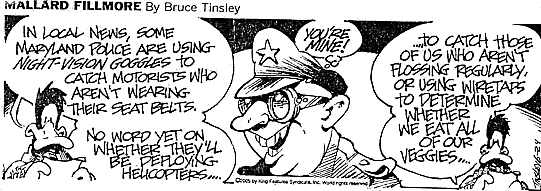
Shop Mallard Fillmore at cafepress.com/mallard
More News from Maryland
According
to this article, at an intersection where a 50-mph expressway ends, Baltimore has a camera
with just a 3-second yellow. It will be interesting to find out
how many tickets that camera has been generating.
This article found by a reader of this website.
This is an excerpt. The
full article can be purchased at:
http://www.sunspot.net/search/bal-archive-1990.htmlstory.
|
City's
red-light citation has couple
seeing double
Pa. visitors sent 2 tickets from same photograph
By Stephen Kiehl
[Baltimore] Sun Staff
Originally published August 6, 2003
[Excerpt]
"Robert and Barbara Lippmann couldn't quite
believe
it when they got a ticket in the mail for running a red light in
Baltimore. They didn't remember running any red light when they were in
town for an Orioles-Phillies game in June.
"But when the Pennsylvania couple got another ticket in the mail for
running the same red light on the same day - six minutes later - they
knew something had gone terribly wrong: The photos on the two citations
were the same.
"Baltimore's red-light camera program is run by a private vendor,
Affiliated Computer Services [ACS, now Conduent Inc.], which also runs cameras in
Anne
Arundel, Montgomery and Prince George's counties.
"If the
Lippmanns did run the light - albeit only once - they may have been
tripped up by the short yellow time at President and Fayette streets.
Drivers of vehicles coming down the Jones Falls Expressway onto
President Street are given three seconds of yellow, according to the
city.
"Federal standards suggest that roads with a 50-mph speed limit - the
limit on the JFX - provide five seconds of yellow time."
|
Bethesda's
Million Dollar Camera
On June 12, 2003,
CBS Evening News aired a report about a Bethesda Maryland camera that earned $1 million
in 14 months because it had a 3.0 second yellow while all other
(non-camera) signals on the same street were set at 4.0.
http://www.cbsnews.com/stories/2003/06/12/eveningnews/main558431.shtml
News about the Washington
DC System
 Charles H. Ramsey, DC Police Chief (1998 - 2006), Camera,
US Capitol
Charles H. Ramsey, DC Police Chief (1998 - 2006), Camera,
US Capitol
The following decade-old press release is here because the DC city council was the first government body to admit
that the cameras were for revenue, not necessarily safety.
AAA News Release
10/2/02
THE
DC BUDGET DESTROYS ANY AUTOMATED
ENFORCEMENT CREDIBILITY
Statement by Lon
Anderson
Director,
Public and Government Relations
AAA
Mid-Atlantic
It is outrageous that the DC government has approved a budget
expanding the use of automated traffic enforcement—speed and red light
cameras—for the sake of helping close its budget deficit.
AAA Mid-Atlantic supports traffic enforcement and the use of
automated equipment when it is done for safety purposes and
with appropriate policies in place to protect the rights of motorists. But
when both the Mayor and Council advance automated enforcement for the
purposes of revenue raising, they reduce DC to the level of the
southern speed trap towns that are avoided by travelers and lampooned by comics.
Welcome to the Dukes of Hazzard, DC version!
Automated traffic safety enforcement already has serious
credibility issues nationally, but especially in DC where it has been
egregiously abused—remember the 20,000 red light camera tickets issued
from one camera in the middle of a block with a blinking yellow signal?
Police Chief Charles Ramsey has continued to insist that DC's
automated enforcement systems are for safety, but now his bosses, the
Council and Mayor, have spoken and have contradicted their Chief. They
have admitted that these systems are being expanded for revenue
raising. While safety was undoubtedly the Chief's intention, that clearly has
been overridden by his superiors who want this program for its money
making.
This is a sad day for the Chief, for city law enforcement,
for the city government's credibility, but most especially for
motorists, who now will have every good reason when they get a ticket
to wonder if they were just the victims of the latest iteration of a new
commuter tax. |
Political
Persua$ion in Pennsylvania
Here are three of the Philadelphia Daily News
pieces about ACS, its campaign contributions, and the competition to operate red light cameras in
Philly and the State of Pennsylvania.
Part
1. An excerpt is below. Balance of Part 1 available
for purchase at:
http://www.philly.com/mld/dailynews/news/local/6208078.htm
Posted on [phillynews.com on] Tue, Jul. 01, 2003
THE BIG PICTURE BEHIND RED-LIGHT CAMERAS
By DON RUSSELL
"AN OBSCURE legislative provision engineered by House Speaker John
Perzel gives one of his campaign contributors a leg up on running the
city's lucrative red-light traffic camera system." |
Part 2 includes a chart showing
who ACS' contributions went to.
Part 2 also discusses The National Campaign to
Stop Red Light Running, which has positioned itself as an
influential, "independent" authority on red light cameras but is
actually industry-funded. Available for purchase at:
http://www.philly.com/mld/dailynews/6208079.htm
Part 3 of the Daily News'
series was this editorial:
Philadelphia Daily News
July 7,
2003
Section: EDITORIAL
OPINION
Page: 13
CAMERA
OBSCURA
RED-LIGHT
CAMERA BILL NEEDS TO CHANGE TO CLEAR WAY FOR BIDDING
PHILADELPHIA'S
RED-LIGHT camera program may be on its way to becoming America's
funniest home video. Except technically, it won't be on video, but on
35mm film. And it's not so funny.
As detailed in a Don Russell story in last week's Daily News, the
Harrisburg legislation that will enable Philadelphia to introduce a
red-light camera program included a provision stipulating outdated
technology. The bill requires the use of the kind of camera only a few
companies still use, including ACS, a company that now has contracts
with the Parking Authority and which has been a campaign contributor to
bill author Rep. John Perzel, as well as to Gov. Rendell and Mayor
Street.
Most of
the 70 communities that have installed cameras at intersections to nab
red-light runners use digital cameras, considered to be more
technically advanced than 35 mm, or "wet film." Both have advantages:
wet film has better resolution; digital cameras are initially more
expensive to install, but in the longer run, they require much lower
labor costs. Most vendors have switched to digital; ACS actually offers
both.
But did Perzel carefully review these pluses and minuses before
inserting the line in the bill requiring only wet-film cameras? No.
Did he have some specialized technical expertise that led him to make
that choice? No. His office admits that he has no knowledge of the
technology.
So do we believe him when he says that the ACS ties and campaign
contributions had nothing to do with the bill's language?
Uh . . . No.
Following Harrisburg's lead, City Councilman Frank Rizzo also included
the 35mm stipulation in his Philadelphia bill for the city's red-light
program, but is now scrambling to amend the stipulation and just sent
letters to Harrisburg lawmakers informing them. Except amending the
city's bill won't do any good unless Harrisburg amends its original
enabling legislation.
It should go without saying that competitive bidding helps keep
everyone honest. But by narrowly restricting the field of companies,
Perzel has restricted the possibility of getting the best deal for
those public funds he's spending (although no one has any idea how much
this pilot program will cost, which makes such controls more
important.)
A spokesman in Perzel's office suggested that it stipulated wet film
because it was familiar and satisfied with ACS's work for the Parking
Authority, and, oh, another thing: the digital companies weren't
considered because they weren't out there "telling their story." This
is not only depressing - especially if you translate "telling their
story" into "hiring expensive lobbyists" like ACS did - but insulting,
given that its the bill's language that shuts out those companies from
telling their stories, which might be far more compelling than ACS's.
Then again, they might not. But we may never know.
We should know, and we could, if Perzel amended his bill. Which we hope
he does immediately so that pros and cons of both kinds of cameras, and
vendors, can be fully investigated.
This page has supported red-light cameras but with some reluctance. Our
concerns are only getting bigger. For example, we believe the red-light
program belongs under police jurisdiction, not the Parking Authority.
And that the flow of money, which is now Byzantine, should be
streamlined so it goes from the Parking Authority to the city without a
stop in Harrisburg.
We don't like what happens when money gets too close to that town. Talk
about a speed trap.
Copyright (c) 2003 Philadelphia
Daily News
|
The Matt Labash
Investigation, from The Weekly Standard
A very readable, and pretty
comprehensive, critique of red light camera systems. Labash starts
with a discussion of the cameras near his base of operations - Washington DC - but don't be put
off. He ends up covering a wide geographic scope.
http://www.weeklystandard.com/Content/Public/Articles/000/000/001/078ftoqz.asp
Sometimes the Press is Really, Really Sharp...
This illustration, by Sandra Hoover, accompanied an even more
critical article published Nov. 25, 2004 by the Sacramento News and
Review. The article was worthy of a major daily paper, but didn't get re-printed by any of them.
...and Sometimes It Isn't
This illustration is the only critical part of an otherwise useless Jan. 6, 2005 New York Times article, written by their LA-based
columnist who described paying her West Hollywood ticket and obtaining traffic school. The fifth-grade level of the cartoon, and
the superficial article, reminded me of Mad Magazine.
Links/Ref/FAQ Page:
- 7 -
Humor (Sort of...)
 Dwayne "The Rock" Johnson: "I one time ran a
red light, and the traffic cam footage alone made a billion
Dollars."
Dwayne "The Rock" Johnson: "I one time ran a
red light, and the traffic cam footage alone made a billion
Dollars."
On
Saturday Night Live, May 20, 2017
A policeman's Christmas tree.
On May 28,
2004 I sent the DMV director a question. Ninety-three
days later (they kept misplacing the letter, so I had to
send it three more times) they sent this reply, signed by the
Department's chief counsel. They didn't answer the question, but
included this novel paragraph.
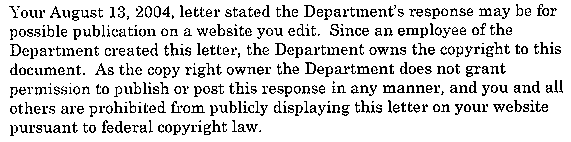
(The excerpt above is published under the "fair use -
commentary" exception to the copyright law. The rest of the letter is in the Fake/Snitch Ticket
section on the Your Ticket page.)
"A Monterey resident received a notice in the mail of a
speed-radar camera* violation from the City of Campbell, near San Jose.
The man
responded by mailing back a picture
of the cash equivalent of the demanded fine. Campbell's police
department promptly dispatched a picture of handcuffs, and the
subdued scofflaw mailed in a check."
From "Photo Cop" by Tom Lankard, in May/June 1999 "Westways"
(Auto Club of So. Cal.)
*Note:
Speed cameras tickets (also known as photo radar tickets) have never been legal in California. But in 2010 there was another (failed) attempt to
legalize them - see the Legislation section on the Action page.
Campbell doesn't have speed cameras anymore, nor does the City of San Jose, which shut theirs
down in March 2007, but in March 2007 a Los Angeles-area parks agency signed a contract to install them in
some of the parks they manage - despite Vehicle Code Sec. 21455.6(c) which presently says: "The authorization in
Section 21455.5 to use automated enforcement systems does not authorize the use of photo radar for speed
enforcement purposes by any jurisdiction." For more info about those LA-area speed cameras, see the MRCA entry on
the Camera Towns page.
Even though we got a
*&@#!! ticket, we think we've kept our twisted sense of
humor. So, for your entertainment, somewhere on this website
there is a link to "The Humor Item du Jour." It will change every few
days, and so will its location. Look around.

Why did the
traffic light turn red?
If you had to change in front of all those people, you'd turn red too.
(Bob Phillips)
This traffic light should really be embarrassed !
(For more information about this photo, see Defect # 7.)
Jack Webb: "You're a cop, a flat-foot, a bull, a dick, John Law. You're the fuzz, the heat. You're
poison, you're trouble, you're bad news."
(From Dragnet TV series) YouTube video Alternate link, audio only

Good
Robot
Bad Robot
Links/Ref/FAQ Page:
- 8 -
Info
About Speeding Tickets
( Including Info from Inside and Outside of California )
Please note that the materials below - except for Section III of JP's Fight Your Ticket - will not
help you with a red light camera ticket.
"Lead Foots" Beware!
In early 2017 our Sacramento legislators introduced a bill which - if it passes - will allow the automated issuance of speeding tickets (photo radar). Even if the 2017 bill gets defeated, they will try again next year. See the Legislation section on the
Action page for more info.
A Recommendation
If you got a non-automated California speeding ticket and radar or laser
was used, defend by using the Speed Trap Law (Vehicle
Code Secs. 40801 - 40805 and 40808). Fight Your Ticket and Help I Got a Ticket (both above) tell you
how. Also see this informal but
detailed discussion
of speed surveys and
the Speed Trap Law, published here on highwayrobbery.net .
Also, do a Discovery, and consider making a motion for Change of Venue (see the Challenges page) or requesting a Trial by Declaration.
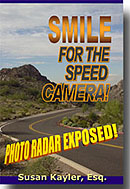
www.PhotoRadarLaw.com
PhotoRadarLaw.com is an Arizona-based
webpage for an affordable book (as low as $12.90 including shipping) on how to deal with
photo radar tickets. Even if you are in California, you should have a look, because our legislature keeps trying to bring photo radar
here - see the Legislation section on my
Action page, and the MRCA section on the Camera Towns page.
If you are in Arizona, be sure to see the Mesa section on the Camera Towns page (includes info about a Sept. 2008 lawsuit against the photo
ticketing).
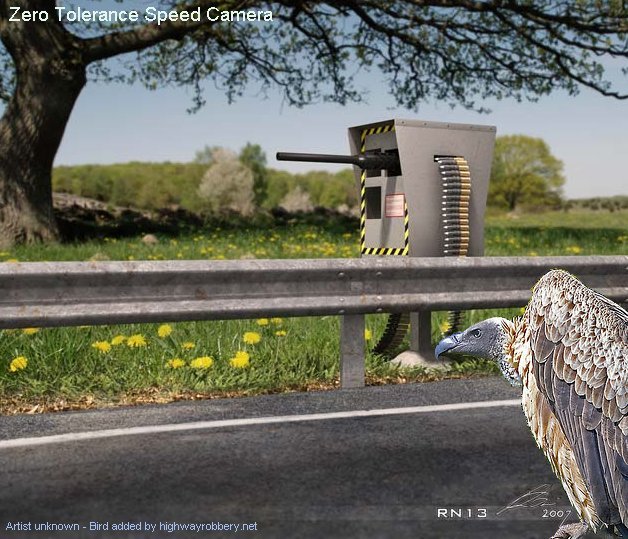
A Letter to the Auto Club of Southern California
Please note that according to their staff, CSAA, the northern California club, does
not have a similar ad campaign. Mr. McKernan's phone number is (714) 885-1222. Additional contact info
for the Clubs is in the big purple box on the Action page.
August 11, 2005
Mr. Thomas V. McKernan, President and CEO
(Please copy to the Board of Directors and Honorary Directors)
Automobile Club of Southern California
Post Office Box 25001
Santa Ana, California 92799
Re: TV Ad - Obey the Speed Limit
Dear Mr. McKernan:
I am a Club member. Recently, I have seen a TV ad in which you appear and ask viewers always to obey the speed limit.
Every study I have seen says that it is far safer if all cars are moving at similar speeds, regardless
of whether they are obeying the speed limit.
The studies echo my own observations - cars moving substantially
slower than "the flow" are just as disruptive as cars moving substantially faster.
Your ad, by encouraging some drivers to impede the flow, could make our highways more dangerous.
I would like to be constructive here, so would like to suggest an alternative, that
the Club put its resources behind a Lane Courtesy campaign. More Lane Courtesy would do a lot to
decrease lane changing, tailgating, and Road Rage.
Very truly yours,
|
On Aug. 29 the Club replied to my letter:
"In this instance, the reference to "always obey the speed limit" is not intended to be an absolute - we wouldn't
endorse holding 65 miles per hour
in the left lane of a freeway with traffic backing up behind, or for that matter driving at the speed limit during
severe weather - and I believe the viewers
understand it that way."
While the Club's letter conceded nothing, I did notice that by the middle of August the "obey the limit" ad had been
replaced by one advising motorists to buckle up.
JP's
Fight Your Ticket
JP's
Fight Your
Ticket (not to be confused with David Brown's book - linked above - of the same name) is a California-based free-of-charge
website with practical advice for dealing with
tickets, including equipment violations. Section III is about red light camera tickets. If JP's drop-down navigation bar
doesn't work with your software, the sections can be accessed by clicking on the
next-page and previous-page arrows at the bottom of each page.
(JP's Fight Your Ticket is currently hosted on
the highwayrobbery.net website, but the content and opinions
presented there are solely JP's.)

Speed Trap Exchange
The Speed Trap Exchange is a
nationwide list of speed traps - to which to you can add your favorites.
Links/Ref/FAQ Page:
- 9 -
Moving Violations Cited (Illegally) Under Local Ordinance or Municipal Code
(Speeding, Stop Signs, Lane Changes, Truck Route, Etc.)
New: 12-16-09, updated 10-7-16
At one time, some cities, one county, and one park district) were citing minor moving violations under a local ordinance or muni code
instead of under the California Vehicle Code. (Some may still be doing it.) The tickets carried no points, and with the exception of the $445 fine in Long Beach, carried a much
lower fine than usual.
What is a city's incentive to issue tickets this way? A: If the motorist pays the ticket without contesting it, the locality gets to keep the entire fine, rather than having to give up more than half to the Superior Court system.
Given the financial advantage, why don't all cities do this? A: It is illegal, per Vehicle Code Sec. 21 which says:
Except as otherwise expressly provided, the provisions of this
code are applicable and uniform throughout the State and in all
counties and municipalities therein, and no local authority shall
enact or enforce any ordinance on the matters covered by this code
unless expressly authorized herein.
In Sep. 2010 Senate Bill 949 was passed, to stop this practice. For more info about SB 949, see that bill's section on the Action page. If you receive one of these moving violation tickets (speeding, lane change, stop sign, etc.) issued under a section of the local muni code rather than the State Vehicle Code, please contact me.
Here are the localities known to have issued these illegal tickets, and some of the ordinances they cite under:
Alameda County Sheriff: 10.36.020
Berkeley:
Long Beach: 10.08.030
MRCA: Stop sign camera tickets (see the MRCA section on the Camera Towns page)
(SB 949 contains a loophole allowing the MRCA to continue citing under its own code.)
Newman: 10.01.030, 10.01.040, 10.20.010, 10.20.020, 10.02.030, 10.03.010, 10.03.040, 10.03.050
Oakland: 10.16.110
Riverbank: 70.07, 70.08, 75.03, 76.01, 78.01, 78.02
Roseville: 11.06.030, 11.08.030, 11.08.040, 11.12.010, 11.16.090, 11.26.010, 11.28.010, 11.28.020
San Diego: 82.21
West Covina: 22-61, 22-143A
Links/Ref/FAQ Page:
- 10 -
Info
About Parking Tickets
The website helpigotaticket.com has a page with a unique way to fight a parking ticket. I will try it out, next time I get a parking ticket.
Internal Links
Email: For the email address of the editor
of this website, go to the Action page.
Back, to top of this page
Site Index
Please report any broken links!
I update portions of this
website almost daily. If you are making a return visit after an
absence of more than a day, I recommend that you hit the "reload" or
"refresh" buttons,
to make sure you have the latest version of the page you're interested
in.
 ---------------------------------
RED LIGHT
CAMERAS
www.highwayrobbery.net
www.highwayrobbery.net