Legislation/Speed Cameras Coming?
Contact/Email Address
Fake/Snitch Tickets Issued by Police
No Ticket Yet? Be Prepared
Journalists/Bloggers/Webmasters
Industry PR - and Ours
Alternatives to Cameras
FAQ Frequently Asked Questions
Library of Transcripts, Briefs, Decisions
Search
Boycott !
This is the
Camera Towns
page
If you've just arrived at highwayrobbery.net, please start by reading the What's Hot box on the Home page.
Is your ticket from a town in LA County, or signed by the LA County Sheriff? If so, you may be able to ignore it! Read the "Countywide
Information," which is Docs Set # 2 on the LA County Documents page, before you make any contact with the court.
Alpha Index to Cities Covered on this Page
The inclusion of a city in this alphabetic index
doesn't necessarily mean they presently have cameras. They may just be thinking
about it. Or, they may have had cameras
at one time, but have since removed them. Or, a city may be listed here just for rumor control. Click on the
highlighted city names.
After this alphabetic
index you will find a
geographic index to most of the same cities.
Some cities have more info elsewhere on this site - check the Site Index.
Recent Start Ups -
Salinas - Dec. 2019 - the first new program in California since Rancho Cordova started in 2012
Recent Closings -
During the period June 2011 to May 2020 the following California cities closed their camera programs, or announced they would be closing:
Baldwin Park, Bell Gardens, Belmont, Cathedral City, Cerritos, Corona, Davis, El Cajon, Emeryville, Encinitas, Escondido, Gardena, Glendale, Grand Terrace, Hayward, Highland, Inglewood, Laguna Woods, Lancaster, City of Los Angeles, Lynwood, Marysville, Menlo Park, Modesto, Murrieta, Napa, Oakland, Oceanside, Oxnard, Pasadena, Poway, Redwood City, Riverside, San Bernardino, San Carlos, San Diego, San Juan Capistrano, San Mateo, San Rafael, Santa Ana, Santa Clarita, South Gate, South San Francisco, Stockton, Victorville, Vista, Walnut, West Hollywood, and Yuba City.
If you are having trouble figuring out which city issued your ticket, see the Disambiguation section, near the bottom of this page.
Anaheim - Ban on Cameras Voted in 2010
Arizona
Arleta
Atherton - Tested Cameras
Bakersfield
Baldwin Park - Closed in 2015
Beaumont - Contract Signed but No Cameras
Bell - No Cameras
Bell Gardens - Closed in 2012
Belmont - Closed in 2013
Berkeley - Closed in 2008
Beverly Hills - Seven New Locations in 2015 and May 2016
Near Beverly Hills - Stop Sign Cameras in Franklin Canyon - MRCA
Near Blue Line Light Rail Crossings
Burlingame - in 2010, City Paid $50,000 Penalty to End Program
Busway Crossings in LA Area
CHP - Tickets Issued by the CHP
Campbell - No Cameras
Canoga Park near Busway (Cameras Operated by Metro/MTA, Tickets Signed by Sheriff)
Capitola
Cathedral City - Closed in 2018
Cerritos - Closed in 2016
Chatsworth near Busway (Cameras Operated by Metro/MTA, Tickets Signed by Sheriff)
Chino - No Cameras
Chula Vista - Vendor Selected, but No Cameras Installed
Citrus Heights
Colton - No Cameras
Commerce
Compton - Closed in 2007
Corona - Closed in 2012
Costa Mesa - Closed in 2010
Near Covina (Cypress and Hollenbeck only) - Closed in 2012
City of Covina
Culver City - Tickets Way Up in Early 2016 & More Cams Added Early 2017
Cupertino - Closed in 2004
Daly City - Big Refund in 2015
Davis - Closed in 2014
Del Aire - La Cienega at 120th - Closed in 2012
Del Mar
Downey - No Cameras
East LA (Whittier Blvd. at Atlantic) - Closed in 2012
East LA - Closed in 2012
Eastside Gold Line Rail Crossings in LA
El Cajon - Closed in 2013
El Monte - Closed in 2008
El Segundo Area - Closed in 2012
Elk Grove
El Segundo - La Cienega at 120th - Closed in 2012
Emeryville - Closed in 2012
Encinitas - Closed in May 2020
Escondido - Closed in 2013
Near Expo Line Light Rail Crossings
Fairfield - Closed in 2008
Fountain Valley - No Cameras
Franklin Canyon Stop Sign Cameras - MRCA
Fremont - Big Expansion in 2020
Fresno - Closed in 2005
Fullerton - Closed in 2009
Gardena - Closed in 2011
Garden Grove
Gilroy - Considered Cameras
Glendale - Closed in 2012
Glendora - Closed in 2012
Near Gold Line Light Rail Crossings in Eastside LA
Grand Terrace - Closed in 2012
Hacienda Heights (Hacienda at La Monde) - Closed in 2012
Hawthorne
Near Hawthorne (La Cienega at 120th) - Closed in 2012
Hayward - Closed in 2013
Hemet - Contract Signed, Then Cancelled
Hermosa Beach - No Cameras
Highland - Closed in 2014
Hillsborough - No Cameras
Hollywood (Except City of West Hollywood) - Closed in 2011
Huntington Beach - Program Cancelled after Survey
Huntington Park - No Cameras
Indian Wells - Closed in 2004
Indio - No Cameras
Is It a Snitch Ticket, or from the LA Area?
If someone sent you a "ticket" that does not give the address of the court, or which says, "Do not contact the court," that's not really a ticket at all - so go to the section titled "Police Going Too Far...," on the Your Ticket page.
Is your ticket from a town in LA County, or signed by the LA County Sheriff? If so, you may be able to ignore it! Read the "Countywide Information," which is Docs Set # 2 on the LA County Documents page, before you make any contact with the court.
Inglewood - Closed in 2014
Irvine - Closed
Laguna Niguel - Cameras Banned by City Council
Laguna Woods - Closed in 2014
Near La Mirada - Telegraph & Colima - Closed in 2012
Lancaster - Closed in 2011
La Puente - No Cameras
Lemon Grove - Did a Test
Light Rail Crossings in LA Area
Loma Linda - Closed in 2010
Long Beach - Closed in 2011
Los Alamitos
Los Angeles, County of - Info about Ignoring Camera Tickets in the County
Los Angeles, City of (Not Including Tickets Near Busway or Metro Light Rail) - Closed in 2011
LA Area Busway & Light Rail Crossings, Many Inside City of LA (Cams Operated by Metro/MTA, Tickets Signed by Sheriff)
Tickets Issued by LA County Sheriff (Other Than Metro/MTA Busway & Light Rail Crossings)
Los Angeles, County of - Info about Ignoring Camera Tickets in the County
Lynwood - Closed in 2017
MRCA Parks - Mountains Recreation and Conservation Authority
MTA/Metro Busway and Light Rail Crossings
Malibu - No Cameras
Manhattan Beach - No Cameras
Manteca - May Install Cams in Early 2020
Martinez - Selected Vendor, but Did Not Move Forward
Marysville - Closed in 2016
Maywood - Closed in 2009
Menlo Park - Closed April 2019
Mesa, Arizona
Metro/MTA Busway and Light Rail Crossings
Millbrae
Mission Viejo - No Cameras
Modesto - Closed in 2014
Montclair - Closed in 2009
Montebello
Moreno Valley - Closed in 2010
MRCA Parks - Mountains Recreation and Conservation Authority
MTA/Metro Busway and Light Rail Crossings - Big Refund in 2017?
Murrieta - Cameras Removed in 2013
Napa - Closed in 2017
National City - Considered Cameras
Newark
Newhall - Closed in 2015
Newport Beach - Ban on Cameras Voted in 2012
North Hollywood near Busway (Cameras Operated by Metro/MTA, Tickets Signed by Sheriff)
Oakland - Closed in 2014
Oceanside - Closed in 2014
Orange - Cameras Banned by City Council
Near Orange Line Busway Crossings in LA Valley Area
Oroville - Contract Signed, Then Cancelled
Oxnard - Closed in 2017, and Big Refund
Pacific Palisades - Stop Sign Cameras in Park - MRCA
Palm Desert - No Cameras
Palo Alto - Considered Cameras
Paramount - Closed in 2006
Park Stop Signs - MRCA
Pasadena - Closed in 2012
Phoenix
Placentia - No Cameras
Pomona - No Cameras
Poway - Closed in 2013
Rancho Cordova
Rancho Cucamonga - Closed in 2010
Redding
Redlands - Closed in 2009
Redwood City - Closed in 2013
Reseda near Busway (Cameras Operated by Metro/MTA, Tickets Signed by Sheriff)
Reseda Blvd. Stop Sign Camera in Park - MRCA
Ridgecrest - Program Cancelled after Survey
Rio Vista - Signed Contract but No Cameras Installed
Ripon - May Install Cams in Early 2020
Riverside - Closed in 2014
Rocklin - Closed in 2011
Roseville - Closed in 2007
Rowland Heights (Colima at Batson) - Closed in 2012
Sacramento, City of
Sacramento, County of
Salinas - Started Dec. 2019
San Bernardino - Closed in 2012 for Non-Payment
San Bruno - Vendor Selected, Did Not Move Forward
San Carlos - Closed in 2011
San Diego - Closed in 2013
San Fernando Valley Busway Crossings
San Francisco
San Jose - Had Speed Cameras, and Wants Them Again
San Juan Capistrano - Closed in 2012
San Leandro
San Luis Obispo - No Cameras
San Marcos - No Cameras
San Mateo - Closed in July 2019
San Rafael - Closed in 2014
San Ramon - No Cameras
Santa Ana - Closed in 2015
Santa Clarita - Closed in 2015
Santa Fe Springs - Closed
Near Santa Fe Springs - Carmenita & Leffingwell - Closed in 2012
Santa Maria - Closed in 2009
Santa Monica - Shopped for Cameras, Didn't Buy
Santa Rosa - Closed after Test
Saugus - Closed in 2015
Sepulveda at Wilshire in West LA - Closed in 2012
Sheriff
Solana Beach
South Central LA, near Blue Line Tracks
South Gate - Closed in 2013
South San Francisco - Closed in 2014
South Whittier - Carmenita & Leffingwell or Telegraph & Colima - Closed in 2012
Stockton - Closed in 2015
Stop Signs in Parks - MRCA
Studio City near Busway (Cameras Operated by Metro/MTA, Tickets Signed by Sheriff)
Sunnyvale - Considered Cameras
Temescal & Topanga Stop Sign Camera in Park - MRCA
Turlock - Chose Vendor, Didn't Sign Contract
USC Area, near Expo Line Tracks
Union City - Closed in 2010
Universal City near Busway (Cameras Operated by Metro/MTA, Tickets Signed by Sheriff)
Upland - Closed in 2009
Valencia - Closed in 2015
Van Nuys near Busway (Cameras Operated by Metro/MTA, Tickets Signed by Sheriff)
Ventura
Victorville - Closed in 2015
Vista - Closed in 2016
Walnut - Closed in 2014
Watts, near Blue Line Tracks
West Covina - No Cameras
West Hollywood - Closed in March 2020
West LA / Westwood (Wilshire / Sepulveda only) - Closed in 2012
West LA / Westwood (Other than Wilshire / Sepulveda)
Westchester
Westminster - Ban Was To Be on Nov. 2012 Ballot but Was Withdrawn
Whittier - Closed in 2010
South Whittier - Closed in 2012
Wilshire at Sepulveda in West LA - Closed in 2012
Yuba City - Closed in 2012
Yucaipa - Closed in 2010
Your Town, and the Watch List
Map of Places to Not Get Off the Freeway
Below - arranged geographically into something like a map - are most of the cities listed above, excluding those that never had cameras.
Printable Version
Why avoid these towns? Many of them have cameras right at the bottom of the freeway ramp, waiting for you! Even if you know exactly where the cameras are and you're not inclined to boycott to send them an economic message, there's still a very practical reason to stay away from neighborhoods and/or towns having cameras. In the questionnaire on this website, I ask defendants how often they have driven through the intersection where they got their ticket. While the majority of defendants were caught at intersections they had not visited previously, a substantial portion of defendants were caught at an intersection they were very familiar with. Conclusion: You are not safe from getting a ticket simply because you know there's a camera there - it is necessary to change your routine, to eliminate repeated visits to the intersection. It's like playing with snakes - no matter how careful you try to be, eventually they will catch you off guard, and you will get bit.
On this map, cities where 50% or more of the tickets are for turns (right plus left) are emphasized in big bold type as are cities which have refused to disclose their breakout by movement (Beverly Hills and San Francisco) and cities which have recently installed cameras (Salinas). The cities which have been thinking about beginning a camera program (Manteca, Ripon) - are in regular type. Cities which formerly had cameras but no longer do are in light italic type.
Yuba City Marysville Roseville Rocklin
City of Sacramento R. Cordova Citrus Hts
San Rafael Napa Fairfield Davis Sac. County
San Francisco Berkeley Elk Grove
Daly City South SF Emeryville Stockton
Millbrae Oakland
Burlingame San Mateo San Leandro Manteca Map by highwayrobbery.net
Belmont San Carlos Hayward Union City Ripon Updated 6-16-20
Redwood City Newark Fremont Modesto
Menlo Park
Cupertino San Jose
Capitola Salinas Fresno
Bakersfield
Santa Maria Santa Clarita Lancaster Victorville
Ventura Chatsworth* Glendale Pasadena
Canoga Pk* Reseda* Van Nuys* NH*
Oxnard MRCA Parks** MTA Orange Line Busway* San Bern.
Bev.Hills W.Hollywood MRCA Parks** Upland R. Cuca. Highland
MRCA Pks** MTA Lt. Rail Xings* Baldwin Pk Montclair Redlands
Wil./Sepul. LA County El Monte Covina Loma Linda
LA City MTA Lt. Rail Xings* Grand Terrace
MTA Lt. Rail Xings* Yucaipa
Culver City Commerce E. LA Montebello Walnut Riverside
Maywood Bell Gdns. Whittier Rowland Hts. Moreno Vly
MTA Lt. Rail Xings*
Inglewood South Gate S.F.Springs South Whittier
LaCienega Hawthorne MTA* Lynwood Corona
Gardena Compton Paramount Cerritos Fullerton Cathedral City
MTA Lt. Rail Xings*
Long Beach Los Alamitos Garden Grove Indian Wells
Santa Ana Mesa, AZ
Costa Mesa Laguna Woods Irvine Murrieta
San Juan Capistrano
Oceanside Vista Escondido
Encinitas
Solana Beach
Map by highwayrobbery.net Del Mar Poway
San Diego El Cajon
*Camera near busway or light rail line, operated by LA MTA/Metro.
**Cameras at stop signs in LA area parks, operated by the Mountains
Recreation and Conservation Authority (MRCA).
On this map, cities where 50% or more of the tickets are for turns (right plus left)
are emphasized in big bold type, as are cities which have refused to disclose
their breakout by movement (Beverly Hills and San Francisco) and cities
which have new camera installations (Salinas).
The rest of the active cities - and those that may be about to install
cameras (Manteca, Ripon) - are in regular type.
Cities which once had cameras but no longer do are in light italic type.
Printable Version of Map
(Click on highlighted city name above, or scroll down.)
Other parts of the country - Baltimore, Washington DC, Philadelphia, etc., are mentioned on the Links page.
Even if your ticket is not from Culver City, you may find the information in the Culver City Chronology (Set # 8 on the Culver City Docs page) to be useful.
I update portions of this website almost daily. If you are making a return visit here after an absence of more than a day, I recommend that you hit the "reload" or "refresh" buttons, to make sure you have the latest version of the page you're interested in.
The listings below are in no particular order.
(1)
East LA - Big Refund at Whittier/Atlantic - Camera Closed in 2012
( The cameras at the Eastside Gold Line light rail crossings are covered in the Metro/MTA section, below.)
The Whittier/Atlantic camera was operated by LA County, which contracted with the CHP to review and sign the tickets. Ticket counts for East LA, and info about the other County-operated cameras, are in the LA County / CHP section.
East LA, May 2003, Whittier
at Atlantic: Big
Refund!
Posted Speed Limit: 30 (Or was it 35?)
Minimum yellow per table: 3.2 (Or 3.6?)
Programmed yellow:
Per the imprint on an actual ticket: 2.9
Per CHP personnel on Mar. 4, 2003: 3.0
Per county public works personnel on Mar.
5:
3.5
According to CHP personnel on Mar. 4, 2003, the
boundary of the nearby 25 mph zone is approx. two blocks west of the
intersection. On a Mar. 6 visit to the intersection, a 25 mph sign
was found just 150 feet west of the intersection.
The signal has between 0.1 and 0.7 less yellow than required by
law. A too-short yellow can cause the issuance of a lot of
unwarranted, and unfair, tickets. On Mar. 4 this discrepancy was
brought to the attention of the CHP personnel who issue the
tickets. And on Mar. 5 county public works personnel promised to
look into the matter, and call back.
By Mar. 24, none of them had called back, so the CHP
was again contacted. They said that they had stopped issuing
tickets at the intersection. But they would not say anything else,
including what they plan to do about the tickets that are "in the
pipeline" - those issued in the last several months.
On Mar. 26 a CHP lieutenant left a voicemail saying: "All
the various entities are looking at your concern very
seriously." He promised they would call again as soon as
there was an answer.
By Apr. 14 there was no answer from the CHP, so a message
was left for the lieutenant.
On May 16, 2003 a front-page article in the
LA Times reported that the CHP and LA County have reversed nearly
3000 tickets issued at Whittier / Atlantic !
Note that these powerful
agencies could easily have swept the defect under the rug - as at
least one local city has - but instead the CHP and the County chose
to do the right thing. They investigated the problem (pretty
quickly, considering the size of both agencies), admitted the
defect, and are attempting to make it right.
Read:
Los
Angeles
Times
DPW May 15 Press Release
(pdf).
On May 23 the County provided a blank copy of the form
letter their
Department of Public Works has sent out. The form letter
contains a phone number (213-744-3451) and an email address (trafficphotoclaims@auditor.co.la.ca.us) for the County department
that will be processing refunds and claims.
Unlike East LA, some other cities that have malfunctions have refused to make refunds of any kind. For a blatant
example, see the Bakersfield section.
East LA: No Automatic Refunds for
Community Service, Traffic School Fees, Increased Insurance
Premiums - To Get a Refund, File a Claim!
Added
6-9-03: If you did
Community Service in lieu of paying your Atlantic / Whittier fine,
you will not automatically
be receiving a check. You should file a claim with the
county - for at least the $270 or $320 value of your labor and the
(approx. $30) Community Service fee. If you went to traffic
school, or experienced higher insurance premiums as a result of
your Atlantic / Whittier ticket, you should file a
claim. The county has stated: "The county will
evaluate each claim individually on its merits, and respond fairly
and promptly."
On June 21 an article in La Opinion reported that as of June 19,
the county had received only one* claim for the reimbursement of
community service, and only fifty-six for reimbursement of traffic school
fees.
Added 11-5-03: *A November 3 letter from the
county said: "The County has not received any claims... from
persons seeking reimbursement for community service nor has the
County reimbursed any persons for community service."
The county claim form is
available at: http://bos.co.la.ca.us/PDFs/AssessmentAppealsClaimForDamages.pdf.
East
LA: Many Whittier / Atlantic Tickets Not
Reversed
The May 16 Times article indicated that there are about 2000 tickets
that were not reversed.
On May 19 I called the County
and asked why, and was told that only tickets with a 0.5 or lower
"Late Time" were reversed.
For more information about Whittier /Atlantic, see the Other California Towns, Step 2, section on the Your Ticket page, and Defect # 5 on the Home page.
To contact CHP headquarters, the elected officials representing East LA, the local Chamber of Commerce, or CalTrans, see the Links page of this website. To contact your State legislator, see the Action page of this website.
(2)
City of West Hollywood,
California "WeHo" (Closed March 2020)
West Hollywood, pop. 38,000, is 5
miles west of downtown Los Angeles.
If you ignore a West Hollywood red light camera ticket (or a camera ticket from any other city in LA County), the LA County Court will not report it to the DMV. For more info, read the "Countywide Information," which is Docs Set # 2 on the LA County Documents page.
Many red light camera towns send out "Snitch Tickets," fake tickets that can be ignored no matter what county the town is in. A Snitch Ticket will not have the Court's name and address on it. For more details, see the Snitch Ticket section at the top of the Your Ticket page.
The City's cameras were provided by Gatso, and the tickets were issued by the Los Angeles County Sheriff, under contract.
Information about West Hollywood is on two different pages -
Ticket counts and a copy of the contract for the cameras are available
at: WeHo Documents..
Details of some 2002 - 2004 trials of WeHo tickets are at: WeHo Chronology.
Also, be sure to read Defect # 5 on the Home page.
(3)
City of Culver City, California - Ticketing WAY Up in Early 2016 - the Highest in the State by Double - and More Cameras Coming in Early 2017
Culver City,
pop. 40,000, is in west LA, 3 miles north of LAX.
If you ignore a Culver City red light camera ticket (or a camera ticket from any other city in LA County), the LA County Court will not report it to the DMV. For more info, read the "Countywide Information," which is Docs Set # 2 on the LA County Documents page.
Many red light camera towns send out "Snitch Tickets," fake tickets that can be ignored no matter what county the town is in. A Snitch Ticket will not have the Court's name and address on it. For more details, see the Snitch Ticket section at the top of the Your Ticket page.
On the
Culver City Documents page you will find much more info about the Culver City cameras.
Set # 13 on that page shows how many tickets have been issued each month.
(4)
City of Costa Mesa, California (System Closed)
Costa Mesa, pop. 110,000, is immediately north of Newport Beach, in Orange County.
Costa Mesa closed its camera system on July 22, 2010. The City says it will continue to prosecute tickets issued before the closure.
Detailed information about Costa Mesa is on two different pages.
Costa Mesa documents, including a table showing camera locations and number of tickets issued, are
at Costa Mesa Documents.
Details of some Costa Mesa trials
are at Costa Mesa Chronology.
Unlike most other cities, Costa Mesa's camera tickets didn't display the Late Time (even though their Nestor system clearly had the
capability to do so). A possible motive to
leave it off could have been so that they could cite for very short Late Times (like 0.1 second) without widespread
criticism (including some from judges) about "Mickey Mouse" tickets. See the purple box in Defect # 7 on the Home page, and Set # 12 on the Costa
Mesa Documents page, for more information.
Costa Mesa has, in the past, refunded/reversed a large block of tickets due to yellow lights that were too short. Details
can be found on the
Chronology page, linked above. However, not all cities that have been caught with too-short yellows have made
refunds. For a blatant
example, see the Bakersfield section.
(5)
City of Fremont - New Cams Summer 2020
Fremont, pop. 190,000, is in the East Bay, 10 miles north of San Jose and 25 miles southeast of San Francisco.
Fremont is a RedFlex town. Many RedFlex towns send out "Snitch Tickets," which you can ignore. A Snitch
Ticket will not have the Court's
name and address on it. For more details, see the Snitch Ticket section on the Your Ticket page.
Ticket counts and other Fremont documents are at Fremont Documents.
Some 2010
Alameda County appeal court
decisions (Singh, Blankenship) addressed the confrontation issue (Defect # 10 - D).
If you have a Fremont red light camera ticket, please also be sure to look at the Countywide Information, on the Oakland Documents page.
(6)
City of Beverly Hills - Expanded in 2015 and 2016
Beverly Hills, pop. 34,000, is 8 miles west of downtown Los Angeles.
If you ignore a Beverly Hills red light camera ticket (or a camera ticket from any other city in LA County), the LA County Court will not report it to the DMV. For more info, read the "Countywide Information," which is Docs Set # 2 on the LA County Documents page.
Many red light camera towns send out "Snitch Tickets," fake tickets that can be ignored no matter what county the town is in. A Snitch Ticket will not have the Court's name and address on it. For more details, see the Snitch Ticket section at the top of the Your Ticket page.
Ticket counts for Beverly Hills' cameras, and details about the new cameras, are
available at:
Beverly Hills
Documents.
If you drive in the hills north of Beverly Hills, have a look at
the MRCA section, below, as there are stop sign cameras in
Franklin Canyon Park.
(7)
City of San Diego (Closed in 2013)
Ticket counts for San Diego's cameras are available
at: San Diego Documents.
The City of San Diego system was re-started in 2003. They issued warning tickets for 30
days on each new camera they installed (for comparison to other towns, see
Defect # 6 on the Home page). The new system had a grace period of 0.5 second until July 18, 2006, when the
city council ordered it reduced to 0.1
second (see July 18 Union
Tribune story).
The last day of operation of the cameras was Jan. 31, 2013 but, according to Mayor Filner, violations photographed on or before that date will be processed.
If you have a San Diego ticket, see Defect # 8 - C.
(8)
City of Los Angeles (System Closed in 2011)
was operating cameras in or near the following locations:
Canoga Park, Westchester, Van Nuys (and More)
While the City of LA has shut down the cameras it contracted for, other agencies still are operating cameras in the City, or close by. Remaining in operation are dozens of cameras near Metro light rail crossings and along the Orange Line Busway in the Valley. They are discussed in the Metro/MTA section, below. Also nearby are the cameras operated by the cities of Beverly Hills, Commerce, Culver City, Hawthorne and Montebello; each of those cities has its own section on this page.
If you ignore a City of Los Angeles ticket or one from any other city in LA County (or the MTA), the LA County Court will not report it to the DMV. For more info, read the "Countywide Information," which is Docs Set # 2 on the LA County Documents page.
Also, if your "ticket" from anywhere in California (even outside LA County) does not have the Court's name and
address on it, it is what I call a "Snitch Ticket," and you can ignore it. For more details, see the Snitch Ticket section on the Your Ticket page.
Ticket counts for the former City of Los Angeles cameras, and other information, are at: LA City Documents.
(9)
City of El Cajon,
California (Closed)
El Cajon, pop. 95,000, is an eastern suburb of San Diego.
Some of El Cajon's tickets can be ignored. If your "ticket" does not have the Court's name and
address on it, it is what I call a "Snitch Ticket." For more details, see the Snitch Ticket section on the Your Ticket page.
The cameras were shut off temporarily on Feb. 27, 2013, to allow a six-month study of the effect, and then closed permanently by a 4 - 1 vote at the Sept. 24, 2013 council meeting.
Ticket counts for El Cajon's cameras are available
at:
El Cajon
Documents
.
(10)
City of Vista,
California - Closed Late 2016
Vista, pop. 85,000, is 30 miles north of San Diego and 5 miles inland of Oceanside and Carlsbad.
Some of Vista's tickets can be ignored. If your "ticket" does not have the Court's name and
address on it, it is what I call a "Snitch Ticket." For more details, see the Snitch Ticket section on the Your Ticket page.
Ticket counts for Vista's cameras are available
at:
Vista
Documents
.
(11)
City of Encinitas,
California - Closed in 2020
Encinitas, pop. 60,000, is on the coast 20 miles north of San Diego.
At their May 6, 2020 meeting, the city council heard a staff report recommending the extension of the City's camera system. They voted 3-2 to end the program.
Some Encinitas tickets can be ignored. If your "ticket" does not have the Court's name and
address on it, it is what I call a "Snitch Ticket." For more details, see the Snitch Ticket section on the Your Ticket page.
Ticket counts for Encinitas's cameras are available
at:
Encinitas
Documents
.
(12)
City of South Gate,
California - Closed in 2013
South Gate, pop. 94,000, is 8 miles south of downtown Los Angeles.
If you ignore a South Gate red light camera ticket (or a ticket from any other city in LA County), the LA County Court will not report it to the DMV. For more info, read the "Countywide Information," which is Docs Set # 2 on the LA County Documents page.
Many red light camera towns send out "Snitch Tickets," fake tickets that can be ignored no matter what county the town is in. A Snitch Ticket will not have the Court's name and address on it. For more details, see the Snitch Ticket section at the top of the Your Ticket page.
Contract details and ticket counts for South Gate's former cameras are available
at:
South Gate
Documents
.
(13)
City of El Monte, California (System Closed)
El Monte, pop. 113,000, is 12 miles east of downtown Los Angeles.
Some of El Monte's tickets can be ignored. If your "ticket" does not have the Court's name and
address on it, it is what I call a "Snitch Ticket." For more details, see the Snitch Ticket section on the Your Ticket page.
Ticket counts for El Monte's cameras are available
at:
El Monte
Documents
.
On Oct. 21, 2008, the El Monte city council voted to end the issuance of tickets, effective Nov. 30, 2008. But they will continue to prosecute
tickets issued before that date.
If you ignore a El Monte ticket (or a ticket from any other city in LA County), the LA County Court will not report it to the DMV. For more info, read the "Countywide Information," which is Docs Set # 2 on the LA County Documents page.
(14)
City of Long Beach, California (Closed)
The City closed the camera system it once ran, so if your ticket is from a camera in the Long Beach area and it is signed by the LA County Sheriff (not the Long Beach Police Department), the camera may be one of those operated by Metro/MTA, at intersections near its Blue Line light rail system. See the Metro/MTA section for more information.
If you ignore a Long Beach ticket (or a ticket from any other city in LA County), the LA County Court will not report it to the DMV. For more info, read the "Countywide Information," which is Docs Set # 2 on the LA County Documents page.
The camera system operated by the City of Long Beach is closed. The cameras were operated by ATS, successor to Nestor, using Nestor software.
Ticket counts for Long Beach's
cameras are available at: Long Beach
Documents
On Nov. 23, 2004 an independent website in Long Beach published a report suggesting that accidents had increased during the time the City's cameras were in operation.
If you have a non-camera ticket - issued to you by a LBPD officer who pulled you over - and he cited you for violation of a Long Beach Municipal Code section rather than a section of the California Vehicle Code, see Section 8 on the Links page.
(15)
City of Hawthorne,
California
Hawthorne, pop. 80,000, is just southeast of
LAX
(For tickets at the intersection of La Cienega and 120th - camera closed in 2012 - see the LA County section, below.)
If you ignore a Hawthorne red light camera ticket (or a camera ticket from any other city in LA County), the LA County Court will not report it to the DMV. For more info, read the "Countywide Information," which is Docs Set # 2 on the LA County Documents page.
Many red light camera towns send out "Snitch Tickets," fake tickets that can be ignored no matter what county the town is in. A Snitch Ticket will not have the Court's name and address on it. For more details, see the Snitch Ticket section at the top of the Your Ticket page.
Hawthorne's 2009 contract with RedFlex included an illegal "cost neutrality" clause, whereby the city does not have to pay RedFlex
the full monthly rent (the so- called "fixed fee") if there aren't enough fines to cover the rent. In 2012 the clause was re-named "financial feasibility." See Subsection B. of the Expanded version of Defect # 10.
Information about Hawthorne is on two different pages -
Ticket counts, signal timing, and a copy of the contract for Hawthorne's cameras are available
at: Hawthorne Documents.
Details of some 2004 - 2006 trials of Hawthorne tickets are at: Hawthorne Chronology.
Hawthorne issued warning tickets at its first camera location only.
As a result, a published 2010 appellate court decision (P. vs. Park) could affect thousands of
tickets Hawthorne issued. Another city has already been forced to suspend the operation of most of its cameras, for 30 days. See
Defect # 6 and Defect # 10, on the Home page.
Right Turns
Hawthorne has, in the past, issued many right turn tickets under the wrong section of the Vehicle code. If you
have an old right turn ticket in Hawthorne, or any other
town, see FAQ # 27 and the Sept. 7 and Sept. 28, 2004 entries in the Hawthorne Chronology.

For more about
the buttons, see the You Don't Have to Shop There section on the
Action page.
(16)
City of Inglewood, California - Closed in 2014
Inglewood, pop. 115,000, is just east of LAX.
(For tickets at the intersection of La Cienega and 120th - camera closed in 2012 - see the LA County section, below.)
If you ignore an Inglewood red light camera ticket (or a camera ticket from any other city in LA County), the LA County Court will not report it to the DMV. For more info, read the "Countywide Information," which is Docs Set # 2 on the LA County Documents page.
Many red light camera towns send out "Snitch Tickets," fake tickets that can be ignored no matter what county the town is in. A Snitch Ticket will not have the Court's name and address on it. For more details, see the Snitch Ticket section at the top of the Your Ticket page.
Inglewood's tickets are heard by
some of the same judges who hear Hawthorne tickets.
Details of some 2004 - 2005 trials of Inglewood tickets are available at: Inglewood
Chronology.
Inglewood's 2008 contract with RedFlex may have included an illegal "cost neutrality" clause, whereby the city did not have to pay RedFlex
the full monthly rent (the so- called "fixed fee") if there weren't enough fines to cover the rent. See Subsection B. of the Expanded version of Defect # 10.
The contracts, and ticket counts for Inglewood's cameras, are available at: Inglewood Documents.
Inglewood's pre-2009 system issued warning tickets at its first camera location only. As a result, a published 2010 appellate court decision (P. vs. Park) could affect thousands of tickets the City issued prior to 2009. Another city has already been forced to suspend the operation of most of its cameras, for 30 days. See Defect # 6 and Defect # 10, on the Home page.
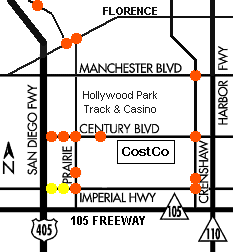
( As of 8-31-05 )
This is CostCo's map showing how to get to its Inglewood store from the three nearby freeways. I have modified the map to show Inglewood's thirteen camera intersections (red dots), and two nearby Hawthorne cameras (yellow dots).

For more about
the buttons, see the
Action page.
(17)
City of Bakersfield, California
Some of Bakersfield's tickets can be ignored. If your "ticket" does not have the Court's name and address on it, it is what I call a "Snitch Ticket." For more details, see the Snitch Ticket section on the Your Ticket page.
The City's contract with RedFlex includes an illegal "cost neutrality" clause, whereby the city will not have to pay RedFlex the full rent if there aren't enough fines to cover the cost. See Subsection B. of Defect # 10.
Ticket counts for Bakersfield's cameras, and information about the refund the City made (and the other refunds it refused to make), are
available at: Bakersfield Documents.
(18)
City of Montclair, California (System Closed)
Montclair, pop.
33,000, is 30 miles east of Los Angeles
In 2009, Montclair removed its Nestor cameras.
Ticket counts for Montclair's former cameras are available at:
Montclair
Documents.
(19)
City of Indian Wells,California (System Closed)
Indian Wells, pop. 3000, is
immediately east of Palm Springs and immediately west of Indio.
Ticket counts for Indian Wells' cameras
are available at:
Indian Wells Documents.
System Inactive
Indian Wells shut down its ACS system sometime in 2004, and the contract ended in July 2005. The city's official position was that they might re-start it
in early 2006. See
this article for details. However, as of March 2009 there were no cameras in the City.
(20)
City of Del Mar,
California
Del Mar, pop. 5000, is 15 miles
north of downtown San Diego
Some of Del Mar's tickets can be ignored. If your "ticket" does not have the Court's name and
address on it, it is what I call a "Snitch Ticket." For more details, see the Snitch Ticket section on the Your Ticket page.
Ticket counts for Del Mar's cameras are available
at: Del
Mar Documents.
(21)
City of Santa Clarita, California - Closed in 2015
Operated cameras in or near the following locations:
Newhall, Saugus, Valencia (and more)
Santa Clarita, pop. 167,000, is
30 miles northwest of downtown Los Angeles.
Some of Santa Clarita's tickets can be ignored. If your "ticket" does not have the Court's name and
address on it, it is a fake ticket, what I call a "Snitch Ticket." For more details, see the Snitch Ticket section on the Your Ticket page.
If you ignore a real Santa Clarita ticket (or a real ticket from any other city in LA County), the LA County Court will not report it to the DMV. For more info, read the "Countywide Information," which is Docs Set # 2 on the LA County Documents page.
The city's contract with RedFlex included an illegal clause, whereby the city did not have to pay RedFlex
the full rent if fine revenue was insufficient to cover the cost. See Subsection B. of Defect # 10.
Ticket counts for Santa Clarita's cameras are available
at:
Santa Clarita Documents.
(22)
City of San Juan Capistrano,
California (Closed in 2012)
San Juan Capistrano, pop.
33,000, is on the coast midway between Los Angeles and San
Diego.
The city signed a contract with Nestor on June 29, 2007. The contract included an illegal "cost neutrality" clause,
whereby the city was not required to pay Nestor
the full rent if the fines collected were insufficient to do so. On Nov. 21, 2008 an appellate court found that Nestor's similar "cost neutral"
contract with the City of Fullerton was illegal. To read that decision, see the expanded version of Defect # 10 - B. On
Feb. 2, 2009 San Juan Capistrano signed a contract amendment, effective that date, changing the contract to
"flat rate." Thus, for violations occurring Feb. 3 or later, Defect # 10 - B will not apply.
On May 30, 2012 the city council voted to let the program end, with the last day of enforcement to be Sep. 29, 2012.
Some of the "tickets" mailed may be "Snitch
Tickets," which you can ignore. A Snitch
Ticket will not have
the Court's name and address on it. For more details, see the Snitch Ticket section on the Your Ticket
page.
Ticket Counts for San Juan Capistrano's cameras are available
at:
San Juan Capistrano Documents.
(23)
City of Rancho Cucamonga,
California (Closed)
Rancho Cucamonga, pop. 118,000,
is 35 miles east of Los Angeles.
The mayor signed the city's contract with RedFlex on Oct. 18, 2007. The City allowed the contract to expire, wihout renewal, at the
end of its term in late September 2010.
Some of the "tickets" mailed may be "Snitch
Tickets," which you can ignore. A Snitch
Ticket will not have
the Court's name and address on it. For more details, see the Snitch Ticket section on the Your Ticket
page.
The contract included an illegal "cost neutrality" clause,
whereby the city did not have to pay RedFlex
the full rent if fines revenue was insufficient to cover the cost. See Subsection B. of Defect # 10.
The contract also said: Definitions. "Warning Period" means the period of thirty (30) days after the Installation Date of the first
intersection approach. (Emphasis added.) See Defect # 6.
Ticket counts for Rancho Cucamonga's old Nestor camera system and its successor, the now-closed RedFlex system, are available
at:
Rancho Cucamonga Documents.
(24)
City of Garden Grove,
California
Garden Grove, pop. 171,000, is
20 miles southeast of Los Angeles.
Some of Garden Grove's tickets can be ignored. If your "ticket" does not have the Court's name and
address on it, it is what I call a "Snitch Ticket." For more details, see the Snitch Ticket section on the Your Ticket page.
Ticket counts for Garden Grove's cameras are available
at:
Garden Grove Documents.
(25)
City of Stockton,
California - Closed in 2015
Stockton, pop. 234,000, is
50 miles east of San Francisco.
Some of Stockton's tickets can be ignored. If your "ticket" does not have the Court's name and
address on it, it is what I call a "Snitch Ticket." For more details, see the Snitch Ticket section on the Your Ticket page.
Ticket counts for Stockton's cameras are available
at: Stockton
Documents.
Stockton issued warning tickets at its first camera location only.
As a result, a published 2010 appellate court decision (P. vs. Park) could affect thousands of
tickets Stockton issued. Another city has already been forced to suspend the operation of most of its cameras, for 30 days. See
Defect # 6 and Defect # 10, on the Home page.
In June 2012 the City filed for Chap. 9 bankruptcy.
(26)
City of Fresno, California (System Closed)
Fresno, pop. 405,000, is 216
miles north of Los Angeles.
Ticket counts for Fresno's cameras are available
at: Fresno
Documents.
Shut Down
On Sept. 1, 2005, Fresno shut its Nestor system down. See
this article for details.
(27)
City of Cerritos,
California - Closed Aug. 2016
Cerritos, pop. 57,000, is 12
miles southeast of downtown Los Angeles.
If you ignore a Cerritos red light camera ticket (or a camera ticket from any other city in LA County), the LA County Court will not report it to the DMV. For more info, read the "Countywide Information," which is Docs Set # 2 on the LA County Documents page.
Many red light camera towns send out "Snitch Tickets," fake tickets that can be ignored no matter what county the town is in. A Snitch Ticket will not have the Court's name and address on it. For more details, see the Snitch Ticket section at the top of the Your Ticket page.
Cerritos tickets were issued by the Los Angeles County Sheriff, under contract with the City.
If you have a Cerritos red light camera ticket, please be sure to contact me.
Ticket counts for Cerritos' cameras, are available
at: Cerritos
Documents.
(28)
City of Mesa & Other Arizona Locales
Mesa, pop. 450,000, is east of
Phoenix.
Mesa has both red light cameras and speed camera vans.
Even though it is not in California, Mesa is listed here because an
event in Mesa shows how lengthening the left-turn yellow can
dramatically lower the number of violators. See: City
of Mesa, Arizona, Documents.
If you have received a photo ticket (speed or red light) issued anywhere in Arizona, you MAY be able to
ignore it. For more info, see Set # 5 on the Mesa Documents page.
On Feb. 20, 2009 the AAA auto club's national office designated Arizona as a "strict enforcement area" - the first time that the club has awarded that title to
an entire state. The warning will be provided to motorists getting maps or route advice from AAA for travel to or through Arizona.
For a book on how to fight speed camera tickets like those issued by Mesa, see the Speeding Ticket section on the Links page.
(29)
City of Upland, California (System Closed)
Upland, pop. 67,000,
is 32 miles east of Los Angeles.
Some of Upland's tickets can be ignored. If your "ticket" does not have the Court's name and
address on it, it is what I call a "Snitch Ticket." For more details, see the Snitch Ticket section on the Your Ticket page.
Ticket counts for Upland's cameras are available
at: Upland
Documents.
(30)
City of Oxnard,
California - Cams Deactivated in Jan. 2017 (Temporarily?), and Big Refund
Oxnard, pop.
152,000, is on the coast 50 miles west of Los Angeles.
Oxnard's contract with RedFlex, which expired in Jan. 2017, included an illegal "cost neutrality" clause,
whereby the city does not have to pay RedFlex
the full rent if there aren't enough fines to cover the cost. See Subsection B. of Defect # 10.
Ticket counts for Oxnard's cameras (which were deactivated in Jan. 2017), and details about a possible refund of some 2015 - 2016 tickets, are available
at:
Oxnard
Documents
.
(31)
City of Pasadena,
California - Closed in 2012
Pasadena, pop. 135,000, is 5 miles northeast of downtown Los Angeles.
Many red light camera towns send out "Snitch Tickets," fake tickets that can be ignored. A Snitch Ticket will not have the Court's name and address on it. For more details, see the Snitch Ticket section on the Your Ticket page.
If you ignore a Pasadena ticket (or a ticket from any other city in LA County), the LA County Court will not report it to the DMV. For more info, read the "Countywide Information," which is Docs Set # 2 on the LA County Documents page.
Unlike most other cities, Pasadena's camera tickets didn't display the Late Time (even though their Nestor system clearly had the
capability to do so). A possible motive to
leave it off may have been so that they could cite for very short Late Times (like 0.1 second) without widespread
criticism (including some from judges) about "Mickey Mouse" tickets. See the purple box in Defect # 7 on the Home page, and Set # 3 on the
Pasadena Documents page, for more information.
Ticket counts for Pasadena's cameras are available at:
Pasadena Documents
.
(32)
City of Fullerton, California (System Closed)
Fullerton, pop. 125,000, is 15 miles southeast of downtown Los Angeles.
Fullerton's contract with Nestor included an illegal "cost neutrality" clause, whereby the city did not have to pay Nestor
the full rent if there weren't enough fines to cover the cost. See Subsection B. of Defect # 10.
In Nov. 2008 a Fullerton defendant got an appellate court decision ruling that the contract violated
Section 21455.5(g) (as of 2013, 21455.5(h)) and that the trial court erred in admitting evidence from the camera. See the Fullerton Documents page, or the expanded
version of Defect # 10 - B, for more info.
A June 2009 article in the Orange County Register indicated that the City had terminated the contract.
Unlike most other cities, Fullerton's camera tickets didn't display the Late Time (even though their Nestor system clearly has the
capability to do so). A possible motive to
leave it off could be so that they can cite for very short Late Times (like 0.1 second) without widespread
criticism (including some from judges) about "Mickey Mouse" tickets. See the purple box in Defect # 7 on the Home page, and Set # 2 on the Fullerton
Documents page, for more information.
Ticket counts for Fullerton's cameras are available at:
Fullerton Documents.
(33)
City of San Jose,
California (Wants Speed Cams)
San Jose, pop. 990,000, is 40 miles southeast of San Francisco.
Despite rumors to the contrary, San
Jose never had red light camera enforcement in the past -- but it may have them in the future! In Fall 2008 the city council voted to
discuss getting red light cameras, ignoring a recommendation by the police chief that the money and effort be directed
towards enforcement by live officers. On May 4, 2009 a city council committee voted to start a "pilot" program. In May 2010 a city council committee voted to delay the program until at least
Fall 2010, due to budget considerations. Staff Report.
What the City did have in the past was
another kind of camera enforcement. From 1997 to 2007 it had
semi-automated speed enforcement ("photo radar") by RedFlex, with cameras mounted in three manned
mini-vans that parked at over 100 different locations. The City called the program "NASCOP."
In early 2007 the legality of NASCOP came under intense scrutiny. In response the City
discontinued the program, in March 2007. If you have an old (unresolved) NASCOP ticket from the City, do not pay it! According to City staff, the City has asked
the court to stop processing NASCOP-related tickets.
See Set # 3 on
the San Jose Documents page. ( For more details
about the current efforts to make speed cameras legal
in California, see the Legislation section on the Action page. Also see the MRCA entry, below.)
Ticket counts for San Jose's speed cameras are available
at: San Jose Documents.
See more info about San Jose in the Humor section on the Links page.
If some other California city or agency has issued you an automated photo radar speeding ticket, please
let me know - because such enforcement is illegal.
(34)
City of Santa Ana - Closed in 2015
Santa Ana, pop. 308,000, is 28 miles southeast of downtown Los Angeles.
Some of Santa Ana's tickets can be ignored. If your "ticket" does not have the Court's name and
address on it, it is what I call a "Snitch Ticket." For more details, see the Snitch Ticket section on the Your Ticket page.
Two 2008 appellate court decisions could affect thousands of Santa Ana tickets. See
Docs Set # 2 on the Santa Ana Documents page, and
Defect # 6 and Defect # 10-B, on the Home page.
Ticket counts for Santa Ana's cameras are available on the Santa Ana Documents page.
(35)
City of San Francisco,
California
San Francisco, pop. 777,000, has a land area of 47 square miles.
San Francisco wants to be allowed to install speed cameras (photo radar). For details
about the current efforts to make speed cameras legal
in California, see the Legislation section on the Action page.
Many red light camera towns send out "Snitch Tickets," fake tickets that can be ignored. A Snitch Ticket will not have the Court's name and address on it. For more details, see the Snitch Ticket section at the top of the Your Ticket page.
San Francisco's cameras are provided by ACS - read Defect # 5 on the Home page.
Ticket counts and other information about San Francisco's
cameras are available at:
San Francisco Documents
. (Big file, can take 5 - 10 seconds to load.)
(36)
City of Fairfield, California (System Closed)
Fairfield, pop. 110,000, is 40 miles northeast of San Francisco.
Some of Fairfield's tickets can be ignored. If your "ticket" does not have the Court's name and
address on it, it is what I call a "Snitch Ticket." For more details, see the Snitch Ticket section on the Your Ticket page.
According to a March 2009 article in the Daily Republic,
"Fairfield pulled the plug on the camera in December 2008 because the camera's manufacturer, RedFlex Traffic Systems, was facing legal action. The case has now reached the California Supreme Court.
City Attorney Greg Stepanicich said the camera... will be in use again once the RedFlex matter has been resolved."
In Oct. 2005, Fairfield fired a 21-year-veteran sergeant who (allegedly) made public a ticket-quota system
in the City. See this article for more details.
Ticket counts for Fairfield's cameras are available at:
Fairfield Documents.
(37)
City & County of Sacramento,
California
Sacramento is 75 miles northeast of San Francisco.
Many red light camera towns send out "Snitch Tickets," fake tickets that can be ignored. A Snitch Ticket will not have the Court's name and address on it. For more details, see the Snitch Ticket section at the top of the Your Ticket page.
On Dec. 1, 2008 the City & County signed a contract with
RedFlex for a new joint system, to be operated by the County.
The contract is "flat rate" - it does not include an illegal "cost neutrality" clause.
Ticket counts, and info about a large refund, are
at Sacramento Documents.
(38)
City of Cupertino, California (Program Closed)
Per the Santa Clara County Sheriff, red light cameras may still be visible, but are
not working. Cupertino had cameras from two suppliers, ACS and APAC/Poltech. A Cincinnati Post
article of Dec. 20, 2004 provided the history:
Officials in Cupertino, Calif., located in the Silicon Valley near San Francisco, stopped its camera program in
January [2004] after three years of use. Although they initially planned on using seven cameras, four were installed in
that period and only two were fully operational, with the other two plagued by technical glitches.
Cupertino ended up spending about $200,000 more each year to operate the program than the revenues it generated.
"The system was never really foolproof enough that the (courts) had full confidence in it," said Rick Kitson, a city spokesman.
But the cameras have some merit, Cupertino officials added.
"The red light enforcement programs are worthwhile efforts as safety programs," said Glenn Goepfert, the city's
assistant public works director. "We did see initially a drop in red light running. It did start rising near the end, though."
(39)
City of Whittier,
California (Program Closed)
Whittier, pop. 84,000, is 10 miles southeast of downtown Los Angeles.
(For tickets at the intersections of Carmenita at Leffingwell and Telegraph at Colima, see the LA County section, below.)
In 2003 Whittier signed a contract with Transol, which was taken over by Nestor in 2005. The program closed in 2010.
Ticket counts for Whittier's cameras are available at:
Whittier Documents
.
If you ignore a Whittier ticket (or a ticket from any other city in LA County), the LA County Court will not report it to the DMV. For more info, read the "Countywide Information," which is Docs Set # 2 on the LA County Documents page.
(40)
LA County System (Closed) & Countywide Info
If you ignore a real ticket issued by a city in LA County, the LA County Court will not report it to the DMV. For more info, read the "Countywide Information," which is Docs Set # 2 on the LA County Documents page.
Many red light camera operators send out "Snitch Tickets," fake tickets which can be ignored. A Snitch Ticket will not have the Court's name and address on it. For more details, see the Snitch Ticket section at the top of the Your Ticket page.
The County's Camera System (Closed in 2012)
( Cameras near light rail and busway crossings are covered in the Metro/MTA section, below.)
The County's cameras were located in unincorporated areas scattered around the County: East LA, Rowland Heights, South Whittier, Wilshire/Sepulveda in Westwood/West LA, Near Covina, and Near El Segundo/Hawthorne. The tickets were issued by the CHP, under contract with the County.
The cameras were provided by Xerox/ACS - read Defect # 5 on the Home page. The County of Los Angeles signed a contract with them in April 2004. The contract included an illegal "cost neutrality" clause, whereby the County did not have to pay ACS
the full monthly rent (the so-called "fixed fee") if the fines were not sufficient to cover the rent. See Subsection B. of Defect # 10.
The County operated cameras at the following intersections:
Covina: Cypress & Hollenbeck (in an unincorporated area near but not part of the
City of Covina, which has its own cameras and its own section on this page),
East LA: Whittier Blvd. & Atlantic (also see the East LA section, above), and First at Eastern,
Rowland Heights: Colima & Batson,
West LA/Westwood: Wilshire & Sepulveda (next to the 405),
South Whittier: Telegraph & Colima (near La Mirada), and Carmenita & Leffingwell (near Santa Fe Springs, which had its own cameras until 2006 and has its own section on this page, and
Del Aire: La Cienega & 120th (near Hawthorne and El Segundo, where the 105 and 405 meet).
Camera-by-camera ticket counts are posted on the LA County Documents page.
(41)
City of Montebello,
California
Montebello, pop. 61,000, is 8 miles east of downtown Los Angeles.
If you ignore a Montebello red light camera ticket (or a camera ticket from any other city in LA County), the LA County Court will not report it to the DMV. For more info, read the "Countywide Information," which is Docs Set # 2 on the LA County Documents page.
Many red light camera towns send out "Snitch Tickets," fake tickets that can be ignored no matter what county the town is in. A Snitch Ticket will not have the Court's name and address on it. For more details, see the Snitch Ticket section at the top of the Your Ticket page.
The city's contract with RedFlex includes an illegal clause, whereby the city does not have to pay RedFlex
the full rent if fine revenue is insufficient to cover the cost. See Subsection B. of Defect # 10.
Ticket counts
for Montebello's cameras are available at:
Montebello Documents
.
(42)
City of Ventura,
California
Ventura, pop. 101,000, is on the coast 53 miles west of downtown Los Angeles.
Many red light camera towns send out "Snitch Tickets," fake tickets that can be ignored. A Snitch Ticket will not have the Court's name and address on it. For more details, see the Snitch Ticket section at the top of the Your Ticket page.
Ticket counts for Ventura's cameras are available at:
Ventura Documents
.
(43)
City of Berkeley,
California (Closed)
Berkeley, pop. 105,000, is 8 miles east of San Francisco.
If you have an old Berkeley red light camera ticket that you haven't taken care of yet, please be sure to contact me.
Per a 2003 report
to the city council, the City was to have cameras at Shattuck / University, University / Sixth, and Adeline / MLK. (In
Aug. 2005, Transol was
acquired by Nestor.)
Berkeley's red light camera program closed in the mid- to late 2000's, when the original Transol/Nestor contract expired. In Sept. 2013 the City's traffic engineer ordered the removal of the oversized warning signs - see photo in FAQ # 19. By Aug. 2014 the signs had all been removed, according to the City. Will Berkeley see a post-2014 drop in the incidence of rear-enders?
If you have a non-camera traffic ticket - issued to you by a Berkeley officer who pulled you over - and he cited you for violation of a Berkeley Municipal Code section rather than a section of the California Vehicle Code, see Section 8 on the Links page.
(44)
City of Compton, California (Closed)
Compton, pop. 92,000, is 6 miles south of downtown Los Angeles.
The City of Compton closed the camera system it once ran a long time ago (around 2007), so if you have a ticket from a camera in the Compton area, the camera may be one of those operated by Metro/MTA, at intersections near its Blue Line light rail system. See the Metro/MTA section for more information.
On Nov. 16, 2004 the City sent me the following data summary.
"Since the inception of the Red Flex Camera
Program, July 1, 2002 to-date in the City of Compton, the accumulative total of violator citations issued is
15,951. The number of citations paid is 4,820. The resulting citation difference of 11,131 are rejects, photos
not clear, or other related factors.".
(45)
City of Emeryville,
California (Closed in 2012)
Emeryville, pop. 10,000, is 8 miles east of San Francisco.
Some of Emeryville's tickets can be ignored. If your "ticket" does not have the Court's name and
address on it, it is what I call a "Snitch Ticket." For more details, see the Snitch Ticket section on the Your Ticket page.
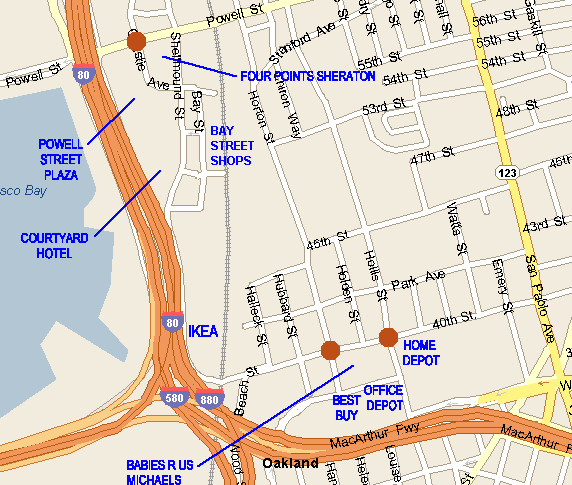
Red dots are Emeryville camera locations.
Major businesses shown: Home Depot, Office Depot, Babies R Us, Ikea, Best Buy, Michaels,
Courtyard hotel, Four Points Sheraton, Bay Street Shops (Abercrombie & Fitch, Apple, Game Stop, Godiva,
Harry and David, Jody Maroni's Sausage Kingdom, Williams-Sonoma), Powell Street Plaza (Trader Joe's, BevMo, Ross).
Map by MapPoint.com
On May 15, 2012 the city council voted to terminate the program. Because the contract requires 45 days advance notice, the program will most likely continue through the end of June.
Ticket counts for Emeryville's cameras, are available at:
Emeryville Documents
.
Some 2010
Alameda County appeal court
decisions (Singh, Blankenship) addressed the confrontation issue (Defect # 10 - D).
If you have an Emeryville red light camera ticket, please also be sure to look at the Countywide Information, on the Oakland Documents page.
(46)
City of Gardena,
California (Program Closed)
Gardena, pop. 58,000, is 7 miles south of downtown Los Angeles.
Some of Gardena's tickets can be ignored. If your "ticket" does not have the Court's name and
address on it, it is a fake ticket, what I call a "Snitch Ticket." For more details, see the Snitch Ticket section on the Your Ticket page.
If you ignore a real Gardena ticket (or a real ticket from any other city in LA County), the LA County Court will not report it to the DMV! For more info, read the "Countywide Information," which is Docs Set # 2 on the LA County Documents page.
Ticket counts for Gardena's cameras are available at:
Gardena Documents
.
(47)
City of Escondido,
California - Closed in 2013
Escondido, pop. 119,000, is 18 miles north of San Diego.
On Aug. 20, 2013 the city council voted to close the program, immediately.
Some of Escondido's tickets can be ignored. If your "ticket" does not have the Court's name and
address on it, it is what I call a "Snitch Ticket." For more details, see the Snitch Ticket section on the Your Ticket page.
Ticket counts for Escondido's cameras are available at:
Escondido Documents
.
Escondido issued warning tickets for 30 days on each new camera it installed (for comparison, see Defect # 6 on the Home page).
(48)
City of Lynwood,
California - Closed Sept. 2017
Lynwood, pop. 66,000, is 5 miles south of downtown Los Angeles.
If you ignore a Lynwood red light camera ticket (or a camera ticket from any other city in LA County), the LA County Court will not report it to the DMV. For more info, read the "Countywide Information," which is Docs Set # 2 on the LA County Documents page.
Many red light camera towns send out "Snitch Tickets," fake tickets that can be ignored no matter what county the town is in. A Snitch Ticket will not have the Court's name and address on it. For more details, see the Snitch Ticket section at the top of the Your Ticket page.
Ticket counts for Lynwood's cameras are at: Lynwood Documents.
(49)
City of Marysville,
California - Closed in May 2016
Marysville, pop. 13,000, is 42 miles north of Sacramento.
The city signed a contract with RedFlex on Dec. 21, 2004.
Many RedFlex
towns send out "Snitch Tickets," which you can ignore. A Snitch
Ticket will not have
the Court's name and address on it. For more details, see the Snitch Ticket section on the Your Ticket
page.
Ticket counts for the City's cameras are available
at: City of Marysville Documents.
(50)
City of Maywood, California (System Closed)
Maywood, pop. 29,000, is 3 miles southeast of downtown Los Angeles.
Some of Maywood's tickets can be ignored. If your "ticket" does not have the Court's name and
address on it, it is what I call a "Snitch Ticket." For more details, see the Snitch Ticket section
on the Your Ticket page.
Maywood closed its camera system in 2009 after the city council
voted 3 - 2 on a motion to deny a one-year
extension of the contract (Ayes: Aguirre, Calderon, Martin).
Ticket counts for the City's cameras are available
at: City of Maywood Documents.
If you ignore a Maywood ticket (or a real ticket from any other city in LA County), the LA County Court will not report it to the DMV. For more info, read the "Countywide Information," which is Docs Set # 2 on the LA County Documents page.
(51)
City of Modesto,
California - Closed
Modesto, pop. 206,000, is 90 miles east of San Francisco.
Some of Modesto's tickets can be ignored. If your "ticket" does not have the Court's name and
address on it, it is what I call a "Snitch Ticket." For more details, see the Snitch Ticket section on the Your Ticket page.
The City's contract with RedFlex includes an illegal "cost neutrality" clause, whereby the city
does not have to pay RedFlex
the full rent if revenue from fines is too low. See Subsection B. of Defect # 10.
Ticket counts, a map of camera locations, and info about the suspension and possible re-opening of the program,
are at Modesto Documents.
(52)
City of Oceanside, California (Closed in 2014)
Oceanside, pop. 158,000, is on the coast 30 miles north of San Diego.
Oceanside signed a contract with RedFlex on Dec. 17, 2003, and the system began operation on Dec. 11, 2004, with 30 days of warning tickets
from all four cameras.
Many RedFlex towns send out "Snitch Tickets," which you can
ignore. A Snitch Ticket will not have the Court's name and address on it. For more details, see the Snitch Ticket
section on the Your Ticket page.
Ticket counts for Oceanside's cameras are at: Oceanside Documents.
(53)
City of Roseville,
California (System Closed)
Roseville, pop. 110,000, is 10 miles north of Sacramento.
The Roseville cameras were shut down in 2007. History:
On Dec. 17, 2003, the City signed a contract with Transol. The contract specified that the City was to pay
Transol $48 per citation paid at the court. (In Aug. 2005, Transol was acquired by Nestor.)
In Oct. 2007 the City Council voted to shut down the cameras.
On June 18, 2008, the City Council approved a contract for a new system, to be installed by RedFlex. The new contract included
an illegal "cost neutrality" clause, whereby
the city would not have had to pay RedFlex
the full rent if the fines received were insufficient to cover it. See Subsection B. of Defect # 10. The contract also
penalized the City if "...the City or Police waives more than 10 percent of valid violations forwarded to the Police
for acceptance..." (see "Quotas" in Defect # 9).
The contract seemed to provide a monetary sanction against the city if city traffic
engineers lengthened the yellows. The contract read:
"Cost neutrality is guaranteed except as follows: If the Customer [the City] fails to maintain the yellow light
change interval that meets minimum standards according to federal, state, and local laws, guidelines, and/or rules."
The passage was open to two conflicting interpretations.
1. The City would be required to maintain yellows at least as long as the length specified by the laws and rules - but could make them longer.
2. The City would be required to maintain the exact length specified by the laws and rules, and could not set longer yellows.
On Mar. 25, 2009, City staff indicated that the City had not been able to reach agreement with RedFlex on
locations for cameras, and that as a result they would not be going ahead with installation unless arrangements
could be made with another vendor.
On Sept. 4, 2009, in an article headlined "City Pulls Plug on Red Light Cameras," the Roseville Press-Tribune wrote: "Camera contractor RedFlex Traffic Systems 'came back and basically
said we can’t find any intersections that would be financially feasible for us to do this and still
guarantee cost-neutrality,' said Roseville Police Spokeswoman Dee Dee Gunther."
Ticket counts for Roseville's cameras are at: Roseville Documents.
If you have a non-camera ticket - issued to you by a RPD officer who pulled you over - and he cited you for violation of a Roseville Municipal Code section rather than a section of the California Vehicle Code, see Section 8 on the Links page.
(54)
City of San Mateo,
California - Closed in July 2019
San Mateo, pop. 91,000, is 15 miles south of San Francisco.
In July 2019 San Mateo refunded nearly 1000 tickets.
Many red light camera towns send out "Snitch Tickets," fake tickets that can be ignored. A Snitch Ticket will not have the Court's name and address on it. For more details, see the Snitch Ticket section at the top of the Your Ticket page.
Ticket counts for San Mateo's cameras (closed in July 2019) are available at:
San Mateo Documents
.
(55)
City of Solana Beach,
California
Solana Beach, pop. 14,000, is on the coast 15 miles north of San Diego.
Many red light camera towns send out "Snitch Tickets," fake tickets that can be ignored. A Snitch Ticket will not have the Court's name and address on it. For more details, see the Snitch Ticket section at the top of the Your Ticket page.
The City signed a contract with RedFlex on Dec. 30, 2003, and began issuing warning tickets in Oct. 2004.
Ticket counts for Solana Beach's cameras are available at:
Solana Beach Documents
.
(56)
City of Davis,
California - Closed in 2014
Davis, pop. 55,000, is 16 miles west of Sacramento.
Many red light camera towns send out "Snitch Tickets," fake tickets that can be ignored. A Snitch Ticket will not have the Court's name and address on it. For more details, see the Snitch Ticket section at the top of the Your Ticket page.
The City signed a contract with Nestor on Aug. 1, 2005. The contract included a "cost neutrality" clause whereby the city would not have to pay Nestor
the full rent if fines were insufficient to cover the rent. On Nov. 21, 2008 an appellate court found that Nestor's similar cost neutrality
contract with the City of Fullerton was illegal. (To read that decision, see Subsection B. of the expanded version of Defect # 10.)
On Apr. 7, 2009, Davis signed a contract amendment removing the cost neutrality clause from its contract.
Unlike most other cities, Davis' camera tickets don't display the Late Time (even though their Nestor system clearly has the
capability to do so). A possible motive to
leave it off could be so that they can cite for very short Late Times (like 0.1 second) without widespread
criticism (including some from judges) about "Mickey Mouse" tickets. See the purple box in Defect # 7 on the Home page, and
Set # 1 on the Davis Documents page, for more information.
(57)
City of Poway,
California (Closed in 2013)
Poway, pop. 50,000, is 15 miles northeast of downtown San Diego.
Some of Poway's tickets can be ignored. If your "ticket" does not have the Court's name and
address on it, it is what I call a "Snitch Ticket." For more details, see the Snitch Ticket section on the Your Ticket page.
Poway signed its original contract with RedFlex in Oct. 2004, and then a new one in Mar. 2010.
At its Mar. 5, 2013 meeting the city council voted to close the system for a six-month study. On Oct. 15 the council voter to permanently remove the cameras.
Ticket counts for Poway's cameras are available at:
Poway Documents
.
(58)
City of Union City,
California (System Closed)
Union City, pop. 65,000, is in the East Bay, 14 miles north of San Jose and 23 miles southeast of San Francisco.
Some of Union City's tickets can be ignored. If your "ticket" does not have the Court's name and
address on it, it is what I call a "Snitch Ticket." For more details, see the Snitch Ticket section on the Your Ticket page.
Program Closed
In March 2005 the city signed a contract with RedFlex. The contract includes an illegal "cost neutrality" clause, whereby
the city will not have to pay RedFlex
the full rent if there aren't enough fines to cover the cost. See Subsection B. of Defect # 10.)
On June 7, 2010 an Oakland Tribune article revealed that Union City would not be renewing the contract, which expired during June.
Big Refund in 2005
In late Sept. 2005 the City announced that it would refund or dismiss approx. 3000 tickets issued prior to Sept. 17, due to
the yellow times having been set too short. Here
is an article about the refund.
And another article.
As of Sept. 26, the City was still deciding what to do about the approx. $270,000 it spent (or owes) RedFlex for issuance of the
now-dismissed tickets. City Manager Larry Cheeves, who until 2003 was the City's
Director of Public Works, told me, "If it (the oversight) was internal, we won't pursue it with RedFlex."
Not all cities that have found too-short yellows have made refunds. For a blatant
example, see the Bakersfield section.
Some 2010
Alameda County appeal court
decisions (Singh, Blankenship) addressed the confrontation issue (Defect # 10 - D).
Ticket counts for Union City's cameras are
available at:
Union City
Documents.
(59)
City of San Leandro,
California
San Leandro, pop. 72,000, is in the East Bay, immediately south of Oakland and 12 miles east of San Francisco.
Many red light camera towns send out "Snitch Tickets," fake tickets that can be ignored. A Snitch Ticket will not have the Court's name and address on it. For more details, see the Snitch Ticket section at the top of the Your Ticket page.
On Sept. 6, 2005 the city council gave preliminary approval to a contract with RedFlex, for cameras at five intersections.
Ticket counts for San Leandro's cameras are
available at:
San Leandro
Documents.
If you have a San Leandro red light camera ticket, please also be sure to look at the Countywide Information, on the Oakland Documents page.
(60)
City of Murrieta,
California - Closed in 2012 after Voters Voted to Ban the Cameras
Murrieta, pop. 93,000, is 30 miles south of Riverside, at the junction of the I-15 and I-215.
On Oct. 18, 2005, the City signed a contract with Nestor. In 2009, the operation of the program was taken over by ATS.
Ticket counts for Murrieta's cameras - and information about the ban - are
available at:
Murrieta
Documents.
(61)
City of Rocklin,
California (System Closed)
Rocklin, pop. 32,000, is 15 miles northeast of Sacramento.
On Sept. 13, 2005 the City signed a contract with RedFlex.
Some of Rocklin's tickets can be ignored. If your "ticket" does not have the Court's name and
address on it, it is what I call a "Snitch Ticket." For more details, see the Snitch Ticket section on the Your Ticket page.
Rocklin's camera program ended on Mar. 8, 2011.
The contract included an illegal "cost neutrality" clause, whereby
the city did not have to pay RedFlex
the full rent if there weren't enough fines to cover the cost. See Subsection B. of Defect # 10.
Regarding the requirement for 30 days of warning tickets (See Defect # 6), the contract did not make
it clear whether there was to be a thirty day warning period each time a new camera is installed, or just
one warning period at the time of the installation of the
first camera.
Ticket counts for Rocklin's cameras are
available at:
Rocklin
Documents.
(62)
City of Laguna Woods,
California - Closed in 2014
Laguna Woods, pop. 20,000, is in Orange County, 12 miles southeast of Santa Ana. It is mostly within the gates of
Leisure World.
Many red light camera towns send out "Snitch Tickets," fake tickets that can be ignored. A Snitch Ticket will not have the Court's name and address on it. For more details, see the Snitch Ticket section at the top of the Your Ticket page.
For ticket counts for the City's cameras,
go to: Laguna Woods Documents.
(63)
City of Loma Linda,
California (Closed)
Loma Linda, pop. 21,000, is 6 miles southeast of San Bernardino.
Some of Loma Linda's tickets can be ignored. If your "ticket" does not have the Court's name and address on it, it is
what I call a "Snitch Ticket." For more details, see the Snitch Ticket section on the Your Ticket page.
On Sept. 13, 2005 the city council gave preliminary approval to a contract with RedFlex.
The draft contract presented to the council includes an illegal "cost neutrality" clause, whereby
the city will not have to pay RedFlex
the full rent if there aren't enough fines to cover the cost. See Subsection B. of Defect # 10.
At its Dec. 8, 2009 meeting the city council voted to have the city manager negotiate with RedFlex for termination of the
program. However, a Jan. 17, 2010 article in the Sun indicated that after negotiations with the city manager, RedFlex had refused to end the program before the Dec. 1, 2010 end of the contract term. At its Apr. 13, 2010 meeting the city council voted to notify RedFlex that the City will not renew the contract.
Ticket counts for Loma Linda's cameras are
available at:
Loma Linda
Documents.
(64)
City of Los Alamitos,
California - Big Refund in 2016?
Los Alamitos, pop. 13,000, is 5 miles northeast of Long Beach.
Many RedFlex
towns send out "Snitch Tickets," which you can ignore. A Snitch
Ticket will not have
the Court's name and address on it. For more details, see the Snitch Ticket section on the Your Ticket
page.
Ticket counts for Los Alamitos' cameras, and details about a possible refund of some 2015 - 2016 tickets, are
available at:
Los Alamitos
Documents.
(65)
City of San Bernardino,
California (Closed for Non-Payment)
San Bernardino, pop. 184,000, is 55 miles east of downtown Los Angeles.
The City's system began operation on Aug. 1, 2005, with a month of warning tickets.
In 2011 the city council attempted to close the program, but was unable to do so because a large early
termination penalty would have been owed to ATS.
In July 2012 the city council voted to file for Chap. 9 bankruptcy protection.
On Dec. 19, 2012 the city attorney wrote that the program was "terminated."
Ticket counts for the City's cameras, and more details about the closing of the program, are available
at: San Bernardino Documents.
(66)
City of Capitola,
California
Capitola, pop. 11,000, is on the coast 75 miles south of San Francisco and just east of
Santa Cruz.
Many red light camera towns send out "Snitch Tickets," fake tickets that can be ignored. A Snitch Ticket will not have the Court's name and address on it. For more details, see the Snitch Ticket section at the top of the Your Ticket page.
Capitola's system began operation on Oct. 1, 2005.
Capitola's contract with American Traffic Solutions (ATS) includes an illegal "cost neutrality" clause, whereby the city does not have to pay ATS
the full rent if there aren't enough fines to cover the cost. See Subsection B. of Defect # 10.
Contract details and ticket counts for the City's cameras are available
at: Capitola Documents.
(67)
City of Santa Fe Springs,
California (System Closed)
(For tickets at Carmenita and Leffingwell, see the LA County section, above.)
Santa Fe Springs, pop. 16,000, is 10 miles southeast of downtown Los Angeles.
Santa Fe Springs signed a contract with Transol in December 2003. (In Aug. 2005 Transol was acquired
by Nestor.) In October 2006 the City cancelled the Nestor contract. On Aug. 25, 2008 the council voted to look into
getting a new camera system. As of March 2009 there were no cameras in the City.
Ticket counts for the City's cameras are available
at: Santa Fe Springs Documents.
If you ignore a Santa Fe Springs ticket (or a ticket from any other city in LA County), the LA County Court will not report it to the DMV. For more info, read the "Countywide Information," which is Docs Set # 2 on the LA County Documents page.
(68)
City of Yuba City,
California (Closed)
Yuba City, pop. 34,000, is 25 miles north of Sacramento.
On Oct. 21, 2005 the city signed a contract with
RedFlex. An article in
the Oct. 19 (or 18?) Appeal-Democrat provides more details.
Many RedFlex
towns send out "Snitch Tickets," which you can ignore. A Snitch
Ticket will not have
the Court's name and address on it. For more details, see the Snitch Ticket section on the Your Ticket
page.
The contract includes an illegal "cost neutrality" clause, whereby the city will not have to pay RedFlex
the full rent if there aren't enough fines to cover the cost. See Subsection B. of Defect # 10.
Defendants having Yuba City tickets should also read Set # 1 and Set # 2 of Marysville Documents - see the Marysville section (# 49) on this page.
On May 15, 2012 the city council voted to let the contract expire on May 31.
Ticket counts for the City's cameras are available
at: Yuba City Documents.
(69)
City of Millbrae,
California
Millbrae, pop. 22,000, is south of San Francisco and just north of San Mateo.
Many red light camera towns send out "Snitch Tickets," fake tickets that can be ignored. A Snitch Ticket will not have the Court's name and address on it. For more details, see the Snitch Ticket section at the top of the Your Ticket page.
If you have a ticket from Millbrae - even one you already have paid - be sure to read the "San Mateo County Information,"
which is Docs Set # 5 on the
San Mateo Documents
page - and contact me!
On March 14, 2006 the city council approved the implementation of a red light camera system, and the
police department's selection of
American Traffic Solutions ("ATS") to be the supplier of the system.
Ticket counts for the City's cameras are available
at: Millbrae Documents.
(70)
City of Newark,
California
Newark, pop. 43,000, is in the East Bay, 9 miles north of San Jose and 24 miles southeast of San Francisco.
The city council approved Newark's contract with RedFlex in March 2006.
Many RedFlex
towns send out "Snitch Tickets," which you can ignore. A Snitch
Ticket will not have
the Court's name and address on it. For more details, see the Snitch Ticket section on the Your Ticket
page.
Ticket counts for the City's cameras are available
at: Newark Documents.
If you have a Newark red light camera ticket, please also be sure to look at the Countywide Information, on the Oakland Documents page.
(71)
City of Baldwin Park - Closed 2015
Baldwin Park, pop. 75,000, is 14 miles east of downtown Los Angeles.
If you ignore a Baldwin Park red light camera ticket (or a camera ticket from any other city in LA County), the LA County Court will not report it to the DMV. For more info, read the "Countywide Information," which is Docs Set # 2 on the LA County Documents page.
Many red light camera towns send out "Snitch Tickets," fake tickets that can be ignored no matter what county the town is in. A Snitch Ticket will not have the Court's name and address on it. For more details, see the Snitch Ticket section at the top of the Your Ticket page.
The city council approved a contract with RedFlex in 2006, an extension in 2011, then in 2015 allowed the contract to expire.
Ticket counts for the City's cameras, and other info, are available
at: Baldwin Park Documents.
(72)
City of Cathedral City,
California (System Closed)
Cathedral City, pop. 36,000, is just southeast of Palm Springs.
The city council approved Cathedral City's contract with ATS in 2005.
The contract included an illegal "cost neutrality" clause,
whereby the city did not have to pay ATS
the full rent if there weren't enough fines to cover the cost. See Subsection B. of Defect # 10.
Ticket counts for the City's cameras are available
at: Cathedral City Documents.
(73)
City of Santa Maria,
California (System Closed)
Santa Maria, pop. 72,000, is 60 miles northwest of Santa Barbara.
On Nov. 24, 2009 the City announced that its camera
vendor had "notified the City that it
will terminate the program" and that the cameras would be removed within 30 days. On Dec. 4 City staff told me that about a week previously the City told the court to stop accepting any fines that came in on the red light camera tickets, and to notify anyone who contacted the court about their ticket (or tried to pay the fine) that the ticket was dismissed. This will not affect fines that the court received prior to the City's order, though. If you have a Santa Maria ticket which you have already paid, please be sure to contact me.
The City has said that it is looking for a new camera vendor. For more info, see the Santa Maria Documents page (linked below).
****
The city council approved Santa Maria's contract with Nestor in November 2006.
The contract included an illegal "cost neutrality" clause,
whereby the city did not have to pay Nestor
the full rent if fines were insufficient to cover the rent. On Nov. 21, 2008 an appellate court found that Nestor's similar "cost neutral"
contract with the City of Fullerton was illegal. To read that decision, see Subsection B. of the expanded version of Defect # 10.
To see examples of the standard reports generated by Nestor (which could be obtained by making a request to the City),
see the reports received from the City of Fullerton (also a Nestor customer), Set # 4 on
the Fullerton Documents page.
Ticket counts for the City's cameras are available
at: Santa Maria Documents.
(74)
MRCA - Mountains Recreation and Conservation Authority,
Southern California
The MRCA is a little-known State-created agency which manages a number of large and small parks in the Greater Los
Angeles area. Among those are Franklin Canyon near Beverly Hills, Temescal Gateway in the Pacific Palisades,
Topanga State Park, Reseda, and the Hollywood Bowl Overlook.
Evidently tired of toiling in obscurity, in March 2007 the MRCA contracted for the installation of two kinds of automated enforcement not permitted by
California law (and found nowhere else in California): (1) Photo enforcement at stop
signs and (2) photo enforcement of
speed.
The MRCA began issuing stop sign tickets in Summer 2007. The speed enforcement portion of the contract was canceled before any speed enforcement began.
The MRCA stop sign cameras use "non-visible" infrared light for
illumination - so humans may not see a flash! To see close-up pictures of an MRCA stop sign cam, see FAQ # 7.
Stop Sign Cam Enclosure on Hillside in Franklin Canyon** Non-standard Warning Sign*** Loops in Pavement, Franklin Canyon
**If to your eye the cam enclosure looks PhotoShopped-in, click on the photo
for a higher-resolution image.
***In addition to the small warning signs attached to the stop signs (depicted above),
the MRCA also has made
up a triangular sign. To see it, go to Defect # 4.
If you ignore a MRCA ticket, you will get a collection letter from a law firm in Ohio.
Ticket counts, and other materials about the MRCA's cameras, are available on highwayrobbery.net,
at: MRCA Documents.
If you would like to help to bring a halt to the MRCA program, call your
State legislators (in your local phone book), your AAA auto club at (714) 885-1222, and the governor, at (916) 445-2841. While you are on the phone with them, please also give them your opinion about the current legislation in Sacramento - see the Legislation section on the Action/Legis page.
You could also write to the LA County District Attorney, Jackie Lacey.
(75)
MTA - Metro - Big Refund in 2017?
Los Angeles County Metropolitan Transportation Authority
If you ignore a Metro red light camera ticket (or a camera ticket from any other city in LA County), the LA County Court will not report it to the DMV. For more info, read the "Countywide Information," which is Docs Set # 2 on the LA County Documents page.
Metro operates buses, subways, and light rail in Los Angeles County.
Metro has over 100 red light cameras, located at road crossings along its Orange Line busway in the San Fernando Valley, along the
Eastside Gold Line light rail in East LA, along the Expo Line light rail which runs from downtown LA to West LA and Culver City,
and along the Blue Line light rail which runs between downtown LA and Long Beach.
Some of the other place and/or street names identified with Metro tickets are Canoga Avenue in Chatsworth and Canoga Park, Reseda, Van Nuys, Studio City, Universal City, North Hollywood, Downtown LA, USC, West LA, Koreatown, East LA, El Monte, South Gate, Lynwood, Willowbrook, Watts, Long Beach Boulevard, and Compton.
The tickets are issued by the Los Angeles County Sheriff, under contract with Metro.
Metro's camera system is separate from the system formerly operated by the City of Los Angeles, and has not shut down.
Metro's cameras are provided by ACS - see Defect # 5 on the Home page.
Metro's contract with ACS includes a clause
whereby ACS is required to "...maintain... the existing rates of citations...." See "Quotas" in
Defect # 9, and Subsection B. of Defect # 10.
At least one Orange Line camera detects an unusual proportion of very high Late Times, compared to other locales (depicted in graph below). For more about that,
see the Metro Documents page.
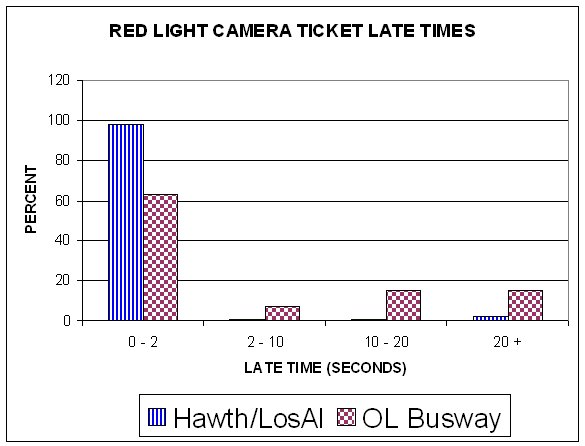
Late Times at Busway Compared to Late Times at Conventional Intersections in Other Cities
Graph by highwayrobbery.net
Many red light camera operators send out "Snitch Tickets," fake tickets that can be ignored no matter what county the camera is in. A Snitch Ticket will not have the Court's name and address on it. For more details, see the Snitch Ticket section at the top of the Your Ticket page.
(76)
City of Lancaster,
California (System Closed)
Lancaster, pop. 145,000, is 40 miles north of Los Angeles.
The city council approved Lancaster's contract with RedFlex in July 2006.
The system closed in 2011.
Many RedFlex
towns send out "Snitch Tickets," fake tickets that can be ignored. A Snitch
Ticket will not have
the Court's name and address on it. For more details, see the Snitch Ticket section at the top of the Your Ticket
page.
If you ignore a real Lancaster ticket (or a real ticket from any other city in LA County), the LA County Court will not report it to the DMV. For more info, read the "Countywide Information," which is Docs Set # 2 on the LA County Documents page.
Ticket counts for the City's cameras are available
at: Lancaster Documents.
(77)
City of Redwood City,
California - Closed in 2013
Redwood City, pop. 76,000, is 20 miles south of San Francisco.
The city council approved Redwood City's contract with RedFlex in April 2007.
The contract expired in Apr. 2013, and the cameras were shut off.
Many red light camera towns send out "Snitch Tickets," fake tickets that can be ignored. A Snitch Ticket will not have the Court's name and address on it. For more details, see the Snitch Ticket section at the top of the Your Ticket page.
If you have a ticket from Redwood City - even one you already have paid - be sure to read the "San Mateo County Information,"
which is Docs Set # 5 on the
San Mateo Documents
page - and contact me!
Ticket counts for the City's cameras are available
at: Redwood City Documents.
(78)
City of Walnut,
California - Closed in 2014
Walnut, pop. 33,000, is 20 miles east of downtown Los Angeles.
If you ignore a Walnut red light camera ticket (or a camera ticket from any other city in LA County), the LA County Court will not report it to the DMV. For more info, read the "Countywide Information," which is Docs Set # 2 on the LA County Documents page.
Many red light camera towns send out "Snitch Tickets," fake tickets that can be ignored no matter what county the town is in. A Snitch Ticket will not have the Court's name and address on it. For more details, see the Snitch Ticket section at the top of the Your Ticket page.
Ticket counts for the City's former cameras are available
at: City of Walnut Documents.
(79)
City of Citrus Heights,
California
Citrus Heights, pop. 88,000, is 8 miles northeast of Sacramento.
Many red light camera towns send out "Snitch Tickets," fake tickets that can be ignored. A Snitch Ticket will not have the Court's name and address on it. For more details, see the Snitch Ticket section at the top of the Your Ticket page.
The city council approved Citrus Heights' contract with RedFlex in Dec. 2007.
If you have a ticket from Citrus Heights - even one you already have paid - be sure to read the "Countywide Information,"
which is Docs Sets # 5 - 6 on the
Sacramento Documents
page.
Ticket counts for the City's cameras are available
at: Citrus Heights Documents.
(80)
City of Riverside,
California - Closed in 2014
Riverside, pop. 248,000, is 50 miles east of Los Angeles.
Many red light camera towns send out "Snitch Tickets," fake tickets that can be ignored. A Snitch Ticket will not have the Court's name and address on it. For more details, see the Snitch Ticket section at the top of the Your Ticket page.
The city council approved Riverside's contract with RedFlex in Aug. 2006. At its July 8, 2014 meeting it voted to close the program - within 60 days.
The contract includes an illegal "cost neutrality" clause,
whereby the city will not have to pay RedFlex
the full rent if there aren't enough fines to cover the cost. See Subsection B. of Defect # 10.
The contract also says: Definitions. "Warning Period" means the period of thirty (30) days after the Installation Date of the first
intersection approach. (Emphasis added.) See Defect # 6.
Riverside holds both the California record for the most tickets issued by a single camera in
one month - 2472 tickets at Indiana/Arlington in Oct. 2009 - and also holds second place, with 2441 tickets at Tyler/91, in Apr. 2009. Complete ticket counts for the City's cameras, and information about the closing of the program, are available
at: City of Riverside Documents.
(81)
City of Moreno Valley,
California (System Closed)
Note: The Moreno Valley courthouse handles the red light camera tickets for a number of Riverside County cities, so "Moreno Valley" is printed
prominently
on all those tickets, and that has led to some confusion. Please double check your ticket to make sure what city issued it.
At a Dec. 15, 2009 study session the Moreno Valley city council voted to terminate the program. The program ended on Jan. 31, 2010.
The city council approved Moreno Valley's contract with RedFlex in July 2007.
Some of Moreno Valley's tickets can be ignored. If your "ticket" does not have the Court's name and
address on it, it is what I call a "Snitch Ticket." For more details, see the Snitch Ticket section on the Your Ticket page.
The City's contract with RedFlex includes an illegal "cost neutrality" clause,
whereby the city will not have to pay RedFlex
the full rent if there aren't enough fines to cover the cost. See Subsection B. of Defect # 10.
The contract also says: Definitions. "Warning Period" means the period of thirty (30) days after the
Installation Date of the subject
intersection approach. (Emphasis added.) See Defect # 6.
Ticket counts for the City's cameras are available
at: Moreno Valley Documents.
(82)
City of Belmont,
California - Closed in 2013
Many red light camera towns send out "Snitch Tickets," fake tickets that can be ignored. A Snitch Ticket will not have the Court's name and address on it. For more details, see the Snitch Ticket section at the top of the Your Ticket page.
The city council approved Belmont's contract with RedFlex in Feb. 2008, and after some delays the cameras went live in April 2010.
If you have a ticket from Belmont - even one you already have paid - be sure to read the "San Mateo County Information,"
which is Docs Set # 5 on the
San Mateo Documents
page.
The contract does not include a "cost neutrality" clause, but does include a clause that
requires the City to enforce on right-hand turns. (See Defect # 9 - B.)
The contract also says: Definitions. "Warning Period" means the period of thirty (30) days after the Installation Date of the first
intersection approach. (Emphasis added.) See Defect # 6.
Based upon figures found in an Apr. 2010 staff report, there could be thousands of right turn tickets monthly at Ralston and Old County.
Ticket counts for the City's cameras are available
at: Belmont Documents.
(83)
City of Highland,
California (Closed in 2014)
Highland, pop. 54,000, is just northeast of the City of San Bernardino.
Many red light camera towns send out "Snitch Tickets," fake tickets that can be ignored. A Snitch Ticket will not have the Court's name and address on it. For more details, see the Snitch Ticket section at the top of the Your Ticket page.
The city council approved Highland's contract with RedFlex in Mar. 2008.
Ticket counts and other information about the City's former cameras are available
at: City of Highland Documents.
(84)
City of San Carlos,
California (System Closed)
The city council approved San Carlos' contract with RedFlex in Nov. 2007.
If you have a ticket from San Carlos - even one you already have paid - be sure to read the "San Mateo County Information,"
which is Docs Set # 5 on the
San Mateo Documents
page.
If you have a San Carlos camera ticket for a straight-thru violation before Jan. 29, 2009, do not pay it! The
yellow light at Industrial and Brittan was set at 3.0 seconds when it should have been set at 3.2, the minimum
required in a 30 mph zone. On Feb. 3, 2009 the City announced it would dismiss/reverse 411 tickets, refund the
fines/points on those already paid, and even reimburse traffic school tuition. At 5 p.m. on Thursday
Jan. 29 they reset the yellow to 3.2 and resumed issuing
tickets. KPIX Report of 2-4-09.
Ticket counts for the City's cameras are available
at: City of San Carlos Documents.
(85)
City of Glendale,
California (Program Closed)
Glendale, pop. 198,000, is 6 miles north of downtown Los Angeles.
Many RedFlex
towns send out "Snitch Tickets," fake tickets that can be ignored. A Snitch
Ticket will not have
the Court's name and address on it. For more details, see the Snitch Ticket section on the Your Ticket
page.
If you ignore a real Glendale ticket (or a real ticket from any other city in LA County), the LA County Court will not report it to the DMV! For more info, read the "Countywide Information," which is Docs Set # 2 on the LA County Documents page.
The city council approved Glendale's contract with RedFlex in Aug. 2007.
The 2007 contract included an illegal "cost neutrality" clause,
whereby the city did not have to pay RedFlex
the full rent if there weren't enough fines to cover the cost. See Subsection B. of Defect # 10.
The cost neutrality clause was removed in 2009.
The contract also says: Definitions. "Warning Period" means the period of thirty (30) days after the Installation Date of the first
intersection approach. (Emphasis added.) See Defect # 6.
Ticket counts for the City's cameras are available
at: City of Glendale Documents.
(86)
City of Napa,
California - Closed Early 2017
Napa, pop. 72,000, is 35 miles north of San Francisco.
Many red light camera towns send out "Snitch Tickets," fake tickets that can be ignored. A Snitch Ticket will not have the Court's name and address on it. For more details, see the Snitch Ticket section at the top of the Your Ticket page.
The city council approved Napa's contract with RedFlex in June 2008.
See the Napa Documents page (linked below) for more info about the contract.
Ticket counts for the City's cameras are available
at: City of Napa Documents.
(87)
City of Redding,
California
Redding, pop. 92,000, is 167 miles north of Sacramento.
Many red light camera towns send out "Snitch Tickets," fake tickets that can be ignored. A Snitch Ticket will not have the Court's name and address on it. For more details, see the Snitch Ticket section at the top of the Your Ticket page.
The city council approved Redding's contract with RedFlex in Feb. 2007.
More information, including ticket counts for the City's cameras, is available
at: Redding Documents.
(88)
City of Daly City,
California - Big Refund in Dec. 2015
Daly City, pop. 106,000, is just south of San Francisco.
Many red light camera towns send out "Snitch Tickets," fake tickets that can be ignored. A Snitch Ticket will not have the Court's name and address on it. For more details, see the Snitch Ticket section at the top of the Your Ticket page.
If you have a ticket from Daly City - even one you already have paid - be sure to read the "San Mateo County Information,"
which is Docs Set # 5 on the
San Mateo Documents
page - and contact me!
The city council approved Daly City's contract with RedFlex in Mar. 2007.
Ticket counts for the City's cameras - and info about the Dec. 2015 refunds - are available
at: Daly City Documents.
(89)
City of Yucaipa,
California (System Closed)
Yucaipa, pop. 54,000, is 15 miles southeast of San Bernardino.
The city council approved Yucaipa's contract with RedFlex in Dec. 2007.
The system was activated on Mar. 1, 2009.
After just over a year of operation, the system was closed, for financial reasons. The last day of operation was June 30, 2010. See this article.
Many RedFlex
towns send out "Snitch Tickets," which you can ignore. A Snitch
Ticket will not have
the Court's name and address on it. For more details, see the Snitch Ticket section on the Your Ticket
page.
The contract included a possibly illegal clause giving the City the right to terminate the contract if fines were insufficient to cover the monthly rent for the system. See Subsection B. of Defect # 10.
The contract also said: Definitions. "Warning Period" means the period of thirty (30) days after the Installation Date of the first
intersection approach. (Emphasis added.) See Defect # 6.
Ticket counts for the City's cameras are available
at: Yucaipa Documents.
(90)
City of Grand Terrace,
California (Closed in 2012)
Grand Terrace, pop. 14,000, is just north of Riverside.
The city council approved the City's contract with RedFlex in Apr. 2007.
On Jul. 12, 2011 the city council voted to close the program on Aug. 14, 2012, when the contract expires. Per the staff report, the reason was fiscal:
"...there was an expectation that citation revenue would cover the cost of the program and provide some additional revenue for the City, which never came to fruition. This coupled with the increased workload the program created for the Finance Department and the Sheriff's Department is the fiscal reason for not extending the program."
Many RedFlex
towns send out "Snitch Tickets," which you can ignore. A Snitch
Ticket will not have
the Court's name and address on it. For more details, see the Snitch Ticket section on the Your Ticket
page.
The contract includes an illegal "cost neutrality" clause,
whereby the City will not have to pay RedFlex
the full rent if there aren't enough fines to cover the cost. See Subsection B. of Defect # 10.
The contract also says: Definitions. "Warning Period" means the period of thirty (30) days after the Installation Date of the first
intersection approach. (Emphasis added.) See Defect # 6.
Ticket counts for the City's cameras are available
at: City of Grand Terrace Documents.
(91)
City of South San Francisco - Closed in 2014
South San Francisco, pop. 60,000, is just south of San Francisco.
Some of the "tickets" mailed by South City may be "Snitch
Tickets," which you can ignore. A Snitch
Ticket will not have
the Court's name and address on it. For more details, see the Snitch Ticket section on the Your Ticket
page, and the example on South City's Documents page.
Ticket counts for the City's cameras are available
at: City of South San Francisco Documents.
(92)
City of Menlo Park,
California (Closed April 2019)
Menlo Park, pop. 31,000, is 20 miles south of San Francisco.
Many red light camera towns send out "Snitch Tickets," fake tickets that can be ignored. A Snitch Ticket will not have the Court's name and address on it. For more details, see the Snitch Ticket section at the top of the Your Ticket page.
If you have a ticket from Menlo Park - even one you already have paid - be sure to read the "San Mateo County Information,"
which is Docs Set # 5 on the
San Mateo Documents
page - and contact me!
Ticket counts for the City's cameras are available
at: City of Menlo Park Documents. If you have a Bayfront/Willow
ticket for a violation before July 3, 2010, be sure to read Docs Set # 3 on that page.
(93)
City of Redlands,
California (System Closed)
Redlands, pop. 73,000, is 10 miles southeast of San Bernardino.
The city council approved the city's contract with RedFlex on Jan. 15, 2008.
If you got a Redlands ticket for a violation before November 2008, please be sure to contact me - even if you already have paid it.
On Oct. 5, 2009 the police department announced that the program had been terminated.
Some of the "tickets" mailed may have been "Snitch
Tickets," which you can ignore. A Snitch
Ticket will not have
the Court's name and address on it. For more details, see the Snitch Ticket section on the Your Ticket
page.
The contract included an illegal "cost neutrality" clause, whereby the city was not required to pay RedFlex the full rent if fine revenue was too low to cover the cost. See Subsection B. of Defect # 10.
The contract said: Definitions. "Warning Period" means the period of thirty (30) days after the Installation Date of the first
intersection approach. (Emphasis added.) See Defect # 6.
Ticket counts for the City's cameras are available
at: City of Redlands Documents.
(94)
City of Victorville,
California - Closed in 2015
Victorville, pop. 105,000, is 20 miles north of San Bernardino, on the route from LA to Las Vegas.
Many red light camera towns send out "Snitch Tickets," fake tickets that can be ignored. A Snitch Ticket will not have the Court's name and address on it. For more details, see the Snitch Ticket section at the top of the Your Ticket page.
The city council approved the city's contract with RedFlex on Sept. 18, 2007.
The contract includes an illegal "cost neutrality" clause,
whereby the city will not have to pay RedFlex
the full rent if there aren't enough fines to cover the cost. See Subsection B. of Defect # 10.
The contract also says: Definitions. "Warning Period" means the period of
thirty (30) days after the Installation Date of each
intersection approach. (Emphasis added.) See Defect # 6.
Ticket counts for the City's cameras are available
at: City of Victorville Documents.
(95)
City of Covina,
California
(For tickets at Cypress & Hollenbeck, see the Los Angeles County section, above.)
Covina, pop. 47,000, is 15 miles east of downtown Los Angeles.
If you ignore a Covina red light camera ticket (or a camera ticket from any other city in LA County), the LA County Court will not report it to the DMV. For more info, read the "Countywide Information," which is Docs Set # 2 on the LA County Documents page.
Many red light camera towns send out "Snitch Tickets," fake tickets that can be ignored no matter what county the town is in. A Snitch Ticket will not have the Court's name and address on it. For more details, see the Snitch Ticket section at the top of the Your Ticket page.
More info, including ticket counts for the City's cameras, is available
on the Covina Documents page.
(96)
City of Bell Gardens,
California - Closed in 2012
Bell Gardens, pop. 44,000, is 6 miles southeast of downtown Los Angeles.
Some of the "tickets" mailed may be "Snitch
Tickets," fake tickets that can be ignored. A Snitch
Ticket will not have
the Court's name and address on it. For more details, see the Snitch Ticket section on the Your Ticket
page.
If you ignore a real Bell Gardens ticket (or a real ticket from any other city in LA County), the LA County Court will not report it to the DMV! For more info, read the "Countywide Information," which is Docs Set # 2 on the LA County Documents page.
The city council approved the city's contract with RedFlex on Oct. 7, 2008.
On Sept. 26, 2011 the city council voted to close the program, effective Mar. 29, 2012.
Ticket counts for the City's cameras are available
at: City of Bell Gardens Documents.
(97)
City of Burlingame,
California (Closed)
Burlingame, pop. 28,000, is 10 miles south of San Francisco.
Many red light camera towns send out "Snitch Tickets," fake tickets that can be ignored. A Snitch Ticket will not have the Court's name and address on it. For more details, see the Snitch Ticket section at the top of the Your Ticket page.
If you have a ticket from Burlingame - even one you already have paid - be sure to read the "San Mateo County Information,"
which is Docs Set # 5 on the
San Mateo Documents
page.
Program Closed
The city council approved the city's contract with RedFlex on Jan. 26, 2007.
On May 24, 2010 a San Mateo County Times article revealed that the city would pay Redflex a $50,000 early termination penalty, and close
the program May 31.
The contract is "flat rate" - it does not include an illegal "cost neutrality" clause.
The contract also says: Definitions. "Warning Period" means the period of thirty (30) days
after the Installation Date of the first
intersection approach. (Emphasis added.) See Defect # 6.
Ticket counts for the City's cameras are available
at: City of Burlingame Documents.
(98)
City of Corona,
California - Closed in 2012
Corona, pop. 150,000, is 10 miles southwest of Riverside.
The City signed a contract with RedFlex on Nov. 5, 2008.
Some of the "tickets" mailed may be "Snitch
Tickets," which you can ignore. A Snitch
Ticket will not have
the Court's name and address on it. For more details, see the Snitch Ticket section on the Your Ticket
page.
The contract includes an illegal "cost neutrality" clause,
whereby the city will not have to pay RedFlex
the full rent if there aren't enough fines to cover the cost. See Subsection B. of Defect # 10.
The contract possibly provides a monetary sanction against the city if city traffic
engineers lengthen the yellows. The contract reads:
"Cost neutrality is guaranteed except as follows: If the Customer [the City] fails to maintain the minimum yellow light
change interval as established by Section 21455.7 of the California Vehicle Code."
The passage is open to two conflicting interpretations.
1. The City is required to maintain yellows that are at least as long as the length specified by the Code - but can be longer.
2. The City is required to maintain the exact length specified by the Code, and may not set yellows that are longer.
The contract also says: Definitions. "Warning Period" means the time period
commencing on the Installation Date for the each
Designated Intersection Approach and ending on the date that is thirty (30) days later. (Emphasis added.) See Defect # 6.
More info about the City's camera program is available
at: City of Corona Documents.
(99)
City of Elk Grove,
California
Elk Grove, pop. 140,000, is 10 miles south of Sacramento.
The City signed a contract with RedFlex on May 23, 2007.
Some of the "tickets" mailed may be "Snitch
Tickets," which you can ignore. A Snitch
Ticket will not have
the Court's name and address on it. For more details, see the Snitch Ticket section on the Your Ticket
page.
If you have a ticket from Elk Grove - even one you already have paid - be sure to read the "Countywide Information,"
which is Docs Sets # 5 - 6 on the
Sacramento Documents
page.
The contract is "flat rate" - it does not include an illegal "cost neutrality" clause.
The contract also says: Definitions. "Warning Period" means the period of thirty (30) days
after the Installation Date of the first
Designated Intersection Approach. (Emphasis added.) See Defect # 6.
Ticket counts for the City's cameras are available
at: City of Elk Grove Documents.
(100)
City of Commerce,
California
( Cameras at the Eastside Gold Line light rail crossings are covered in the Metro/MTA section, above.)
The City of Commerce, pop. 12,500, is just southeast of downtown Los Angeles.
If you ignore a Commerce red light camera ticket (or a camera ticket from any other city in LA County), the LA County Court will not report it to the DMV. For more info, read the "Countywide Information," which is Docs Set # 2 on the LA County Documents page.
Many red light camera towns send out "Snitch Tickets," fake tickets that can be ignored no matter what county the town is in. A Snitch Ticket will not have the Court's name and address on it. For more details, see the Snitch Ticket section at the top of the Your Ticket page.
Commerce tickets are issued by the Los Angeles County Sheriff, under contract with the City.
If you have a Commerce ticket, be sure to read Set # 2 on the Commerce Documents page (see below for link).
The City signed a contract with RedFlex on Jan. 2, 2007.
The contract includes an illegal "cost neutrality" clause,
whereby the city will not have to pay RedFlex
the full rent if there aren't enough fines to cover the cost. See Subsection B. of Defect # 10.
The contract also says: Definitions. "Warning Period" means the period of thirty (30) days after the
Installation Date. "Installation Date" means the date on which RedFlex completes the construction and
installation of at least one (1) Intersection Approach.... See Defect # 6.
Ticket counts for the City's cameras is available
at: City of Commerce Documents.
(101)
City of Hayward,
California - Closed in 2013
Hayward, pop. 140,000, is across the Bay Bridge from San Francisco, and 4 miles south of Oakland.
The City signed a contract with RedFlex on Nov. 9, 2007.
At its Mar. 5, 2013 meeting, the Hayward City Council voted to shut the cameras down, "as soon as possible."
The contract may have been cost neutral. See Subsection B. of Defect # 10, and the discussion on the Hayward Documents page.
The contract also said: Definitions. "Warning Period" means the period of thirty (30) days
after the Installation Date of the first
intersection approach... (Emphasis added.) See Defect # 6.
Some of the "tickets" mailed may be "Snitch
Tickets," which you can ignore. A Snitch
Ticket will not have
the Court's name and address on it. For more details, see the Snitch Ticket section on the Your Ticket
page.
Ticket counts for the City's cameras are available
at: City of Hayward Documents.
If you have a Hayward red light camera ticket, please also be sure to look at the Countywide Information, on the Oakland Documents page.
(102)
City of Oakland - Closed 2014
Oakland, pop. 370,000, is across the Bay Bridge from San Francisco, and just south of Berkeley.
Many red light camera towns send out "Snitch Tickets," fake tickets that can be ignored. A Snitch Ticket will not have the Court's name and address on it. For more details, see the Snitch Ticket section at the top of the Your Ticket page.
The City signed a contract with RedFlex on Aug. 31, 2007.
Some 2010
Alameda County appeal court
decisions (Singh, Blankenship) addressed the confrontation issue (Defect # 10 - D).
If you have a non-camera ticket - issued to you by a OPD officer who pulled you over - and he cited you for violation of an Oakland Municipal Code section rather than a section of the California Vehicle Code, see Section 8 on the Links page.
Ticket counts for the City's red light cameras - and info about the possible speed camera (photo radar) program - are available
at: City of Oakland Documents.
If you have an Oakland red light camera ticket, please also be sure to look at the Countywide Information, on the Oakland Documents page.
(103)
City of San Rafael - Closed 2014
San Rafael, pop. 57,000, is north of San Francisco.
Many red light camera towns send out "Snitch Tickets," fake tickets that can be ignored. A Snitch Ticket will not have the Court's name and address on it. For more details, see the Snitch Ticket section at the top of the Your Ticket page.
The City signed a contract with RedFlex on Mar. 3, 2009.
The contract was "flat rate" - it did not include an illegal "cost neutrality" clause.
The contract also said: Definitions. "Warning Period" means the period of thirty (30) days after the
Installation Date during which only warning notices shall be issued by RedFlex for a Violation. "Installation Date" means
the date on which RedFlex completes the construction and
installation of the RedFlex System at a Designated Intersection Approach.... See Defect # 6.
Ticket counts for the City's cameras are available
at: City of San Rafael Documents.
(104)
City of Paramount,
California (Closed)
Paramount, pop. 55,000, is 7 miles south of downtown Los Angeles.
In a press release dated July 20, 2006, RedFlex announced
that it and the City had mutually agreed that effective Aug. 1, 2006 the City's single
camera would be shut down, "due to a low incidence of red light running." Paramount's system went into operation
on Sept. 1, 2004.
Some of the "tickets" mailed may be "Snitch
Tickets," fake tickets that can be ignored. A Snitch
Ticket will not have
the Court's name and address on it. For more details, see the Snitch Ticket section on the Your Ticket
page.
Ticket counts for the City's
cameras are at: Paramount Documents.
If you ignore a real Paramount ticket (or a real ticket from any other city in LA County), the LA County Court will not report it to the DMV. For more info, read the "Countywide Information," which is Docs Set # 2 on the LA County Documents page.
(105)
City of Irvine,
California (Closed)
In late 2000 Irvine installed two red light cameras, provided by Nestor. They were removed mid-year 2001.
(106)
City of Rancho Cordova,
California
Rancho Cordova, pop. 65,000, is on the east edge of the City of Sacramento.
Many red light camera towns send out "Snitch Tickets," fake tickets that can be ignored. A Snitch Ticket will not have the Court's name and address on it. For more details, see the Snitch Ticket section at the top of the Your Ticket page.
In Feb. 2011 the city council approved a contract with RedFlex.
The cameras went live on Dec. 12, 2012.
More info is available at: Rancho Cordova Documents.
(107)
City of Salinas,
California
Salinas, pop. 158,000, is 12 miles northeast of the City of Monterey.
Many red light camera towns send out "Snitch Tickets," fake tickets that can be ignored. A Snitch Ticket will not have the Court's name and address on it. For more details, see the Snitch Ticket section at the top of the Your Ticket page.
In Nov. 2018 the police department signed a contract with Verra Mobility, formerly ATS.
The cameras will begin issuing real tickets in early Dec. 2019.
According to info published as of Nov. 17, 2019 on the police website, the locations are:
SB Sanborn/Laurel
SB Main/Laurel - near Rabobank Stadium
SB Davis/Laurel - 900' West of the 101 at the Laurel exit
SB Main at Boronda - 800' East of the 101 at the Boronda exit
(108)
Why Don't You Check the Cameras in Your Town? [2]
The "Watch
List"
(And Rumor Control)
The following towns appear on various Internet
lists of places that either have cameras or have signed a contract. Sometimes those lists are
incorrect, premature (the city is just thinking about installing cameras), or out-of-date (the city has shut the cameras
down). Please note that this "Watch List" may not be fully up-to-date. Some cities listed here may have installed cameras. When I receive
further information about any of them, it will be posted below. When a copy of a city's signed contract has become available, a new section will
be added to the town-by-town listing, above.
Anaheim
On June 8, 2010 the city council voted to place a charter amendment banning cameras on the November 2010 ballot. It passed by 73%, and will prevent any future city council from installing cameras unless they first obtain voter approval to remove the ban. See
this article.
Arleta
Arleta, a neighborhood within the City of Los Angeles rather than an independent city, is indexed here because the Insurance Institute for Highway Safety (IIHS) listed it as a city having red light cameras. For information about possible cameras in Arleta, see the City of Los Angeles section, above.
Atherton
On May 17, 2006 the city council voted to conduct a 12-hour test at three intersections. The agenda said, "...if the trial
proves viable, staff recommends... permanent installation." As of Jan. 2009 there were no cameras, but on Jan. 13 the Transportation Committee agenda contained a report
about cameras, and on Feb. 5 City staff indicated that they plan to do a test.
Beaumont
Per a press release dated Oct. 2004, Beaumont had signed a contract with Transol. However, as of Oct. 2005, no system
had been implemented; city staff said they still intended to have a system, but were having problems with CalTrans.
(In Aug. 2005, Transol was acquired by Nestor.)
As of Nov. 2008, Beaumont still did not have a system.
Bell
Status as of Oct. 19, 2005: Per city staff, no red light cameras. Bell's inclusion on some Internet lists
may be because of Maywood's cameras nearby.
See the info about Bell's former police chief, on the Glendale Documents page.
Campbell
Status as of Oct. 6, 2005: Campbell never has had red light cameras but appeared
on lists on some other websites as Campbell did at one time have automated cameras for speeding violations (and
nearby San Jose had speed cameras until they were shut down in March 2007).
Chino
In 2005, Chino was looking into having red light cameras, but had not yet selected a vendor or
signed a contract. On Dec. 6, 2008 PD desk said there were no red light cameras in the city.
Chula Vista
Status as of Jan. 30, 2009: The city had selected RedFlex as their vendor, but had not yet signed a contract.
Colton
Per a
June 15, 2005 article
in the (Bay Area) Daily Review, Colton was looking into having red light cameras. On Dec. 6, 2008 PD desk said there were no red light cameras in the city.
Downey
Status as of Oct. 10, 2005: No red light cameras and no plans to install any. The Florence / Paramount intersection, reported
on some
websites as having a red light camera, does not. It has traffic flow monitoring cameras.
The Firestone / Garfield intersection, reported to be in Downey, is actually in South Gate.
Fountain Valley
Status as of Oct. 19, 2005: Per city staff, no red light cameras. Fountain Valley's inclusion on some Internet lists
may be because of Santa Ana's very busy camera at Harbor / Warner, just across the river.
Gilroy
From the May 7, 2009 Gilroy Dispatch: "We are in the exploratory stage of looking into red light enforcement cameras," said Gilroy Police Sgt. Jim Gillio. "There are no enforcement cameras in Gilroy. Prior to proceeding, we are researching the pros and cons of enforcement cameras to ensure that we make informed recommendations and decisions."
Hemet
The city manager signed a cost neutral contract with Nestor on Jan. 8, 2009.
In Sept. 2009 Nestor, which had gone into receivership, was taken over by ATS, a competitor.
On Oct. 22, 2009 the Riverside Press Enterprise reported that the City was unlikely to go ahead with the program. The PE quoted Police Chief Richard Dana as saying, "I plan on putting out a memo to the City Council that we can't justify it, unless they wish to go ahead."
In his Dec. 18, 2009 PE column, Bob Pratte wrote: "When [ATS] officials examined the Hemet intersections, they backed out of the deal because they didn't believe the intersections would produce sufficient profits." He added: "Good riddance."
On May 11, 2010 the city council heard a report by the police chief. As reported by the PE, Chief Dana said, "It is my recommendation at this time to do nothing with regard to red lights. The chances are if we do it and we start making some money, we could lose a lawsuit and have to pay it back, which would be worse than never getting it in the first place."
Speaking about the contract's "cost neutrality" clause, Chief Dana said, "That essentially amounts to a quota."
On May 29 the PE reported that the council will hold a study session to reconsider the May 11 decision.
On Nov. 15 the City Clerk noted: "The last presentation to the City Council regarding Red Light Cameras was on May 11, 2010."
Hermosa Beach
Status as of April 6, 2005: Hermosa Beach was considering red light cameras. Some information is
available at: Hermosa Beach Documents.
Hillsborough
A Jan. 29, 2006 article in the Oakland
Tribune quoted Hillsborough Police Capt. Mark O'Connor as saying that his department hoped to permanently
install cameras at El Camino Real and Floribunda. However, on June 19, 2006 Capt. O'Connor told me that a RedFlex test of the intersection
revealed no violations during a 24-hour period, and that an installation would not
be cost effective. (The test looked for straight-through violations, not turns.) On Dec. 5, 2008, city staff confirmed that there still is
no contract, and no cameras.
Huntington Beach
On Mar. 2, 2009 the city council voted 5 - 2 (yes: Bohr, Coerper, Green, Hansen, Hardy) to sign a contract for RedFlex to study a number of intersections
in town and to report back to the council in four to six weeks, for final approval.
The program did not gain final approval - a June 2, 2009 Orange County Register article indicated that the police had rejected the program. The article said:
"Panicked drivers trying to avoid a ticket might slam on the brakes causing a rear-end crash, [Police Chief] Small said. Also, he said the number of major traffic collisions from drivers running a red light was not great enough to warrant the cost of the system."
The proposed contract was "flat rate" - it did not include an illegal "cost neutrality" clause.
Huntington Park
Status as of Dec. 6, 2005: At the council meeting of Dec. 5, the city council considered a
police department memo and voted not to move ahead with a camera
program. The City's inclusion on some Internet lists
may be because of Los Angeles's cameras at Olympic and Soto nearby.
Indio
In 2005 Indio was looking into having red light cameras, but on
Dec. 5, 2008 PD staff said there were no red light cameras in Indio. The inclusion on some Internet lists
of a camera on Fred Waring Drive at Miles is inexplicable, as the two streets do not intersect. Neighboring city Indian Wells did have
several cameras along Fred Waring, but they are inactive.
La Puente
At their meeting of July 10, 2007 the council decided not to do a staff-recommended traffic study which could have led
to the installation of cameras.
Laguna Niguel
At their meeting of Sept. 20, 2011 the council voted 4 - 1 (nay: Councilmember Joe Brown) to adopt an ordinance banning the use of red light cameras in the City.
Lemon Grove
As of Nov. 23, 2009 a camera company had studied five intersections, to see how many violations occurred, but the city had not yet
received the results.
Malibu
At its meeting of Oct. 6, 2010 the Malibu Public Safety Commission had on its agenda "...make recommendations to the Council regarding the installation of of traffic and law enforcement cameras." The Commission heard a presentation by Deputy Porche of the West Hollywood red light camera program, but did not recommend red light cameras to the Council. The Commission did recommend the purchase of automated license plate readers.
Manhattan Beach
Status as of Mar. 10, 2006: At the council meeting of Mar. 7, 2006, the city council decided not to install cameras. The
staff report
is on-line on the City's website, under the city council agenda for that date.
Manteca
In Dec. 2019 the council asked staff to look into the installation of cameras, and make a presentation in Feb. 2020.
Staff
Report Article
Ten years earlier, there was a previous attempt to install cameras. In May 2008 the council approved a camera installation to be supplied by Nestor Traffic Systems, but in June 2009 Nestor went into receivership and was sold to ATS (now Verra). No cameras were installed;
an Oct. 12, 2009 Manteca Bulletin
article indicated that the City had cancelled the contract, supposedly because ATS would not provide the collision avoidance systems offered by Nestor.
Martinez
On Feb. 7, 2007 the city council agreed, 4 - 0, to "...research utilization of cameras
for traffic signal enforcement." Status as of Feb. 2, 2009: The city had selected RedFlex
as their vendor, but had not yet signed a contract. Status as of June 17, 2009: Per the city clerk, the city still had not signed a contract.
Mission Viejo
Status as of Oct. 6, 2005: No red light cameras, and no plans to install any.
National City
At its meeting of June 1, 2010 the city council considered the adoption of a contract with RedFlex, and asked staff to report back in two weeks about price and legal issues (the proposed contract contained a cost-neutral clause - see Defect # 10 - B). As of the council agenda for July 6, the matter had not been brought back to the council.
Newport Beach
A charter amendment banning cameras was on the November 2012 ballot and it passed. It will prevent any future city council from installing cameras unless they first obtain voter approval to remove the ban.
Orange
At is meeting of July 26, 2011 the city council adopted an ordinance banning the use of red light cameras in the City.
Oroville
The city signed a contract with RedFlex in Aug. 2007, but then did not move ahead with installation of cameras.
Palm Desert
Status as of Oct. 31, 2005: Palm Desert's inclusion on some Internet lists may be due to Indian Wells' red light camera at
Eldorado / Fred Waring.
Palo Alto
A June 8, 2010 Daily Post article said that Palo Alto may be budgeting for red light cameras. The police department said that they don't yet have a proposal from a red light camera supplier and that the project is "in the research phase."
Placentia
The city council held a study session on Feb. 7, 2006, and according to a Feb. 20, 2006 article
in the Orange County Register,
by April the police were to submit plans for a pilot program, with American Traffic Solutions running
the cameras. On Dec. 8, 2008 city staff said there are no cameras in town.
Pomona
On Mar. 20, 2006 the city council heard a report by the
police chief, in which he did not support the installation of cameras. Nevertheless, the council asked for
more information and the chief said
he would collect cost figures and ask camera companies to make presentations. On Dec. 6, 2008, PD staff said there were no cameras in the city.
Ridgecrest - Shut Down after Survey
In December 2003 they contracted with RedFlex for the
installation of up to
eight systems. The following exchange, found in the minutes of the June 2, 2004 meeting of the Ridgecrest City Council, explains why
no cameras were installed.
"[A citizen] asked if we are proceeding with the RedFlex red light system at our major
intersections. Chief Avery said
RedFlex has completed their survey but no intersection meets their criteria but they have some other things
they think we might be able to use." Per a Dec. 4, 2008 check with city staff, there still are no cameras.
Rio Vista - Contract Signed but Not Implemented
Status as of Nov. 6, 2008: Per City staff, "The contract [including an illegal cost-neutral clause] was approved by adoption of Resolution No. 2006-158 on December 7,
2006; however, enforcement actions on State Route 12 by the Rio Vista Police reduced the amount of red light runners
and the camera was never installed."
Ripon
In Dec. 2019 the council asked staff to come back, in Jan. 2020, with the "firm cost" of installing cameras.
Staff
Report Article
San Bruno - Vendor Selected
On June 9, 2009 the city council voted to install cameras. The police chief told them that negotiation
of a (cost-neutral) contract with RedFlex would be completed in 30 to 60 days. You can watch the
meeting on YouTube. The city
attorney's discussion of cost-neutrality is at 24:45. On May 11, 2010 the city council discussed a report from the
police chief, and appeared not to be interested in moving forward with the program.
San Luis Obispo
Status as of Oct. 31, 2005: Per police department staff, no red light cameras. San Luis Obispo's inclusion
on some Internet lists
may be because of congestion-management or signal-timing cameras they have at some intersections.
San Marcos
Status as of Sept. 29, 2005: Per
an article in the
Sept. 29 North County Times, Councilmember Hal Martin would like to study
installing red light cameras in San Marcos, while the other councilmembers, and the sheriff, didn't see a need for cameras.
San Ramon
Status as of Dec. 5, 2008: PD staff said no red light cameras in San Ramon. The inclusion on some Internet lists
of cameras on Bollinger at Bishop Ranch may be because of the security cameras there.
Santa Monica
On Sept. 25, 2007 the city council approved a camera program. On Dec. 22, 2008, city staff indicated that they will not be
accepting any of the four
proposals received and will be recommending to the city council to not go forward with the project. On Jan. 13, 2009 the city council voted
to adopt the staff recommendation.
Santa Rosa - Shut Down after Test
In approx. 2000 there was a brief test of red light cameras. Then they were removed. PD staff said: "They were not
cost-effective." Status as of Nov. 7, 2008: Per city staff, still no cameras.
Sunnyvale
The Sunnyvale city council discussed cameras at their Sept. 14, 2010 meeting, and by a 7 - 0 vote directed staff to come back after June 2011 with a further report. The item begins at 1:28 on the Granicus video of the meeting (available at the City's website).
Turlock
The Turlock city council discussed cameras at their Apr. 14 and Apr. 28, 2009 meetings, and was considering signing a contract with RedFlex. However, according to an article in the May 13 Turlock Journal, Interim City Manager Gary Hampton said:
"The city attorney and I don't see it being advantageous to the City of Turlock to engage in this effort that could result in us having to expend our valuable financial resources having to defend our red light cameras, at this time." Per the May 18 Modesto Bee, "Reid [TPD Lt. Ron Reid] said the cameras would not be positioned to catch right-hand turn infractions, which are seen as a less serious safety problem..."
West Covina
The City did a test in 2006, but did not sign a contract, and
per a Dec. 4, 2008 inquiry to city staff, there are no cameras.
If you have a non-camera ticket - issued to you by a WCPD officer who pulled you over - and he cited you for violation of a West Covina Municipal Code section rather than a section of the California Vehicle Code, see Section 8 on the Links page.
Westminster
Status as of Oct. 5, 2012: The City does not have cameras. In 2011 the City Council approved a measure for the Nov. 2012 ballot that would have allowed voters to decide if they want red light cameras in the City - like what Anaheim did (see above). In early 2012 the Council decided to remove the item from the ballot.
Westminster's inclusion on some Internet lists
may be because of Garden Grove's cameras on Westminster Boulevard at Brookhurst.
Tickets Issued by Sheriff, CHP, Los Angeles: Disambiguation *
* Wikipedia uses this big
word, so I will too! It's not defined in my dictionary, but I think it means to clarify or explain something.
Some cities/counties/agencies use an outside law enforcement agency to issue their red light camera
tickets. Sometimes only the name of the law enforcement agency (sheriff, CHP) is printed
on the ticket, making it difficult to figure out what city, etc., contracted to have the cameras
installed - and is prosecuting you. Many cities uses the local sheriff to issue
the tickets, but sometimes it is not that simple. This section is meant to clarify the most confusing situations.
CHP officers handle the tickets issued by both the City of Sacramento and the County of Sacramento - but the tickets say they come
from the County of Sacramento, or the Sacramento county sheriff.
The CHP also issued the tickets for the dozen cameras once operated by the County of Los Angeles (you'd think the LA county sheriff
would have been doing that job).
The LAPD issued the tickets for the cameras once operated by the City of LA.
The LA county sheriff issues tickets for the MTA/Metro light rail and busway crossings (even though most crossings are within
the City of LA), and for the cities of
Cerritos (now closed), Commerce, Lancaster (now closed), Lynwood (now closed), Santa Clarita (now closed), Walnut (now closed), and West Hollywood (now closed).
To add to the confusion already surrounding LA area red light camera tickets, some tickets issued for violations near the Metro/MTA Orange Line Busway crossings
show "Van Nuys" as the city issuing the ticket. Van Nuys
is not a separate city - it is a district, or neighborhood, within the City of LA. Tickets from the cameras formerly operated by the City of LA were signed by
the LAPD, and tickets from the MTA/Metro cameras are signed by the LA county sheriff.
Is It a Snitch Ticket?
If someone sent you a "ticket" that does not give the address of the court, or which says, "Do not contact the court," that's not really a ticket at all - so go to the section titled "Police Going Too Far...," on the Your Ticket page.
Footnotes
[1] Sources of Culver
City figures: My estimate of the number of tickets is calculated
using the city's budgetary estimate of income from all cameras,
divided by the dollar amount the City receives per ticket (in
Culver City in 2002, $79.38 - higher in 2004, see FAQ #16), and
divided by the number of cameras in town. It is adjusted to
compensate for whether that camera appears to catch a
disproportionately higher, or lower, number of violators compared
to the other cameras in town. Camera program revenue and expense is
from City's Adopted Budget book, FY 2001-2, pages 2 and 191.
Surplus is from City's Comprehensive Annual Financial Report
("CAFR"), FY ended June 30, 2001, page 4, line entitled: "Excess of
revenues and other sources over expenditures and other uses." All
figures/documents were obtained lawfully. Every city issues a
budget book and a CAFR, and they are public documents.
[2] To report an
illegal camera in your town (or that you've checked their yellow
interval and they're OK), see the Action
page.
[3] The precise grace
time allowed is not stated here, to discourage deliberate running
of the signals.
[4] These statistics
are derived from courtroom testimony. They may not add up to the
total number of tickets heard, as some tickets are disposed of
before the officer has had a chance to complete his testimony and/or display the photos.
[5] See these cities' entries in the Site
Index.
[6] See these cities' entries on this page.
Internal Links
Email: For the email address of the editor of this website, go to the Action page .
Onward, to the Your Ticket page
Can't find
something? There's now a Site
Index
---------------------------------
RED LIGHT
CAMERAS
www.highwayrobbery.net
www.highwayrobbery.net