|
Your Ticket Page:
- 4 -
Handling Your Ticket
( Including: Tickets You Can Ignore, Traffic School, Reduced Fines, Plea Bargaining If Not Eligible for Traffic School, Trial, Trial by Declaration, Trial de Novo, Appeal, Payment Plans, Collections & Amnesty on Delinquent Tickets )
You may be able to ignore your red light camera ticket! Read the "Ignore Your Ticket" section, near the top of this page, before you make any contact with the court.
Is the ticket from a city in LA County, or from a camera near an LA County MTA/Metro light rail line or the Orange Line busway?
In June of 2011 we found out that the LA County Superior Court has not been reporting ignored tickets to the DMV! For info about the option to ignore LA County red light camera tickets, go to Set # 2 on the LA County Documents page.
If you don't want to ignore your ticket but would have great difficulty paying the full fine, read the CalMatters article in the "Ignore Your Ticket" section, near the top of this page, before you make any contact with the court.
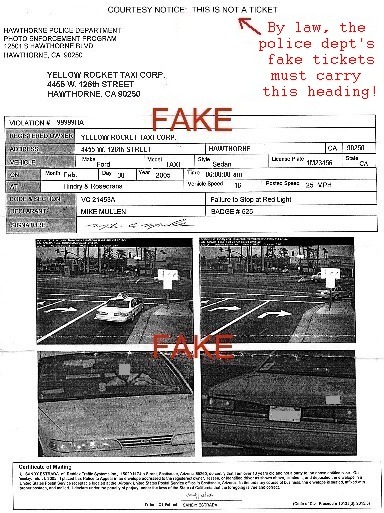
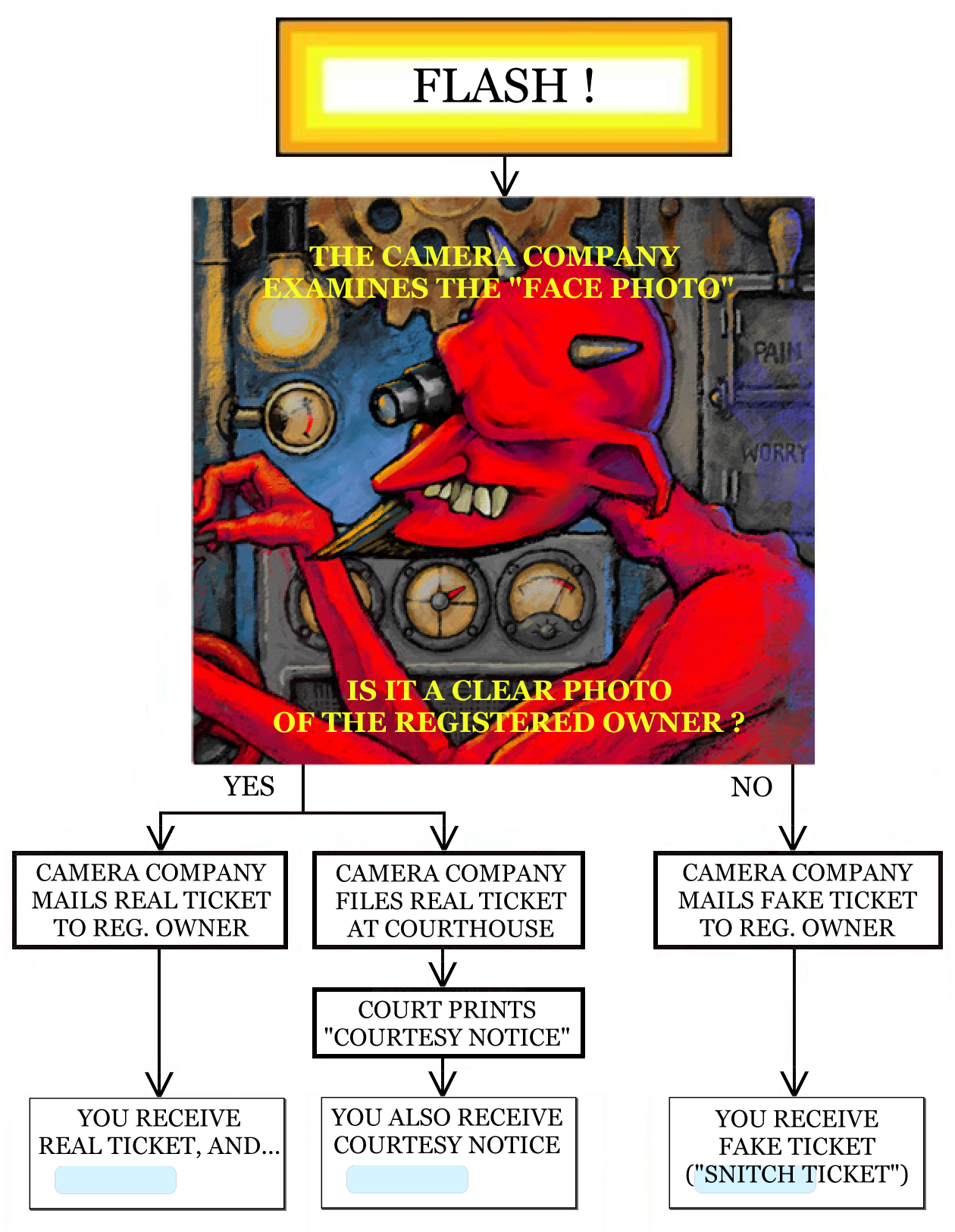
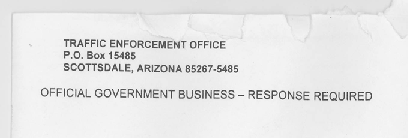
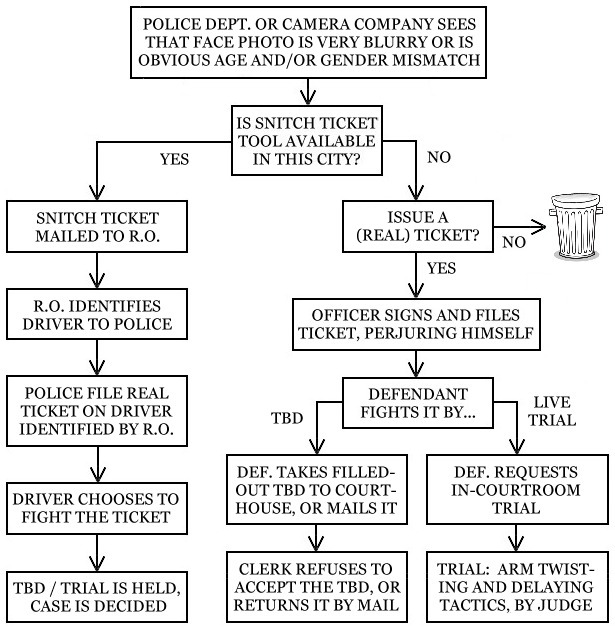
Is It a Snitch Ticket?
If someone sent you a "ticket" that
does not give the address of the Court, or which says, "Do not contact
the court," that's not really a ticket at all - so go to the
section titled "Police Going Too Far...," above.
Did You Get Your Ticket Because Someone Snitched on You?
Or Did You Snitch on Yourself?
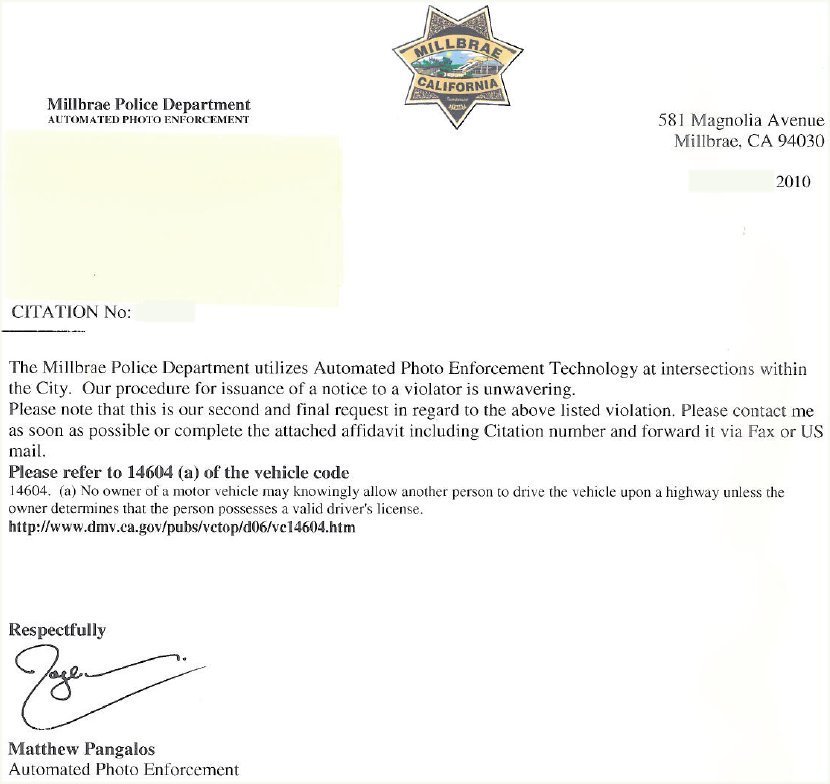
If you got your real ticket only after someone else (or you) received a fake ticket (Snitch Ticket) and
replied to it, be sure to read Defect # 8 before you do anything further.
Was Someone Else Driving Your Car?
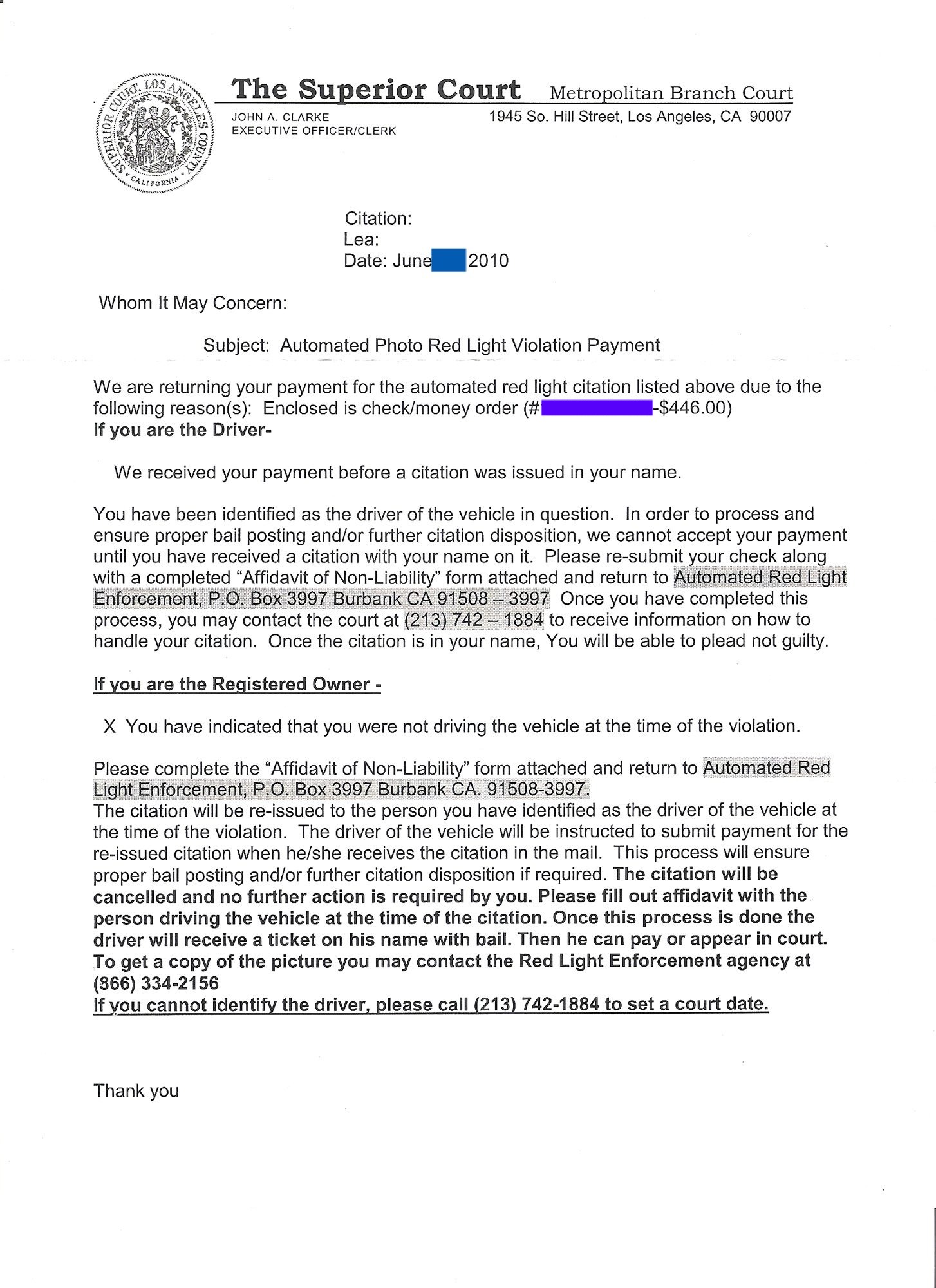
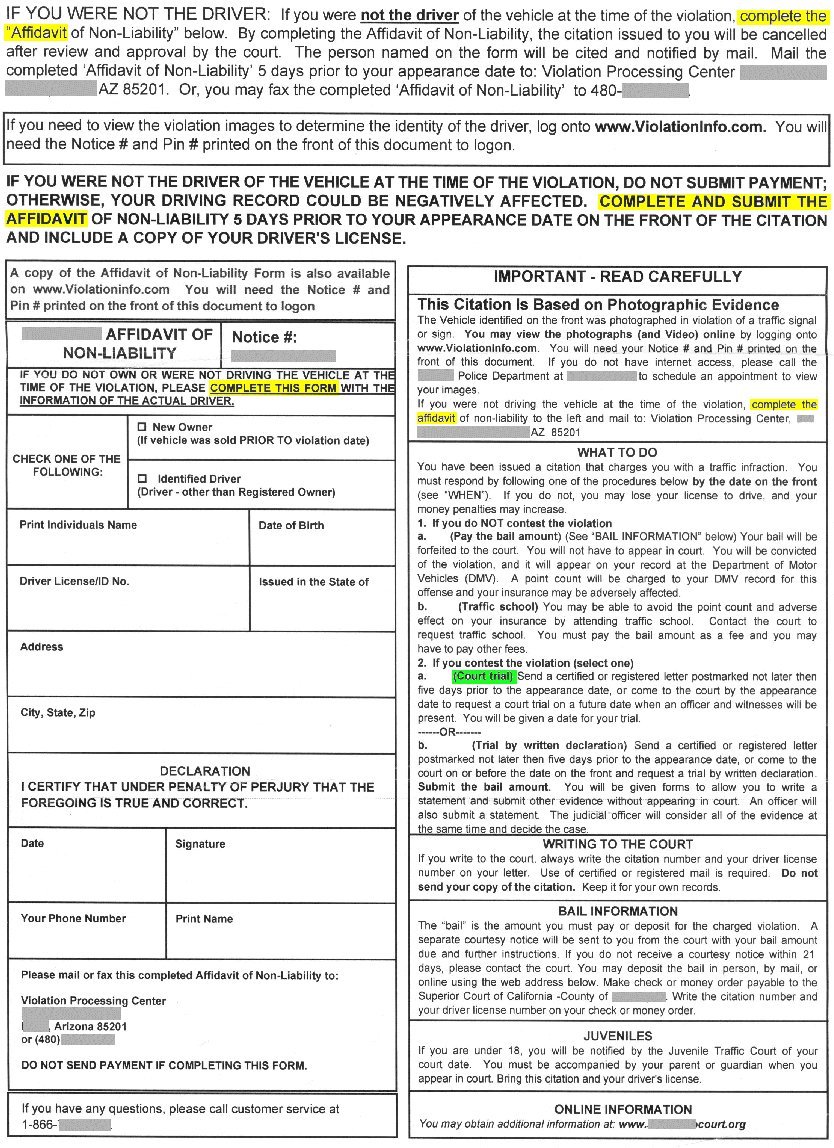
If it's not you in the picture but your name is on the ticket, and it's not a Snitch Ticket, go to the section titled
"It's Not Me," above.
Have You Been to Traffic Court on a Previous Ticket?
If you have never been to traffic court before, you might want to read
this article
about it, to get the "feel" of what traffic court is like.
Is Your Ticket "In Collection," Seriously Delinquent, or Unaffordable?
If so, please read the information in this box.
|
Tickets in Collection, Seriously Delinquent, or Unaffordable - Amnesty
If you would have great difficulty paying the full fine but don't want to ignore your ticket, read the Jan. 2021 CalMatters article in the "Ignore Your Ticket" section, near the top of this page, before you make any contact with the court.
(If the ticket is from a location inside LA County (a city, or the MTA, or the LA County Sheriff), you may have the option to ignore the collection!)
Many defendants never received their original ticket in the mail - or ignored it. If
your case is "in collection" (you got a nasty letter from a collection agency) and you no longer wish to ignore it, get a copy of the original ticket (from the police, the collection agency,
or from the courthouse).
If you see that the original ticket was mailed to a totally
incorrect address due to an error by the issuing agency, the service of the ticket could be defective and you may be able to make your ticket
go away by filing a Serna motion or by "demurring" to it. For more info about
demurring, see Defect # 8, Expanded, and for more info about Serna motions, do an Internet search.
Amnesty/Reduced Fines
If you don't want to ignore your ticket but would have great difficulty paying the full fine, read the Jan. 2021 CalMatters article in the "Ignore Your Ticket" section, near the top of this page, before you make any contact with the court.
Here is info about some previous - now expired - amnesty programs -
From Oct. 1, 2015 to Mar. 31, 2017 there was a statewide amnesty program having the potential to save motorists a lot of money on their old tickets - with even greater savings for low income motorists. Article Official Site.
From Jan. 1 to June 30, 2012 there was a statewide partial amnesty (50% off) for tickets that were due by Jan. 1, 2009 or before. The amnesty was available in every county in the State. The LA County Superior Court issued a press release about the amnesty. To read the amnesty legislation, go to Section 38 of Senate Bill 857 of 2010, and also read Assembly Bill 1358 of 2011.
If you weren't eligible for one of the amnesties, or simply missed the date, and the original mailing of your ticket was to a "good" address for you (maybe it got thrown out with the junk mail, or you ignored it), you can still go to court, see the judge, and
get the amount reduced by a lot. You
should not have to pay the collection in order to get a court date (an "arraignment"). Here's one defendant's story.
"I contacted the collection agency and they gave me new court date and didn't ask for any money. I refused to
give them any information on my address, etc. Strange function for a collection agency, to set up court dates. On their
records it showed that I had gone to court once already. I haven't. What a mess these court records must be. Anyway, I have
to go to the Court in July. I will contact the police and ask for a copy of the ticket. I didn't know I could do
that. Also, I checked with the DMV and I don't have a hold on my license and the collection agency told me that there
is no warrant out for me--whew! Here's hoping that the picture is completely blurred or they dismiss the case."
Some months later the same defendant wrote: "I had court today. Paid the ticket [pled 'nolo contendere'] and was able to get the $300 for not showing up last
time removed. Not a total victory but I'm happy. I have used a P.O. box forever and have that address on my license, registration
and car title, but for some reason the police decided to access my physical address from the DMV and use it. According to
the DMV, that isn't supposed to be done unless it is an emergency or criminal matter. I don't feel that the original
traffic violation was a criminal matter but who's to say. The judge didn't seem to know or care one way or another. He was
waiving the failure to appear charge for most people."
(There's another defendant's "collection story" in Step 2 of the It's Not Me! section, above.)
If the collection notice says
that you have to call the collection agency in order to get a
court date - and on the phone the collection agent tells you that you have to
pay the collection or you can't have a court date - get the name of the
agent, then call the court and
complain. Again: You should not have to pay in order to get a court
date.
I have talked with many camera defendants who were in the "Collections" line at the courthouse. They break-down into
two categories. Some have a collection for about $800 and a driver's license suspension for failure to
appear ("FTA"). The others
have a collection for about $600, no suspension, no FTA. The people with the larger $$ amount
and the suspension told me that right after they first received their ticket they had contacted the court, to get information or to
take an extension. By doing so they
acknowledged that they had
received the ticket. The people with the smaller $$ amount and no suspension had not acknowledged receiving the ticket -
because they genuinely hadn't received it due to mail being misdelivered, not forwarded, or stolen.
When you appear before the judge, he will wipe out all of the collection fees. But if you
had an FTA, he will charge you approx. $100 in "court costs."
If you want to fight it, not just give up and pay the money, have a look at Defect # 8 on the Home page, this
Arizona appellate
court decision (Arizona), and Penal Code Sec. 1214.1
If the ticket is from a location (a city, or the MTA) inside LA County, you may have the option to ignore the collection!
If you live outside of California and are thinking about ignoring the collection, see FAQ # 39.
|
Dealing With It
If you don't want the worry of deliberately
ignoring the ticket (who does? - unless it's a Snitch Ticket), please continue reading.
What's Your Late Time ?
Late Time is how long the signal already had been red (actually, how long power had been applied to the
red light bulb) when your picture was taken. If you cannot find the Late Time figure on your ticket, or it is
illegible, see Defect # 5 and the How to Read Your
Late Time box in Defect # 7.
Beating It on a Technicality
Technicalities having to do with late mailing of the ticket, improper proof of service, or an
incomplete ticket, are described in Defect # 8 on the Home page. Examine your ticket carefully!
Another technicality: The contract - between the city and the company supplying the cameras - may be illegal. State law says the city shall not
pay the camera supplier on the basis of the number of tickets issued, or as a percentage of the revenue coming to
the city from the court. Despite that law, many cities
have agreed to do so. See Defect # 10 - B for more information.
And one more technicality: One
experienced defendant recommends that you
immediately file an extensive Discovery (to which the City must
reply within 15 days), refuse to waive your right to a trial within 45 days ("speedy trial" - also see FAQ # 28) and, when the City has not complied with the
Discovery request, go to court and ask for dismissal of the case.
He admits that it does not work all the time in the lower (traffic)
court, but will guarantee your conviction being overturned on appeal.
Change of Venue
Moving your ticket to a different judge, or a different courthouse, may be to your advantage. See
the Challenges page.
Confusing Terminology
If you're not sure what an extension to a "respond to" date is, and what the
difference is between an arraignment and a trial, please read the info in this box.
|
Often-Misunderstood / Confused Courthouse Terminology
The Three Steps: "Respond to..."
and
Arraignment
and
Trial
1. "Respond to..."
The first step. Except in LA County where you may have the option to ignore the ticket, you must
do something on or before the "respond to the court" date printed on your ticket. See details, below.
2. Arraignment
The next required step.
3. Trial
The last step, which is optional.
The Details
"Respond to..."
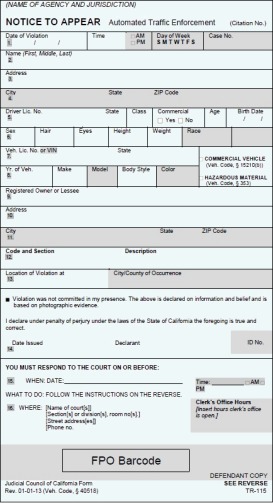
Your ticket should say, "You must respond to the court on or before ________ ." That's part
of the official format, so if your ticket
doesn't have such a statement, it could be a
fake ticket; see the Police Going Too Far... section, above. If the ticket is real, you will need to take one of
the following actions by that "respond to" date (or any extension of it) - unless the ticket is from a city or agency located in LA County. (You may have the option to ignore an LA County ticket.)
1. Put it off: If you need time to think, or to contact the police, or to get the fine money together, you can ask the court clerks for an
extension; depending upon what county you are in, they
will add 30 to 60 days to the "respond to" date. In most counties, you can obtain your extension at the website for that county's Superior Court. Or, you can do it by phone, by mail, or by going to the courthouse. (If you make your extension
request over the phone, make a note of the name of the
clerk you talked to, and the date and time you called.) When that extension is about up you will have to
make a decision: If you want to do a Trial by
Declaration, you will need to ask for it (and pay the bail) before the extension runs out. (See "The Deadline to
Request a TBD," in the TBD
section at the big green heading, way below.) If you don't
want to do a TBD, you could wait 'til the extension is about up, then call the court and
set up an arraignment date, which will be 2 to 10 weeks (or much more) away. Or, if your court offers it, you could
go to a "walk-in" arraignment (no appointment necessary). Before you do your arraignment, you
will need to decide whether to
pay the ticket (see the paragraph below), or fight it at a "live" trial (see the Trial section, in this box).
2. Arraign yourself, or schedule a date for an arraignment in front of a judge, or set
up a TBD: In California, traffic
tickets are a criminal matter (the least serious kind, an infraction), so are handled somewhat like the
more serious crimes. First there is an arraignment, and then, if you want to fight the ticket, there is
a trial. (Usually on a separate date, although some counties push to combine arraignment and trial.)
3. Pay it: If you don't want to fight your ticket - you just want to pay it and get
traffic school (assuming you're eligible for regular traffic school and have all the money together - or a credit card) - you
can enter your plea of "guilty" and also pay the fine, both in the same visit to the clerk's
window. Or, you could do it by mail, phone, or even possibly on the Superior Court's website - you can avoid
visiting the courthouse even once! But there is a possible disadvantage of not going to court: Some judges reduce
the fine on certain tickets, such
as rolling rights, or those with a short Late Time!
Arraignment
The basic purpose of arraignment is for you to
enter a plea of "guilty" or "not guilty." With a more serious crime like a misdemeanor or a felony, arraignment is always in front of a judge; but
for your infraction, you may have the option to arraign yourself at the clerk's window,
by mail, on the phone, in front of a judge, or even on
the Superior Court's website. If you're pleading "guilty," you will also make arrangements to pay
the fine. If you're pleading
"not guilty," you will set a date for the trial. If you enter your "not guilty" plea at the court and then sign a written promise to show up on the trial date, you should not have to post any bail. One form of "not guilty" arraignment is to request a
Trial by Declaration ("TBD"). If
you want to do a TBD, you will need to request it
by the "respond to" date, or by the extended "respond to" date, and you will need to post the bail. (See "The Deadline to Request a TBD," in the TBD section at
the big green heading, way below.)
Arraignment in Front of a Judge
You don't have to do your arraignment in front
of a judge (see above), but here are some good reasons to do so. (You do not have
to pay any money, or any "collection," in order
to obtain an arraignment date in front of a judge - even if your ticket is in collection.)
1. You're planning to plead "guilty" - which by itself does not require an appearance before
a judge - but you want to plea bargain, see if the judge will reduce the fine, give you Community Service, or extra time to pay (see Payment Plans, immediately below this box).
2. You're not eligible for traffic school, and you want to plea bargain - ask the judge if he will change the charge from CVC 21453 to some other section not carrying a point - in exchange for your guilty plea. (Read the
pink-ish Alternatives box, below, for more
info.)
3. You want to tell the judge that it was not you driving
the car and get the ticket dismissed. For a discussion of what not to say to the judge if it wasn't you, see the Second Step of
the "It's Not Me!" section, above. Please also note that most judges are unwilling to
decide identity issues at arraignment and will suggest that you plead "not guilty" and go to trial - especially if the
person pictured looks similar to you.
4. You want to get rid of collection fees or a "failure to appear."
5. You're planning to plead "not guilty" and set up a trial date (things you can do by mail), but want to maintain your "right to a speedy trial" or you want to avoid having to put up the bail.
If you enter your "not guilty" plea by mail, or with a window clerk -
not in front of a judge - you may be giving up your right to a speedy trial. See FAQ # 28.
6. You want to tell the judge about the city's failure to respond to your Discovery request.
7. You want to make a request for Change of Venue (moves the case to another courthouse).
8. You have mailed-in a Peremptory Challenge, but there has been no response from the court.
9. You plan to file a demurrer (per Defect # 8 - A).
10. Your arraignment appearance could be an extra opportunity to set up a
Trial by Declaration ("TBD") - See "The Deadline to Request a TBD," in the TBD section at the big green heading, way below.)
An arraignment session is NOT:
It's not a trial, so the officer who issued your ticket will not be present. As a result, you will not be allowed to
argue your case, except for (possibly) the issue of identity.
Trial
or
Trial by Declaration ("TBD")
If you've decided that you want a trial, you have a choice
of a "live" trial, or a Trial by Declaration.
To set up a "live" trial you plead "not guilty." If you enter that plea at the court and then sign a written promise to show up on the trial date, you should not have to post any bail.
You can enter your "not guilty" plea by "snail" mail so long as you act at
least 5 days before your "respond to" date or any arraignment date you've set, whichever is later. But you will have to post the bail!
At your trial there will be a representative
from the police department that issued your ticket. (It doesn't have to
be the same person who signed your ticket. See FAQ # 36.) The trial will be your opportunity to question
the officer, or ask the
judge if he thinks the blurry or similar-looking person pictured on the ticket really is you. At the trial you can still
do some of the things you can do at an arraignment. For instance, even if the judge has just found you "guilty," you can
still ask for traffic school, Community Service, a reduced fine, or extra time to pay. (You may or may not be granted
traffic school, etc. - at a trial the granting of such things is at the judge's discretion.)
A TBD - Trial by Declaration - can be done without making any visits to the courthouse. If
you want to schedule a TBD, you will need to make your request
by the "respond to" date or extended "respond to" date. For more info, see the
TBD section at the big green heading, way below.
|
Payment Plans
Most courts offer some kind of
time-payment plan to defendants who plead "guilty," to allow you a couple
extra months to pay. In most counties, you will need to appear before a judge in order to set up a payment plan; but in LA County - beginning Dec. 2015 -
you can set up a payment plan by visiting the court's website (press release). In all counties there is a finance
fee for the payment plan privilege, but it may be included in the traffic school fee. If you want to combine time to pay and traffic school,
you will need to finish all payments within 90 days, per CVC 42007(a)(2).
From a reader:
"Perhaps you could make a suggestion to people that when they pay their fine or their bail, that they write
in the 'memo' area of the check a much-needed purchase like
"new tires," "car insurance," "health insurance," "college tuition," "mortgage payment," or "children's school clothing." You get the
idea. Force the employees administering this beast to live with the personal
individual carnage every day at work."
More Often-Misunderstood Courthouse Terminology***
"Suspended sentence"
Sometimes a judge will offer to "suspend your sentence." That
means that you will not have to pay the fine - but he or she is still
finding you "guilty" and you will have a point on your record unless you
go to traffic school.
***This is not the "big green" Terminology box! Scroll up for it.
|
Please first read the What's Hot box on the Home page, and on the Camera Towns page, the
information about "your" town.
Is It a Snitch Ticket?
If someone sent you a "ticket" that
does not give the address of the Court, or which says, "Do not contact
the court," that's not really a ticket at all - so go to the
section titled "Police Going Too Far...," above.
Be Very Skeptical of Anything Court Personnel Tells You:
Index to Lies/Disinformation Coming from the Authorities

1) If the Court's address and phone number are not on the ticket, the
ticket may not be real! - Have a look at the "Police Going Too Far..." section, near the top of this page.
2) If you've been told you can't do discovery on a traffic ticket, see
the Getting Records/Discovery page.
3) If you've been told you cannot tape your trial, see
the Get Your Trial Recorded page.
4) If you are not the
driver pictured on the ticket, see the purple Sneaky Lies box in the It's Not Me! section, above.
5) If you are planning to do a Trial by Declaration ("TBD"), see the
purple Doing a TBD? Watch Out for This! box in the TBD section, below.
|
Step 1: Extensions, Discovery, Traffic School, Preparation
Extensions & Discovery
If you
just got a red light camera ticket, don't plead
"guilty" right away, even if they'll let you go to traffic school. In most counties you
are eligible for an extension, no questions asked, and you won't be asked to post the bail or
enter a plea. The extension can be up to 60 days, and it will be added to
the "respond to the court" date printed on the ticket. (If your ticket
doesn't say "respond to the court," it could be a
fake ticket; see the Police Going Too Far... section, above.)
In order to get an extension, you have to contact the court, and that contact acknowledges that you received the ticket - with a downside: If the ticket is from a city or agency inside LA County, you lose your option to ignore the ticket and will get a Failure to Appear ("FTA") charge if you do not take care of the ticket by the extended due date.
There's several ways to request an extension.
a) You may be able to request the extension over the Internet, by going to the website of the Superior Court of the county in which your ticket was issued. If the court's website address is not listed on your ticket, you
can get it here.
b) Call the court's phone
number, which is listed on the ticket. (If you make your extension request over the phone, make a note of the name of the
clerk who you talked to, and the date and time you talked. And, when you are talking to that "live" court clerk, find out
what day of the week and time - morning or afternoon - the "not guilty" trials are held. The information
may come in handy later.)
c) If it is at least five business days before your "respond to" date, you could
request your extension by mail - but be sure to use Certified Mail, with a Return Receipt.
d) Go to the courthouse and see the window clerks. If you are going to the courthouse, you may want to schedule your visit at a time
that court is in session, so you can go watch the judge in action. See the "About Your Judge" box, below.
Once you have your extension, use the
extra time to do the research indicated in Step 2
below. If you are going to
fight the ticket and want a preview of the documents and photos/video the City will present at the trial, do a Discovery without
delay. I strongly recommend doing so. Details about
Discovery are at: Getting Records/Discovery.
Traffic School, Commercial Licenses, Alternate Pleas To Avoid a Point
If you have a commercial license and your violation occurred while you were driving a commercial vehicle, or if you attended
traffic school for a
previous violation that occurred less than 18 months before the date of
your red light camera violation (the interval is measured between the
dates the violations occurred, not between dates of conviction), you're
probably not eligible for traffic school - So read the "Alternatives" info in the big box, below.
Alternatives:
Traffic School
Commercial Licenses
Alternate Pleas to Avoid a Point
If you do not have a commerical license and
you are not eligible for traffic school because of
the required 18-month spacing or because you live outside California, there is an alternative. You
could plea bargain - ask the prosecutor (usually the police) or the judge if they will allow you to plead
guilty to CVC
21710, "Coasting," which does not carry a
point. Or CVC
38300.
Or a violation of some section of the local
municipal code.
If you have a commercial license and your violation
occurred while you were driving a non-commercial
vehicle, a new law (CVC
42005) effective Jan. 1, 2013 allows you to
attend traffic school!
If you have a commercial license and your violation
occurred while you were driving a commercial
vehicle, you're probably not eligible for traffic
school, but you could try plea bargaining, described above.
For the official rules about traffic school, and
some case law, follow the links at the bottom of the
Editorial
in Section 5 of the Links page.
|
If you want to get away from a particular judge because he doesn't reduce fines, give a reasonable amount of time to pay, doesn't allow Community Service, or for any other reason, you
can file a Challenge, under Code of Civil Procedures 170.3 or 170.6, to
get another judge. If your Challenge is successful
and your judge was the only traffic judge in the courthouse, your case
likely will be moved to another courthouse. If you have pled "not
guilty," that extra distance will improve the odds that the officer will not show up for
your trial. See: Challenges.
But there is a deadline for
filing a Challenge, and if it is now too late for you to file one,
pleading "not guilty" is still a good idea - maybe the judge you don't
want will be on vacation on your trial date, and the substitute judge
will grant you the reduced fine, or payment plan that you need.
About Your Judge
Checking Him Out in Advance
If you don't know what "your" judge is like - does he reduce fines, does he
grant Community Service, etc. - and don't want to wait 'til your arraignment (or trial) date to find out, you could go observe one of his
court sessions. I recommend, however, that you leave the courtroom before the last case is called. Why? If
the judge has just
called the last case on his list and he notices one more person (you) still sitting in
the "pews," he will ask you, "Do you have a case scheduled today?" You will have to explain that
you are "just observing" - and he will end up remembering you.
Judge, Commissioner, or Pro Tem?
I recommend that you move your case away from any judge or commissioner who handles a lot of red light camera cases.
And, I strongly recommend that you not allow your case to be heard by any Pro Tem. A Pro Tem is an attorney acting as a temporary judge, and you can simply refuse to
have your case heard by one. You have the right to have your case heard by a commissioner, or a judge - unless
you waive that right! If there is a Pro Tem on the bench, the courtroom personnel will ask you to sign a waiver (often it will be on a clipboard passed around the courtroom), and you can refuse to sign. You don't have to use up your
one Peremptory Challenge to do so, either.
It may be
to your advantage to have your case heard by a real judge. If your case is scheduled to be heard by a
commissioner and all the other courtrooms in the courthouse are
presided over by judges, you may want to file a Peremptory Challenge ("PC"), so that your
case might be moved to one of the judges. You won't always get a judge, though, as they could instead move your case to another
commissioner in another court building nearby in
the county.
|
Preparing for Trial - and More about Traffic School
|
The New "No Bail" Privilege Could Be a Trap for You!
A June 2015 amendment to the Rules of Court allows defendants to schedule a "not guilty" court trial without posting bail. But be warned: If a defendant sets up a trial date without posting bail and then fails to show up for the trial, the judge is likely to issue a bench warrant and/or suspend the defendant's license. So, defendants who are not so good about making it to important appointments should think twice before taking advantage of the new "no bail" privilege.
|
If you want to go to trial, you
will need to plead "not guilty" and pay the bail unless you are taking advantage of the new "no bail" privilege (see box above).
(Warning: If you wish to maintain your "right to a speedy trial" you will need to enter your not guilty plea in front of a judge, not at the clerk's window and not by mail. See FAQ # 28.)
If you want a preview of the documents and photos/video the City will present at the trial, file for Discovery (and issue
any subpoenas for other documents) without delay. (If possible, file for Discovery well before
your arraignment date.) Details about Discovery and subpoenas
are at: Getting
Records/Discovery. Later, if
the City has not supplied the Discovery materials you asked for, take the action recommended in
Fight Your Ticket.
Request an extension if necessary. Use the extra time
to do the research indicated in Step 2 below. (If you obtain your extension via a phone call to the court, make a note of the name of the
clerk who you talked to, and the date and time you called.)
Defendants who go to trial and lose can still
ask for traffic school (either kind), although the granting of it after you've pled "not guilty" is at the discretion of the judge. If you receive reliable information that your judge hardly ever grants traffic school
to those who lose at trial, consider doing a Peremptory Challenge. Or, if after you asked
for a trial you got a "Trial Date" letter or a "Notice of Trial After Written Plea"
containing a statement similar to this one formerly found in notices from the Long Beach courts,

(Don't
panic - it isn't true! - Editor)
you should file a Peremptory
Challenge. Be prepared to do the same if sometime during the trial session the
judge announces a general policy of "no traffic school after trial." And
if it is too late to file a PC, you could try a
Challenge for Cause - the prejudice being that by pre-determining your
penalty, the court has pre-judged your case. See: Challenges.
If it was the bailiff, or (earlier) a phone attendant at the clerk's office who said, "no school after trial," ask your trial judge if it
is true.
Further reading about traffic school is in the Editorial on the Links page,
the materials linked at the end of it, and the traffic school info in Step 3, below.
I strongly recommend that you make a
request that your trial be recorded. Otherwise, some
judges will trample all over you. It is best to make the request ahead of time, before
the trial date.
If you have filed a Discovery request, doing so obliges you to discover your materials to the prosecution prior to trial.
Trial by Declaration
See the TBD section, at the big green heading below.
Step 2: Investigation
Step 2: Defects # 2, 4 through 8, and 10, are the focus here as they are the least subjective
defects. Either the signal had enough yellow time in compliance
with Section 21455.7, or it didn't; either the warning signs were
big enough and posted in the required places, or they weren't; either the red light is visible
in the ticket photo, or it isn't; either the
City issued warning tickets for 30 days when they
started your camera, or they didn't; either the ticket was
mailed on time and with proper proof of service, or it wasn't; either the City (not the camera company) wrote up
guidelines (and by the appropriate date), or they didn't; either (a non-grandfathered) city pays its vendor a totally flat
rate, or it doesn't.
To find out if the intersection you were
ticketed at has enough yellow, look up the legal minimum in the Yellow
Change Interval table (see Defect # 2 on the Home Page). Compare that
with the amount the
signal actually has. The box below tells you how to determine that actual
amount, and document it.
Step 2
(cont'd): Measuring
the Yellow - Some Methods
Method 1: The Fastest - It Might Be on Your Ticket!
Some cities imprint the length of the yellow right on the ticket,
sometimes in the very small print along the top border of the photos.
[Important
Note: While the ACS camera system used in many
cities, such as West Hollywood, actually imprints the programmed yellow time in a
black box right on the ticket photos, that figure may not represent, as
we had been led to believe, the actual length of the yellow you would
see while driving - as we found at Whittier / Atlantic in East
LA. (See the East LA section of the Camera Towns
page,
and Defect # 5 on the Home page.)]
Method 2: Requires a Visit to the Intersection and a Stopwatch and/or Video Camera
A. Go to the intersection with a video
camera and a stopwatch. Measure the yellow with the
stopwatch, several times. Stopwatches aren't very accurate, but if the
stopwatch reads more than (approx.) 0.4 seconds above the required
minimum and about the same as the yellow imprinted on your ticket (if
the ticket is from a camera type that imprints the yellow), the yellow
length is probably OK.
B. Next, if the stopwatch time is less than 0.4
above the minimum, make a videotape of the signal (or a 30-frames-per-second video using a high-end
digital still camera*), then play the video a frame at a time and
count the number of frames that the yellow is lit (stop counting
when you see the red begin to come on, even if the yellow still is glowing
slightly). Divide by 30 to get the number of seconds (or by 15, 16.4 or
30, whichever is the frame rate of your still camera). If the result,
rounded down to
tenths, is equal to or greater than the required minimum and not greater than
the yellow imprinted on your ticket (if any), the yellow interval is
probably OK. But if your result is less than the
required minimum, or greater than the yellow imprinted on your ticket
(if any), you may have found an illegal camera. Keep the tape.
Get someone else to make a back-up tape of the signal, with another camera. Or call the local TV news.
*A video camera, because of its frame rate
of 30 frames per second, will give you a more accurate measurement than will a digital still camera or a cellphone camera,
which may have a frame rate of half that.
Method 3: Get the Violation Video and Count the Frames
If your ticket was from a
camera that takes a 12-second long video of each violation, you may be able to measure the yellow
by counting frames on that video - similar to the method immediately
above.
Sometimes the copy of that video available at the camera company's website is one that has been cut down to 15 frames per
second, to save bandwidth on the site. In that case, to get a look at the full 30-frame original you may need to file for Discovery - see the Getting
Records/Discovery page. Once you
have the video, use a program such as Windows Movie Maker to play it.
If you are trying to save one of the photos from the camera company's website, and the website will not allow
you to save it, you can hit your "Print Screen" button (upper right corner of keyboard), which will
grab a copy of your entire screen! Then just go to your favorite "paint" program and paste-in the saved screen image by hitting Ctrl-V.
|
Step 2 (cont'd): Length of Yellow
If you have checked the length of the yellow and it appears
to be shorter than the length required for the posted speed, get a certified copy
of the signal timing chart for "your" intersection - or call the local TV news people.
Or, if the yellow appears to be long enough for the posted speed but you intend
to argue Defect # 2 because there is a big difference between the 85th
Percentile speed and the posted speed limit, get two things: (1)
A certified copy of the speed survey for "your" street and (2), ask me to
send you a copy of my appeal briefs.
Details about making requests for city documents
are at: Getting
Records/Discovery.
Step 2 (cont'd): Are Warning Signs OK?
Until Jan. 1, 2013, cities had to post warning signs facing all four
directions of traffic at camera-enforced intersections - even if the
cameras were monitoring just one or two directions - or they could post signs at all major entrances to
town. Beginning Jan. 1, 2014, there must be a warning sign at each camera, and it's no longer an option to post
the entrances to town. The warning signs must measure at least 42"
top-to-bottom. If they are less than that, or obscured by trees or parked
vehicles, or of a non-standard design (see Defect # 4 on Home page),
take pictures or video to document the situation. Be sure to document
the date.
Step 3:
The Not-Guilty Trial: Defenses, and More about Traffic School
The following advice is about a live "not guilty" trial.
I strongly recommend that in advance of your trial date you make a
request that your trial be recorded. Otherwise, some
judges will trample all over you.
Show up at court! Many cases are dismissed at the trial session,
because of bad photos or other technical problems. Or sometimes
because the officer didn't show up. But those dismissals don't
apply to defendants who don't show up.
"If there is any other advice to give readers please advise them
to park in a lot or a garage vs. at meters. I lost count of the number
of people I encountered who had to leave the courtroom to go feed their meter
and missed out on important information. Plus, the whole time they were stressing
about their meter instead of paying attention to what was happening in the courtroom."
Once you get to the courthouse, hang on tight! Sometimes the police have lost or garbled the electronic evidence. Or, the camera company
didn't send the data disk on time. Or, their laptop is broken. Or, often, they realize that the face photo is not of the quality required by
the judge who will be trying the cases. A lot of things can go wrong! The officer knows that once the case is called, he's
going to have to ask the court to dismiss it.
He also knows that you don't know about the problem, so in the minutes leading up to the trial he may
contact you and try to bluff you into giving up, changing your plea to "guilty." He might contact you while you
still are sitting in the hallway, or he may wait until you are seated
in the courtroom. He (with the court's assistance) may try to "bribe" you into
giving up: Before the judge comes in, many bailiffs offer traffic school to everyone there who has not had it in
the last 18 months. They don't have to make that offer - once you plead "not guilty," the granting of
traffic school is optional, at the judge's discretion - but this plea bargaining works to the
court's advantage (it promotes "judicial economy") by getting a lot
of defendants to leave so that there's not so many cases to be heard. If you don't take the bailiff up on his offer, and go
ahead and argue your case, are found "guilty," and then ask for traffic school, your chances of getting it are
much lower. Post-conviction, some judges don't give it
at all, because they can see that granting it would just encourage more
defendants to argue their cases.
Sometimes you just have to hang on for the ride! This
defendant did...
I wanted to let you know what happened in court.
I got there along with about 75 other people. I suppose these camera courts are more crowded
because they're only held once a week, whereas the non-camera traffic infractions are held throughout the week.
The bailiff asked, "All those here for tickets in the City of ______ raise your hands." About half
the people raised their hands. Then he did the same for [another town that's also served by the same court], and
a number of people raised their hands.
Then a police officer comes up to me and says my name. I get up and approach
him and ask, "How did you know who I was?" He said, "Your photo is on the ticket." I said, "Oh!" He asked if I wanted
to view the video. I said, "Nah, I saw it." He showed me the ticket and asked if that was my photograph. I thought for
a moment and said, "I don't have to tell you that." He said, "No you don't."
Then he went away briefly and came back with a piece of paper. He said, "I can read this at trial, or if you wish
you can read it over now and sign it." I go sit down and read it. It's a
brief list of the codes [that the town that ticketed me] followed in setting up their camera system. I realized
it's not a legal document, he didn't sign it at all, let alone with a declaration of perjury, and direct knowledge
that the items listed were true and correct, so I knew I could actually use that paper against him at trial. He never
came back for it, and after about 45 minutes total sitting in the courtroom, the bailiff called my name, handed me a
piece of paper and told me my case was dismissed.

Step 3:
The Not-Guilty Trial (cont'd)
(To be prepared in case the bailiff or the judge makes a general announcement that there is "no traffic school after trial," please read
the traffic school Editorial on the Links page,
the materials linked at the end of it, and the traffic school info in the Preparing for Trial section, above.)
|
This is Not Your Typical Traffic Court Trial
In the typical traffic court trial - let's say you were pulled over for speeding - the judge will call your name, then you and the officer who pulled you over will come to the table in front of the judge, and the case will proceed: You would make any pre-trial motions you might have and then, if your motions have not stopped or delayed the trial, the officer will testify (he testifies first because the burden is on him to prove your guilt), and then it will be your turn to cross-examine him and/or to testify.
|
Briefly...
The typical camera ticket trial day involves multiple defendants - it could be as many as 50 - all charged with the same violation, so is handled in a mass production fashion, to promote "judicial economy." When it is time for the camera cases to be heard, the judge will announce that the officer will testify, just once, to provide the "foundational" testimony common to all the red light camera cases. (More about foundation below.) After that, the judge will begin going through the individual cases, with the officer testifying first, giving the date and time of the violation and showing the photos and video. Then it is the individual defendant's chance to cross-examine him and/or testify. And then the next case, and the next.
In Detail...
The moment the officer begins to present the individual case on your ticket is your
last opportunity to make pre-trial motions such as a Peremptory Challenge (if you haven't filed it
earlier - check the deadlines given on the Challenges page),
and/or a request for the trial
to be recorded. (If the trial is not being recorded, some
judges will trample all over you.)
This would be the time to ask for a continuance because there's been no reply to
your subpoena(s) and/or your request for Discovery. Also, if you requested
Discovery from the prosecutor, this would be your last opportunity to give the officer/prosecutor any documents
you need to Discover to him.
Since these things need to be done right away, you will need to interrupt the
officer's description of your violation, before he gets more than a few words out. "Your Honor... I have a pre-trial motion."
|
The Timing...
"Timing is Everything"
Exodus 2:11-15
Technically, the right time to make pre-trial motions is before any testimony. Thus, if you wait - as described above - until after the officer has given his foundational testimony, it could be too late! On the other hand, if you interrupt the mass proceedings before the officer has begun to lay the foundation, you could get an impatient or angry reaction from the judge.
|
Defense: Identity
Once all the preliminary matters (pre-trial motions, foundational testimony) have been taken care of (by now you could be in another courtroom and/or on
another day), the Court will allow the officer
to continue presenting his case.
The officer will show the judge the photo of the driver's face,
after which the judge might speak up and say that he thinks it's not
clear enough, or that it is not you. (If the face photo is of poor quality, don't cave-in and ask for traffic school before
the officer has shown it to the judge.)
If the face photo is blurry (or not you) and the judge hasn't
reacted, bring the subject up once the officer has completely finished his
presentation and it is your turn to talk. Ask
the judge to "dismiss
for lack of proof beyond a reasonable doubt" that you were the driver,
or simply ask him, "Your Honor, are you sure it's me?" Do not say "It's not me!" if you know that it was you driving,
as that would be a lie, which is
perjury.
(As part of your preparation to do an identity defense at trial, you should read Defect # 1 on the Home page, and the Fourth Step
in the It's Not Me
section above on this page.
Also read about California's Truth in Evidence law
and the Best Evidence Rule.)
If the judge rules that it was you in the photo, you could ask for traffic school and still have a fair
chance of getting it; or, you could move on to your next line of questioning.
Defense: Foundational Requirements
Once the officer has presented his evidence (and you have questioned identity, as above), you (still) have the floor.
Earlier, when he "laid the foundation," the officer should have testified that they posted warning
signs (Defect # 4), gave public notice / announcements 30 days before starting up the system and gave
warning tickets for 30 days (he may call it a "grace period" - Defect # 6), have long enough yellows (Defect # 2), and that the camera was calibrated and operating properly (CVC 21455.5(c)(2)(C)).
Ask the officer who is certifying that the camera was calibrated and operating properly. (Subsections A & D of Defect # 10 - Hearsay.)
Ask the officer what date the contract with the camera vendor was signed. If he replies that it was after Jan. 1, 2004, ask him
if the city is paying the vendor at a flat-rate rent per month. Any kind of sliding scale that depends upon the
quantity of tickets issued or the amount of ticket revenue the city receives from the court would be a violation of CVC 21455.5(h). Bring
a certified copy of the contract with you, so you won't have to depend upon
the officer's memory. (Subsection B of Defect # 10 - Cost Neutrality.)
Ask the officer what date "your" camera was activated. (If the judge questions the relevance
of your question, tell him about CVC 21455.5.)
Ask the officer for the dates he gave warning tickets to drivers at your camera, and any
document proving same. (Defect # 6, Defect # 10.)
Ask him if there was a public announcement - mentioning your
camera. Ask for proof of that announcement - such as a newspaper "tear sheet." (CVC 21455.5, Defect # 10.)
Ask the officer to show you and the court the written guidelines - all three
kinds - and the "...procedures to ensure compliance." And check the dates they were written, and who wrote them. (CVC 21455.5, Defect # 10 - A.)
Ask for proof the warning
signs were posted - make the officer provide evidence that they
were up at the subject intersection at
the time the ticket was issued. (CVC 21455.5, Defect # 4.)
If the city has failed to meet any one of the foundational requirements above, make a
motion to exclude the photos and dismiss the case, for "lack of foundation." Include a statement
addressing Truth in
Evidence.
|
About Cross-Examining the Officer
"More often than not, when you ask the officer
a good question - one to which a truthful answer might be damaging to the prosecution - the officer will avoid answering
directly. Another frequent annoyance is where the officer properly answers your question but then starts to give a
speech. This can be unnerving - and it is improper. You may want
to 'rein in' the officer..."
From Fight Your Ticket, which tells you how to do
that, in the section "Cross-Examining the
Officer - Basic Strategy," in Chapter 11.
About Lies
"You don't tell deliberate lies, but sometimes you have to be evasive."
Margaret Thatcher, former British
Prime Minister, 1925 - 2013
"That's not a lie, it's a terminological inexactitude. Also, a tactical misrepresentation."
(Ret. Gen.) Alexander
Haig, Nixon's Chief of
Staff, Secretary of State to Reagan, 1924 - 2010
"If you cannot convince them, confuse them."
Harry S. Truman, American President, 1884 - 1972
"We payt a person the compliment of acknowledging his superiority whenever we lie to him."
Samuel Butler, British
satirist, 1835 - 1902 (wrote "Erewhon" and "The Way of All Flesh")
"Falsehood is invariably the child of fear in one form or another."
Aleister Crowley, English
occultist, poet, novelist, painter and mountaineer, 1875 - 1947
"There are people who exaggerate so much they can't tell the truth without lying."
Mark Twain,
American writer, 1835 - 1910
"Half the truth is often a great lie."
Benjamin Franklin, 1706 - 1790
"A lie which is half a truth is ever the
blackest of lies."
Alfred Lord Tennyson, English playwright, Poet Laureate, 1809 - 1892 (wrote "Charge of
the Light Brigade")
"There is no worse lie than a truth misunderstood by those who hear it."
William James, American M.D., teacher,
philosopher, 1842 - 1910 (wrote "Principles of Psychology," brother of Henry James)
"If it doesn't make sense, you should find for the defense."
Atty. Johnnie Cochran, 1937 - 2005
Lies by Court Personnel
Compiled by highwayrobbery.net
|
Step 3 (cont'd): More about Your Not Guilty Trial
If the judge denies your "foundation" motion (or if you didn't make one), argue your other defenses, if you have some. If your
other defenses involve photos
that you have taken, or documents you have found, bring three (3) copies of each with you - one for the judge, one for
the officer, one for you.
As part of your preparation, you should read about California's Truth in
Evidence law and the Best
Evidence Rule.
If nothing works and you are found "guilty," remember to ask for traffic school, if you want
it. If you forgot to ask for it while you were in front of the
judge and court is still in session, ask the courtroom clerk if you can re-appear before the judge.
Trial Checklist
Here is a checklist, a condensed version of Step 3, above.
Note: In a murder trial with a jury, the
expert lawyer might switch items C. and D. below,
asking the foundational questions first - to keep the
jury from ever seeing the face photo, no matter how blurry. But for traffic trials - which never have juries - I suggest using the
sequence as given.
|
Abbreviated Trial Checklist
A. Take enough cash with you so you can park in a lot, instead of a meter!
B. Don't panic and ask for traffic school before you're called forward for your trial.
C. Once you have been called forward, immediately make your pre-trial motions -
(1) Ask for the session to be recorded.
(2) Make your Peremptory
Challenge (CCP 170.6) if you need to (if the judge is convicting
everyone, won't give traffic school, etcetera).
(3) Give the prosecutor or officer any last-minute Discovery you
owe him, and ask for a continuance if you have issued a subpoena or asked for Discovery
and there has been no reply.
D. Identity: If the face photo is blurry, or clearly not you (or the officer forgot to
show it to the judge), tell the judge
you're not testifying, then ask for dismissal for lack of proof beyond a reasonable
doubt that you were driving the vehicle. (See Defect # 1 on the Home page, and the Fourth Step of the It's Not
Me section, above on
this page.) In the heat of trial, most defendants
forget to ask this question; so, I suggest that you write it on your hand or on a Post-It that you
will stick to the defense table.
If the judge rules that it was you driving, and you have not prepared any other
defenses/questions, ask for traffic school.
E. Foundational Questions -
(1) Ask who is certifying about calibration and proper operation. (CVC 21455.5(c)(2)(C), Defect # 10 - A & D.)
(2) Ask the date the contract was signed, and if after 1-1-04, if it is totally "flat rate."
(CVC 21455.5(h), Defect # 10 - B.)
(3) Ask for dates of, and proof of, warning tickets and also
public announcements, for your camera. (CVC 21455.5(b), Defect # 6, Defect # 10.)
(4) Ask to see written guidelines - "uniform guidelines for screening and issuing violations and for the processing and storage of confidential information" (both in CVC 21455.5(c)(1), Defect # 10 - A), and "selection of
location" (CVC 21455.5(c)(2)(A)). And ask for the "procedures to ensure compliance" with those
guidelines (also in CVC 21455.5(c)(1)). Check the date they were written, and by whom.
(5) Ask for proof the signs were posted. (CVC 21455.5(a)(1), Defect # 4.)
(6) If appropriate, make a motion to exclude the photos, and dismiss the case, for lack of
foundation. Include a statement addressing Truth in
Evidence.
F. Argue your other defenses, if you have some.
G. If you lose, ask for traffic school.
|
'CHEAT SHEET' AVAILABLE
If all these Code sections (and other numbers) are beginning to circle around in your head, I suggest that
you go to the Site Index and print out the 'Cheat Sheet'
available there. That way, you will have a ready reference to refresh your memory. I use it too!
Trial
by Declaration ( "TBD" ) / Trial de Novo ( "TDN" )
We almost lost Trial de Novo! Until June 24, 2014, there was a bill moving through the California Legislature, to take away Trial de Novo after a Trial by Declaration. Details are on the Action/Legis Page.
TBD is trying a ticket by mail. TBD allows you to have a trial, without having to go to the courthouse even once! And, if you
lose your TBD, you can ask for a second trial, called a Trial de Novo, which will be just like a regular in-courtroom
trial. While some other ticket advisors have been strongly recommending doing a TBD, I have not been, because I think it can be a waste of time. But there are some situations, discussed below,
where TBD could be a way to dispose of the
ticket. I have provided pre-written declarations for one of those situations. See "Filing a TBD," below.
Advantages of Doing a TBD
You won't have to stand nervously in front of the judge - possibly forgetting to state some of your best arguments.
It gives you an additional bite at the apple (two chances to win), potentially in front of two different judges.
It gives the police two opportunities to fail to present their case, in which case you win. One of those opportunities
would be if they don't file their TBD papers, and the other would be if their officer does not show up for
a later Trial de Novo (an in-courtroom trial).
It helps you prepare for a later Trial de Novo (should one be necessary), in a couple ways. It rehearses you,
gets your thoughts in order. Plus, the City's TBD papers - you can get a
copy - will reveal the arguments and evidence
they will use during the TDN.
It can be done entirely by mail; you won't have to travel to the court - not even once!
You won't lose a day, or days, of work.
Disadvantages of Doing a TBD
You probably will not be able to appear at an in-court arraignment, thus you may miss a chance to get a reduced fine
in return for a guilty plea.
You give up your guaranteed traffic school. With a TBD, as with a live trial, traffic school is at the judge's discretion.
In order to do a TBD, you must put up the full bail - there is no "OR" or payment plans. However, you might be able to retrieve some of that money
by including in your TBD a request for Community Service or a reduced fine.
Statements you make in your TBD could possibly be used against you in a later Trial de Novo. The TBD form includes this:
"I know that I have the right not to be compelled to be a witness against myself. I understand and agree that by making any statement, I am giving up and waiving that right and privilege."
For more information,
read TBD Situation # 3, below.
We almost lost Trial de Novo! Until June 24, 2014 there was a bill moving the California Legislature to take away Trial de Novo after a Trial by Declaration. Details at Top of Action/Legis Page.
TBD Situation # 1 - No Warning Tickets
In Mar. 2014 the California Supreme Court issued its decision about warning tickets. In People
v. Gray it agreed that a city must issue warning tickets when it adds a
new camera, but the Court limited that protection to benefit only those motorists whose violations occurred when the new camera first became operational. So, if "your" city installed "your" camera and did not issue warning tickets for 30
days after that installation, and your violation occurred during that period, this issue can be raised
in court. After the Gray decision the few cities still adding cameras to their systems will be careful to issue warning tickets, so highwayrobbery.net will not update the pre-Gray written declaration below (in the blue "wallpaper" area) until a city errs.
See the expanded version of
Defects # 6 and # 10 on the Home page.
TBD Situation # 2 - Missing Warning Signs
At Prairie and 111th in Inglewood, the City
forgot to put up all the required warning signs (see Defect # 4 on the
Home page, and the Inglewood section on the Camera Towns page).
They finally had all the signs up on Aug. 19, 2004, but by that time
they had issued hundreds, perhaps thousands, of tickets there.
When this same thing happened in Bakersfield, the City (eventually)
decided to dismiss all the tickets. But in Inglewood there has
been no general dismissal, even though it has been months since the
problem was revealed. As a result, each defendant with a Prairie
/ 111th ticket that occurred prior to Aug. 19 will have to have to take
it to court, if they want to beat it. See the pre-written declaration, below (in the blue "wallpaper" area).
TBD Situation # 3 - "It's Not Me!" / Wrong Defendant
If the ticket is in your name but it's not
you in the photo AND the photo
is sufficiently clear that a comparison between it and your
driver's license photo would raise a strong doubt that it
was you driving the car, or if it is inconvenient for you to come to court in person, you may want
to do a TBD on the question of the identity of the driver.
You could submit a color copy of your driver's license photo plus
other photo ID (passport?) if suitable, and a color copy of your ticket (or the original). I suggest being
careful about the wording of your TBD - so that if you later have a Trial de Novo, the judge there will
not be able to use the words you wrote in your TBD to force you to
testify and identify the driver. A discussion of wording is in Steps # 2 and # 4 of
the "It's Not Me!" section above on this page. There is no pre-written declaration, below.
|
Doing a TBD? Watch Out for This!
Some courts have been trying to make it difficult or impossible for
defendants to fight their tickets by TBD. Some of the barriers thrown up
are designed to block defendants who want to contest identity via TBD - even where there is an obvious gender mismatch.
Alameda County: The Alameda County courts had a local rule, rescinded Feb. 9, 2009, which said,
"Rule 4.320. A defendant who proceeds to trial by written declaration in a Photo Red Light Citation issued
by an automated traffic enforcement system
gives up the right to contest the fact that he or she was not the driver of the vehicle." [Rescinded.]
Alameda County still has, as of 2009, some court clerks who invoke a (long-ago rescinded) "100-mile" rule. They say that
if you live within 100 miles of the court
you cannot make your request for TBD by phone - you must come to the court in person!
Sacramento County: When you contact a court and
request a TBD, most courts will give
you, or send you, the necessary forms. In Sacramento County, in addition to the usual statewide-approved
TBD forms (TR-205, TR-200), they have a special form that they created just for their own
courthouse; it asks you to stipulate (admit) that you were the driver! For more info about the form,
look at Set # 6 of Sacramento Documents.
In 2014 they almost took Trial de Novo away from us! Until June 24, 2014 there was a bill moving the California Legislature to take away Trial de Novo after a Trial by Declaration. Details at Top of Action/Legis Page.
If "your" county court has made up their own rules or forms in an effort to deprive you of your rights,
please let me know.
|
Filing a TBD
Often, you can use all or parts of the text from the sample
TBDs that are in the blue "wallpaper" area at the
end of this web page. Excellent directions on how to file a TBD are in Fight
Your Ticket. Information is also available on the
web site Help! I got a
ticket! If you just need blank
forms, you can get
the latest versions of the TR-205 and TR-200 forms from the forms page of the
Judicial Council of California.
If you do decide to submit a TBD, make sure that you include a TR-205 (even though it might be redundant), and be sure
to get an extra copy of your TBD date-stamped by
the court clerk, so that you will have solid proof that the
court received it. If you want to submit your TBD
through the mail, simply enclose an extra copy of the TBD
(marked "copy"), a stamped self-addressed envelope, and a note asking
the clerk to date-stamp the copy and return it to you. I am a
"belt and suspenders" person, so if I was going to mail a TBD
to the court, I would send it by Certified Mail, return receipt
requested. And I would still ask the clerk to return a stamped
copy to me. I also recommend that you type your TBD paperwork - handwritten TBDs seem to be less successful.
Cal. Veh. Code
Sec.
40902 and Cal. Rules of Court
Rule
4.210 ( alternate link to rules )
govern TBD and provide that a defendant who has lost his TBD is entitled to a new trial in court, called a Trial de
Novo. Again, see Fight Your Ticket.
The Deadline to Request a TBD
Rule
4.210 ( alternate link to rules )
says that a request for a TBD should be made by the date indicated on the Notice
to Appear (where it says, "You must respond to the court on or before ______"). While Rule 4.210 does not
say it in so many words, it is clear to me that the deadline to request TBD would be extended by any extension you have obtained of
the "respond to" date. It is less clear whether the deadline to request TBD
would be extended to the date of a later in-court arraignment. Help I got a ticket! says
that you can request TBD at arraignment. I think it will depend upon the individual arraignment judge's interpretation
of Rule 4.210.
A reader pointed out:
"I'm just now filing for a TBD. The
ticket contained one set of instructions ON the ticket
in small print, saying you must file for a TBD FIVE DAYS before your appearance
date. But the instructions sent on a separate sheet
WITH the ticket said you simply must file by the
appearance date. The court took the liberty of
using the 5-day rule and marked my case as "bail
forfeiture." After going down there, showing them
the instructions sent WITH the ticket and proof that I
followed those instructions, they removed the bail
forfeiture and are allowing me to file the trial by
declaration paperwork. Just a problem your website
readers might want to watch out for."
|
Making Sense of the TBD Filing Deadline
Rule 4.210 isn't very clear, the Form TR-205 title is confusing, and the local court's info pages don't help much either.
To initiate the TBD process, post the bail. (The new "no bail" privilege does not apply to TBDs.) If you are posting it by mail, use Certified mail, with a return receipt. If you haven't yet written up your defense argument, no problem! All they require is that you post the bail on or before the "respond to" date (or the extended "respond to" date). Once you post the bail they will give you some extra time to write up and submit your defense argument. Those who cannot come to the clerk's window at the courthouse will need to mail in the bail, and they should mail it at least five days before the "respond to" (or the extended "respond to" date). Why not by phone or the 'Net? Bail payment must be by cash or check. They will not take credit cards for the bail, so you will not be able to initiate the process by phone or the Internet. Interestingly, if you just want to plead guilty and pay the fine and not have a TBD or a trial, they WILL take credit cards.
So, when the "respond to" date (or the extended "respond to" date) is near and you want to do a TBD, you have two choices -
(1) If you already have your TBD argument all written up on a TR-205 form you have downloaded (your argument must be written on or at least be accompanied by a TR-205 form), just mail or bring the completed form to the court, along with a check for the bail*. If you are mailing it to the court, you should put it in the mail at least five days in advance of the "respond to" date (or the extended "respond to" date), and use Certified mail with a return receipt.
Or...
(2) If you haven't yet written up your defense argument, just mail or bring the court your check for the bail* and a note saying that you are pleading not guilty and want do do a TBD. The court will send you or give you a TR-205 form, and on that form they will have written a due date that will be 25 days away. You then fill-in your argument (your argument must be written on or at least be accompanied by a TR-205 form), and then mail or bring the completed TR-205 back to the court. These mailings should be done at least five days in advance, by Certified mail with a return receipt.
*To avoid any confusion, you should write "TBD bail" on your check. Do not include the traffic school fee in your bail check. If your TBD includes a request to be granted TS if you are found guilty, and the judge finds you guilty and also grants TS to you (a rare occurrence), the court will notify you to send in the traffic school fee.
|
Following-Up on a TBD
A very useful website (JP's Fight Your Ticket, see my Links page) gives this warning:
ADVISORY: It is imperative that you follow up on your TBD. Some courts sit on these
cases. They are also aware that if you know how to fight by TBD (remember, less than 1% of those ticketed
actually fight [On red light cameras it's more like 10% - editor, highwayrobbery.net], and even a smaller percentage
request TBDs), you also know how to request a Trial de Novo. You
have 20 days from the TBD verdict to request a Trial de Novo. By withholding case disposition
information from you, they hope that the odds of you continuing the fight will be nil. It happened to me in
one of my cases; I had to personally drive to the traffic court to get the "guilty" letter in my hand 14 days
after the verdict because they never updated my case disposition. Call the court once a week if you
have to. Get their direct number as they deliberately mask it to keep you from calling them. Also read
Chapter 10 in [Brown's]
Fight Your Ticket.
(From
Section VI. of JP's
Fight Your Ticket.)
Filing for Trial de Novo
When you file for your TDN, be sure to request a copy of whatever papers or statements the officer filed as his response to your
TBD. Also note that while
Rule
4.210(b)(7) ( alternate link to rules )
provides that they must give you a TDN date that is within 45 days of the date you filed your request
for the TDN, there is little a defendant can do if the court violates the Rule. See FAQ # 28.
In 2014 we almost lost Trial de Novo! Until June 24 there was a bill moving the California Legislature to abolish Trial de Novo after a Trial by Declaration. Details at Top of Action/Legis Page.
Trial Examples, More Actions to Take
To
read some sample trial
transcripts, see my Library of Transcripts, Briefs, and Court Decisions.
Even if your ticket is
not from Culver City, Hawthorne or Inglewood, you may find the information in those cities'
chronologies (on the Camera Towns page) to be useful.
Other resources: David Brown's book
Fight Your Ticket,
and the website Help! I got a ticket! See the Links page for more details.
Finally, please send information about your
illegal intersection, so it can be posted on the
Camera Towns page. You can use the questionnaire on
the Action page, if you wish.
Continue to fight your ticket. Alert your local press. And contact your legislators/auto club about the
Legislation (on the Action page).
Appeals
If you are about to go to trial and are planning to appeal if you lose, be sure to make a
request for your trial be recorded or steno'd. It is best to make the request ahead of time, before
the trial date.
If you've been
found "guilty" and the trial was steno'd, the first thing you will need to do - right away - is contact the
stenographer and order the transcript. If the trial was tape recorded by the court, you will need to contact
the court and purchase a copy of the tape.
The deadline to file your Notice of Appeal is within 30 days from the date the
guilty verdict was handed down. But don't file your Notice of Appeal right
away. Wait until about the 25th day of the
30-day appeal period. Why?
Once you have filed your Notice of Appeal, you will have just 15 days
to file your Proposed Statement on Appeal ("PSOA"). The PSOA must include a brief statement of your grounds for appeal, and a
recounting of what happened at trial. That recounting can be a summary, written by you, of the portion(s) of the trial where
you think the legal error(s) occurred,
or it can be a word-for-word transcript of the trial, transcribed by you or by a court reporter. It can
take several weeks for a court reporter
to provide a transcript - thus the suggestion, above, to wait until the 25th day to file your Notice of Appeal.
If your trial judge granted your request for traffic school, and you wish to preserve the ability to attend the school (in case you do not win your appeal), consider requesting a "stay." The request should be made shortly after filing the Notice of Appeal. See the example, here.
After your PSOA and the prosecutor's PSOA (rare!) have been filed with the court,
an in-court hearing (with your original trial judge) is set to reconcile
the PSOA(s) with what the judge remembers.
After the in-court hearing, the judge will send the Settled Statement, and the exhibits, to the Appellate Department. I recommend
that you wait a couple weeks after the hearing,
and check with the Appellate Department to see if all your exhibits were sent up and if the Settled Statement correctly describes what happened
during the trial.
During the appeal process, whenever you are supposed to serve documents on the opposition, serve both the city attorney and the district attorney - even if
someone has told you that you only need to serve one or the other.
Resource Materials for Appeals
The book
Fight Your Ticket has a whole chapter devoted to the subject
of Appeals.
The forms for appeals (CR-141 thru CR-144) are available on
the court's official forms site. (At the site, select "Traffic Infractions" on the drop down menu.)
Appeals are controlled by rules of court 8.900 - 8.929 which are
at official rules site. ( alternate link to rules )
For examples of
appeals, see my Library of Transcripts, Briefs, and Court Decisions.
Internal Links
Email: For the email address of the editor
of this website, go to the Action page.
Back,
to Top of this page
Back, to Home Page
Can't
find
something? There's now a Site Index
I update portions of this
website almost daily. If you are making a return visit after an
absence of more than a day, I recommend that you hit the "reload" or
"refresh" buttons,
to make sure you have the latest version of the page you're interested
in.
(Scroll down a little for the sample Trial by
Declaration)

---------------------------------
RED LIGHT CAMERAS
www.highwayrobbery.net
www.highwayrobbery.net
|