Site Index by Subject
Fight for Your Right
(to Tape)
If you haven't already done so, please read the Home Page
Taping Your
Trial
I strongly recommend
that you make a request that your trial be recorded or steno'd.
Otherwise, some judges will trample all over you if they know that no
verbatim record is being made. Unless you are able to make really
good notes, like this defendant did.
"There was no official recording of the
proceedings, so the Court cannot explain
how [the defendant] purports to be reproducing a verbatim account
of what was said. Without an explanation for this from [the
defendant], the Court
suspects [the defendant] either surreptitiously recorded the
proceedings
in violation of California Rule of Court 1.150(d) or that she is simply
making things up and using quotation marks to make the
statements appear authentic."
From the trial judge's Summary of Testimony in P. v.
Annette B[ ], quoted in pages 7 - 8 of the Feb. 2012 decision by the Court
of Appeal.
Here's the transcript of a trial
where the defendant may have been "saved by (the presence of) the
steno."
You clearly have the
right to have your ticket
trial recorded or steno'd (or to record it yourself, with the court's knowledge).
But in
many courts you have to ask, because they do not already have a steno
or a recording system. And in some courts you may have to fight for
your right. It is best to make the request ahead of time,
before the trial date. Here's a sample form:
| (Name, address and phone of
Defendant) ________________________________ ________________________________ ________________________________ Defendant in Pro Per
IN
THE
SUPERIOR COURT OF CALIFORNIA
The above-named defendant in the above-entitled action hereby requests that the Court provide for attendance at trial proceeding herein by a stenographic court reporter, or that the proceedings be electronically recorded. Or in the alternative, that defendant be allowed to record such proceedings under Rule 1.150 of California Rules of Court.
According to case law set forth in In re Armstrong
(1981) 126 Cal.App.3d 565, all misdemeanor proceedings must, on the
defendant's request, be recorded electronically or by a stenographic
court reporter. This requirement is incorporated into infraction
proceedings by Penal Code Section 19.7, which states, "Except as
otherwise provided by law, all provisions of law relating to
misdemeanors shall apply to infractions..." According to People
v. Matthews (1983) 139 Cal.App.3d 537, this statute incorporates into
infraction procedure all constitutional procedural protections
applicable to misdemeanor procedure, even where not required by the
Constitution for infraction procedure per se. Thus, infraction
trials must be recorded or reported at the defendant's request.
|
Fight Your Ticket gives
more details. See pages 181,
271 and 338 in the 13th Edition and in the 14th Edition see "Recorder
or Reporter in FYT's index.
Here is a defendant's narrative about a court's bad behavior during a
trial that wasn't being recorded.
| At your suggestion,
shortly after scheduling my court date, I called
back to request that the session be recorded. I was told that, "They
don't do that for lower level cases such as yours." So,
unfortunately I don't have a recording. However, I remember just about
everything from that court session, and I'll try to recount it here for
you. When the officer began reciting his case, as soon as he mentioned the cameras, I said, "Objection," intending to argue that any photos or video provided by said cameras was inadmissible due to the language in the contract being contrary to the law. Before I could even finish what I was saying and why I was objecting, though, the commissioner said, "Overruled" and the officer proceeded with his case. I was confused why he didn't let me finish but figured I'd try again when the officer again mentioned the pictures/video. Again I said, "Objection," but again the commissioner cut me off with "Overruled" before I could say why I was objecting. Finally, right as the officer was about to play the video, I objected and proceeded to say why I was objecting. The commissioner then asked me to explain my objection (he seemed a bit annoyed). I read section (g) of the CVC code [21455.5], then read the relevant paragraph of the city's contract. The commissioner looked at me and said that there was already a lengthy appeals process in the courts about it, and as it hadn't been overturned yet, he wasn't going to allow me to use that argument to keep the video from being played. The officer then proceeded to play the video of me going through the red light. Once he was finished, the commissioner asked if I had any questions for the officer. The first one I asked him is if he was familiar with CVC 21455.5. He said he was generally familiar. I asked him if he was aware of section (g) of that code; he said he wasn't specifically aware of that section. I gave him a copy of it then asked him if he was familiar with the city's contract with the camera supplier and the payment provisions in it. He said he was not at all familiar with the contract. I gave him a copy and proceeded to ask again about the payment language, but he didn't have an answer for me. After the fact, I realized he was probably not telling the whole truth about that, considering the type of case he was fighting, and that it was in his and the court's best interest for him to play dumb rather than lie. However, at the time, his answer just threw me. The commissioner then asked me if I had anything else. Given that my best argument (the contract's validity) was not going to be allowed, I proceeded to show him the maintenance log provided by the camera supplier and that I had gotten from the city clerk's office showing that the cameras in my intersection kept having multiple problems the week I received my ticket. The commissioner said that the maintenance logs were not valid evidence since the officer had already testified that the cameras had been working properly and thus disregarded the logs. I then tried my final shot - the fact that the light had been red less than a quarter of a second when I went through, and that the powering of the bulbs varies to sometimes take up to a quarter of second to be fully on, and as such didn't qualify as a "steady red light" under CVC 21453. After confusing the numbers (he kept saying that the light had been red 2 seconds), he said that it didn't matter how long the light had been red, that the fact that it had been red at all was all that counted. After all that, the commissioner stated that given all of the evidence, he was basing his decision on the officer's testimony and finding in favor of the People. I told him that I planned to appeal his ruling, and he said I was more than welcome to do that. By the way, there was a point during the proceedings when he thought he heard me turn on a tape recorder, and he freaked out. He raised his voice at me and asked 3 or 4 times, "Are you recording me?" He instructed the sheriff to check my stack of papers for a recorder, to which the sheriff looked very confused (as there was clearly only a stack of papers in front of me). I wonder if he was freaked out when he thought all of his comments were going to be on record. I wish I would have known that I had the option of recording the session myself; I would have. |
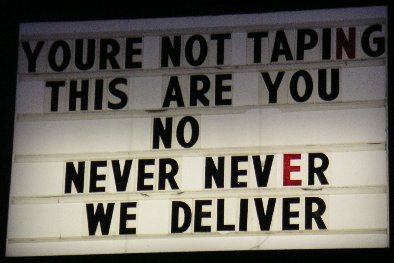
Don't try to sneak a tape recorder in!
This advertising sign was found at a local pizza parlor.
---------------------------------
RED LIGHT CAMERAS
www.highwayrobbery.net
www.highwayrobbery.net