Email
Address
Site
Index by Subject (Search)
If
you haven't already done so, please read Section
4.5 on the Action page
Industry / Police PR - and Ours
Including Crash Photos !

Book cover art by Dan Perkins
On this PR page - scroll down, or click on these
links:
1. Astroturf Lobbying
2. Conventional Lobbying
3. Their "Sophisticated
Technology"
4. Dueling Studies, Including:
4.5 Candor from Officials
5. Crash Photos
1.
Astroturf Lobbying
In the Summer of 2010 a series of articles exposed
"Astroturf" lobbying by the Industry.
In politics, Astroturf lobbying is when a PR firm
creates an artificial grass roots movement by setting
up a local "citizen sponsored" website, or when the PR
firm's employees post comments to articles in the
local newspapers.
Astroturf lobbying by the camera Industry became
evident when petition drives to ban cameras in
several cities were met by "cookie cutter" opposition.
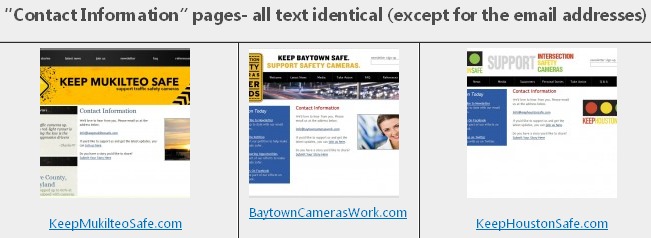
From BanCams.com. (Sorry, in this image
from the article, the links are not clickable!)
When the petition sponsors examined the pro-camera
websites, they were found to be owned and operated by
a Texas PR firm employed by ATS (now re-branded as
Verra Mobility). On Aug. 13 and 17, BanCams.com
wrote about the paid opposition. Links:
http://bancams.com/does-ats-think-we-are-stupid/
http://bancams.com/more-front-groups/
On Aug. 24, 2010 the Washington State Wire wrote about
Astroturfing:
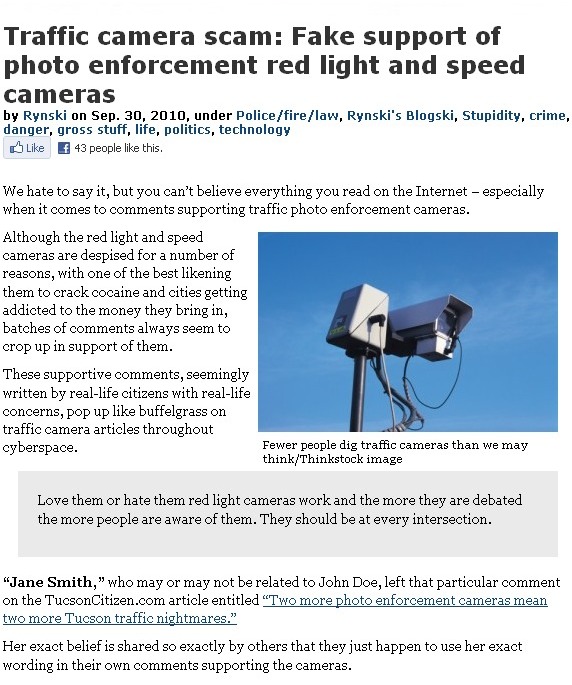
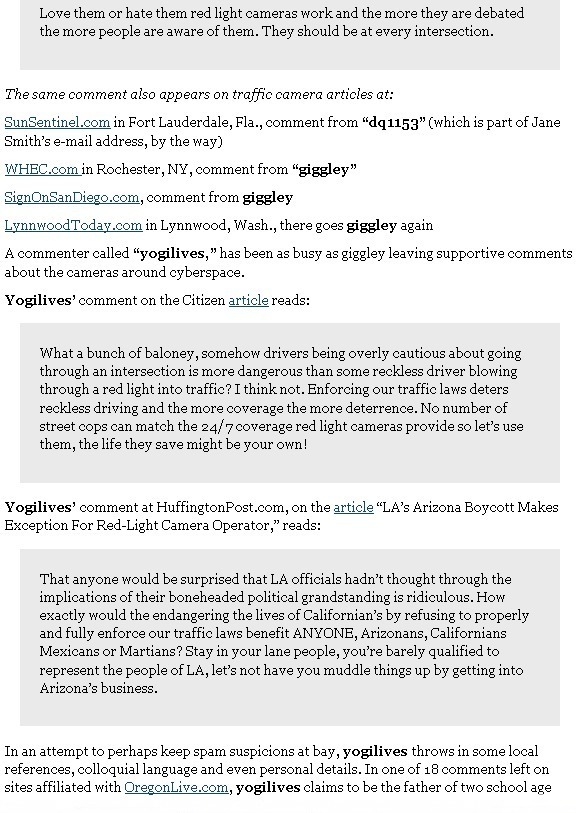
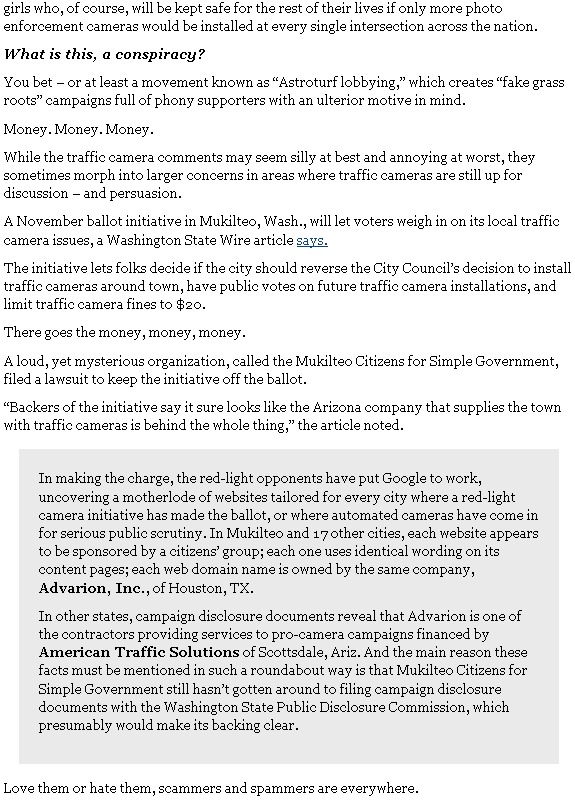
On Sep. 30, columnist Rynski wrote about it in the
Tucson Citizen:
   |
Lest anyone get the impression that ATS/Verra is the
sole creator of "citizen supported" websites, here is
one attributed to RedFlex.
An Oct. 2010 Cleveland Plain
Dealer
investigation revealed that RedFlex helped
start Safe Roads Ohio and gave it $7500. The
Plain Dealer also pointed out that RedFlex' support
was not noted on a mailer Safe Roads sent out.
Nor (even as late as July 2011) was RedFlex mentioned
anywhere on the website for Safe Roads.
Safe Roads describes itself as "grassroots."
In Jan. 2011, BanCams did another
article.
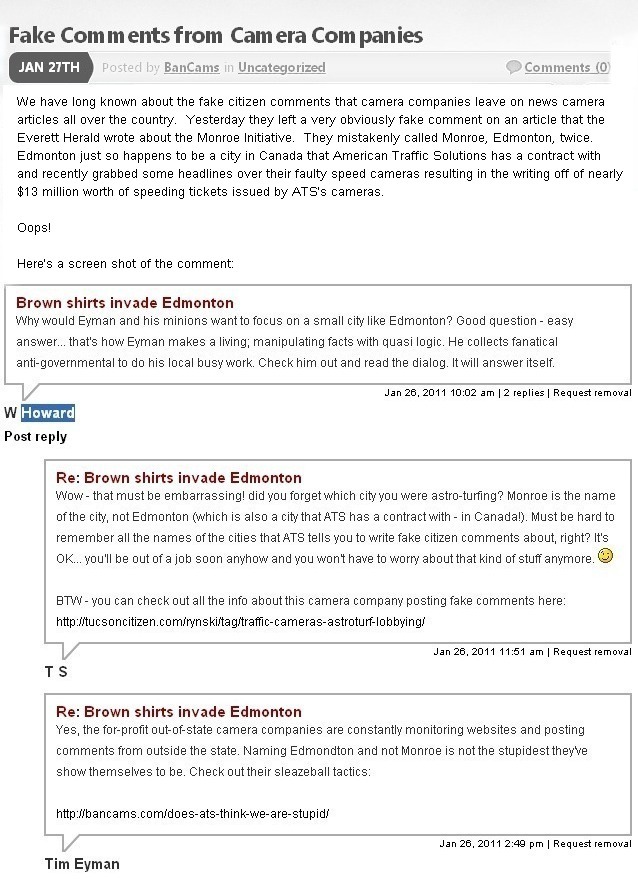
Sorry, this is
an image from the article, so the links
are not click-able! Original article: http://bancams.com/fake-comments/
In March 2011 there was an article
about ATS' activities in Missouri.
At ATS, Some of
the Astroturf was Manufactured in the
Executive Suite, by a Ph.D.
In a May 17, 2011 article
(archived
copy) the Daily Herald of Everett, Washington
(heraldnet.com) exposed extensive Astroturf commenting
on its red light camera articles - 43 pro-camera posts
by a person using the screen name W Howard. (He
also appeared on the bancams.com website - he is in
the example, above.)
The Herald traced the W Howard posts back to the Arizona office of ATS Vice President for Business Development Bill Kroske Ph.D., whose middle initial is "H." The Herald article showed that Dr. Kroske had posed as a concerned resident of Monroe, Lynnwood, and Everett.

William H.
Kroske, Ph.D.
A later article in
the Spokane Spokesman-Review revealed that
Dr. Kroske had also posed as a resident of
that city, under the screen name Obie1.
On May 18 the stock
of ATS competitor RedFlex jumped 4%. (ATS
is privately held; the stock is not
publicly traded, although Goldman-Sachs is
known to own 1/3 of the shares. See
FAQ # 34 for further details about ATS'
finances.)
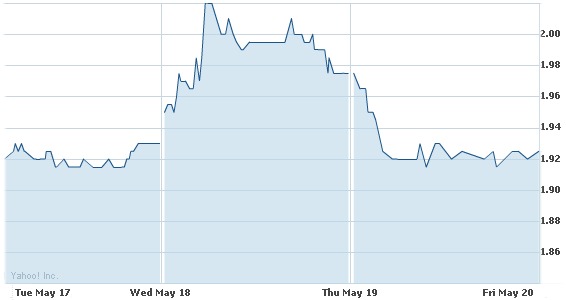
RedFlex
Stock Price, May 2011, in Aus$
Then, in a statement
given to the Herald on May 18, ATS
President and CEO James Tuton said:
"Such a lack of disclosure violates
not only ATS company policy, but also our
core values. While we
share in the commenter's passion for red
light safety cameras, we also recognize
the importance of honest engagement.
The employee in question has been
suspended indefinitely pending further
investigation. Furthermore,
we are taking steps to make sure all
of our employees know that this type of
activity is unacceptable." [The
bolding has been added.]

ATS Founder
James Tuton
So, now that VP
Kroske is suspended, will Tuton be rooting
out the other ATS employees or vendors who
may be responsible for the huge number of
comments by "giggley," "yogilives,"
and the like? Or do they expect us
to believe that Dr. Kroske was
sufficiently prolific to be the source of
all of it?
Will ATS also be
firing Advarion, Inc., the PR firm behind
their cookie cutter "citizen supported"
pro-camera websites?
Another ATS' employee was Mark
Rosenker.
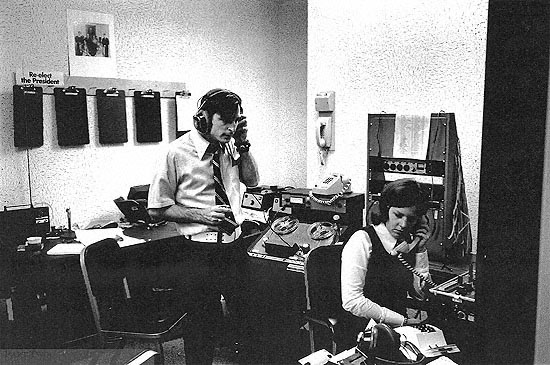
Mark
Rosenker monitoring tapes and equipment
at the CRP (Committee to Re-Elect
President Nixon) headquarters, June 29,
1972.
The Watergate break-in had just
occurred, on June 17.
Photo by Fred
J. Maroon

Mark
Rosenker, (Former) Senior Advisor to
NCSR
Starting in Apr.
2011, Rosenker, trading upon his
credential as a former chairman of the
National Transportation Safety
Board, published numerous pro-camera
"guest columns" in newspapers
around the country. In those columns
Rosenker mentioned his position as Senior
Advisor to the National
Coalition for Safer Roads but never
disclosed that the NCSR is operated
by ATS.
Rosenker left the NCSR later in 2011.

David
Kelly, NCSR President, and Principal,
Storm King Strategies, Washington, DC
On March 31 someone (not me!) started an "Anti-National-Coalition-for-Safer-Roads" page on Facebook!
What about the 1000+ videos ATS began to distribute on May 18? They were attributed to the NCSR, with no mention of ATS, despite Mr. Tuton's pledge, made on the same day, of "honest engagement."
|
About the ATS Video
ATS created a short video* which recounts, in the words of family members, three fatal accidents. It appears ATS bought space and inserted it into at least a thousand websites. The video began showing up on websites on May 18, with more insertions occurring as late as May 30. How to find the videos: Each insertion of the video includes the words "powerful video" in the introduction, so Google ["national coalition for safer roads" powerful video] to find examples of the video. An interesting detail: A large proportion of the websites carrying the video are "Mom Blogs." Per the website mombloggersclub.com, there are at least 13,000 of these. Many will host advertorials without mentioning that it is a paid ad. The closest to a proper disclosure was this, which I found at the bottom of one site:
This blog is a personal blog written and edited by me. For questions about this blog, please contact info @ themommaven.com. This blog accepts forms of cash advertising, sponsorship, paid insertions or other forms of compensation. The owner(s) of this blog is compensated to provide opinion on products, services, websites and various other topics. Even though the owner(s) of this blog receives compensation for our posts or advertisements, we always give our honest opinions, findings, beliefs, or experiences on those topics or products. The views and opinions expressed on this blog are purely the bloggers' own. Any product claim, statistic, quote or other representation about a product or service should be verified with the manufacturer, provider or party in question. This blog does contain content which might present a conflict of interest. This content will always be identified. To get your own policy, go to http://www.disclosurepolicy.org The Wall Street Journal commented: "Many bloggers are embracing corporate relationships as they seek to turn their Web hobbies into businesses. Mom bloggers have been especially courted because marketers believe they are regarded as more authentic." One of the brokers facilitating the insertion of the ATS video into Mom Blogs was Global Influence ("A resourceful mommy media network"), based in the Washington, DC area. On its site, it says: "Global Influence is a network of nearly 1500 bloggers and social media users who have chosen to receive campaign information tailored specifically to their audience and to Global Influence client needs. Founded by Amy Lupold Bair of Resourceful Mommy Media.... formerly known as Momfluence..." ****
*This discussion is solely about the method used by ATS to distribute their video, and is not intended in any way to make light of, or in any way minimize, the terrible tragedy suffered by the families depicted in the video. |
Another ATS VP
Bites the Dust
At the same time ATS
was suspending VP Bill Kroske, it was
firing another another top executive,
Senior VP Michael Lenza. The
company also filed suit against him, for
(allegedly) "diverting opportunities away
from ATS."
ATS:
"Honest Engagement? You
Misunderstood Us. We said, 'Oddest
Management'"
In May 2011 ATS claimed (see CEO Tuton's statement, above) to have a "Core Value" of "Honest Engagement." But two months later yet another secret ATS lobbyist was exposed, this one in Texas. On July 12 KTRK (ABC) Houston wrote:
| "In the back and forth
over red light cameras in Houston, there
is a question over who you can trust.
American Traffic Solutions (ATS), the
camera company, was looking to keep the
red light cameras on across the state,
so they hired nearly a dozen lobbyists,
including a well-known Houston police
officer in a deal we only found out
about once it was over. "[Mark] Clark was paid at least $10,000 by ATS to fight a possible statewide camera ban in Austin. It wasn't for work in Houston, but camera opponents still cried foul. 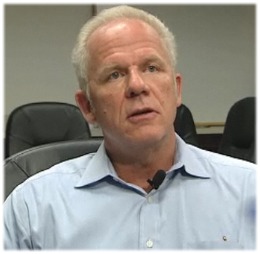 Mark Clark, Houston Police Officer and ATS Lobbyist " 'People, naturally and rightly so, trust when a police officer tells them something; that they can be trusted and what they're saying is true. When that influence is being bought and paid for, then the public can be deceived,' said [camera opponent Byron] Schirmbeck. "While Clark did disclose his deal to the state, the city and the union, he never said anything publicly. So when he told Eyewitness News viewers last weekend, 'We're glad the cameras are back on. They never should have been turned off to start with;' neither you nor us had any idea he had worked for the company at the same time he worked for the union and the city. " 'I gave viewers what they needed to know. If you're worried about red light cameras, don't run a red light,' Clark said. "Clark and ATS say their work together is now over. However, so is the legislative session which means there is no need for any more lobbying. The legislature, by the way, didn't ban cameras statewide, and ATS won that battle." |
ATS Still Doesn't Get It!
For a whole year,
starting in the Summer of 2010, ATS was pounded
in the press and on the 'Net for failing
to disclose its presence (and supporting
money) behind front people (like Rosenker,
Kroske and Clark) and front organizations
(like the NCSR and Keep Houston
Safe). You'd think that by the
following Summer ATS would have figured
out that bad press is bad for business -
but evidently they had not.
On Aug. 8, 2011, the ATS-operated NCSR
distributed a press
release which named six groups
participating in the NCSR - but didn't
mention the elephant in the room, ATS,
whose corporate officers constitute
a majority on the NCSR Board of
Directors.
(This press release also appeared many
other places, including
FamilyCarGuide.com, TheCarConnection.com,
and the Sacramento Bee.)
In early 2015 ATS
dodged questions about whether it was
financing a local PAC which paid people
$18 an hour to protest against an upcoming
ballot item to eliminate the cameras in
Arlington, Texas.
Article. (The ban won in a
landslide, with 59.5% of the vote, and the
cameras were shut down.)
More Police
Lining Up to Lobby for ATS
On Aug. 18, 2011 the Everett Daily Herald revealed that in Lynnwood, Washington, the deputy chief responsible for negotiating the City's red light camera contract with ATS was asking the company about employment at the same time she was negotiating the contract, and the sergeant who ran the camera program was offering to assist the company with lobbying and marketing. See their emails to ATS at http://www.heraldnet.com/article/20110818/NEWS01/708199929 (archive of article).
More Bad
Press for the Boys
On Oct. 11, 2011 the
Miami New Times ran an article
discussing the pasts of some of ATS'
employees in Florida.
Dr. Kroske Back
in 2012? Was He Ever Gone?
A July 2012 Press
Enterprise article
(archived
copy) revealed that in April 2012 -
ten months after CEO James Tuton stated he
was "suspended indefinitely," Dr. William
Kroske was still working for ATS, and he
was working hard. He was putting
together a lawsuit to force an anti-camera
initiative off the Nov. 2012 ballot in
Murrieta. His emails to the City,
obtained via a Public Records Act request,
showed him looking for a local
entity or person to "front" the lawsuit,
as the plaintiff.
In the PE article,
ATS Vice President Charles Territo was
quoted as saying of Kroske,
"He was allowed to keep his email address as he closed out his relationships with customers he had been directly involved with during his tenure." "He was not authorized nor was he instructed to make any outreach on behalf of the company on this particular issue."
ATS' name did not
appear as plaintiff on the Murrieta
lawsuit, and ATS has refused to admit that
it is funding the suit. For more
information about the lawsuit, see the
Murrieta Documents page.
Statistical Sleight of Hand from ATS
In April 2013 ATS
distributed a memo containing this
graph...
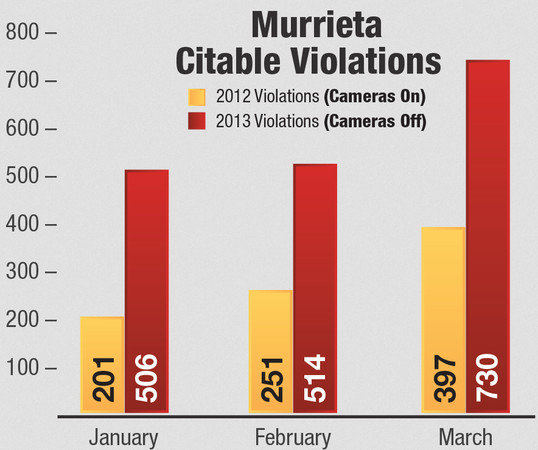
...and claimed that
two months after ticketing was suspended
in Murrieta, violations had increased
86.9%.
The way ATS obtained
that high percentage - by cherry picking
the data - teaches us some important
lessons:
1. Don't let an interested
party such as the camera company - or even
the police department - produce the
analysis of the system performance.
2. Don't let interested parties
control the only copies of the raw data.
3. Don't believe a company when they
say - as ATS did in 2011 (above) - that
they have a policy of "honest engagement."
For more about ATS
and how they produced this graph, see the
Murrieta
Docs page.
2.
Conventional Lobbying
The Industry also
invests heavily in conventional
lobbying.
An Apr. 2011 article in the Hartford (Connecticut) Courant revealed that the Industry, and two interested cities, had engaged seven lobby firms to push for pro-camera legislation by the Connecticut legislature.
An Aug. 2011 article
in the Orlando (Florida) Sun Sentinel
revealed that ATS spent $1.5 million to
lobby in that state.
In Sept. 2011 the
National Motorists Assn. published an article
about some of the more underhanded
examples of lobbying.
Also be sure to look
at FAQ #
34 here at highwayrobbery.net.
Baloney from
RedFlex
On Dec. 6, 2011 RedFlex held a little press
conference at an intersection in Chandler, Arizona, to
try to get Phoenix-area cities to try its Halo
collision avoidance system. During their
interview, reporter Diane Ryan from Fox 10
asked RedFlex spokesman Tom Herrmann, "Have you tried
this [Halo collision avoidance system] anywhere else?"
Herrmann replied, "We have done a test, in Northern
California, and it was very successful."

Herrmann didn't name the city, but that test was in
Marysville. The Chief of Police there was
surprised when I told him, in December 2011, that
RedFlex had called the Marysville test "very
successful." The chief noted that since the
Marysville contract had just been approved in June (of
2011), it was too early to tell if Marysville's
Halo system was a success.
Six months later, it still was too early to
tell: In May 2012 I filed a public records
request with Marysville, for "All writings,
presentations or communications concerning the City's
collision avoidance system." The city clerk
replied: "There is not any information regarding
the Collision Pre-emption System."
I inquired again in May 2013. Still no
information. I inquired again in Apr.
2014 and again in Feb. 2015 and both times there was
no new information about Marysville's Halo
system. In May 2016 Marysville shut its cameras
down - and there still was no information about the
performance of the City's Halo system.
Other cities with contracts mentioning Halo systems
are Bakersfield, Commerce, Ventura, and Paradise
Valley, Arizona.
3. Their
"Sophisticated Technology"
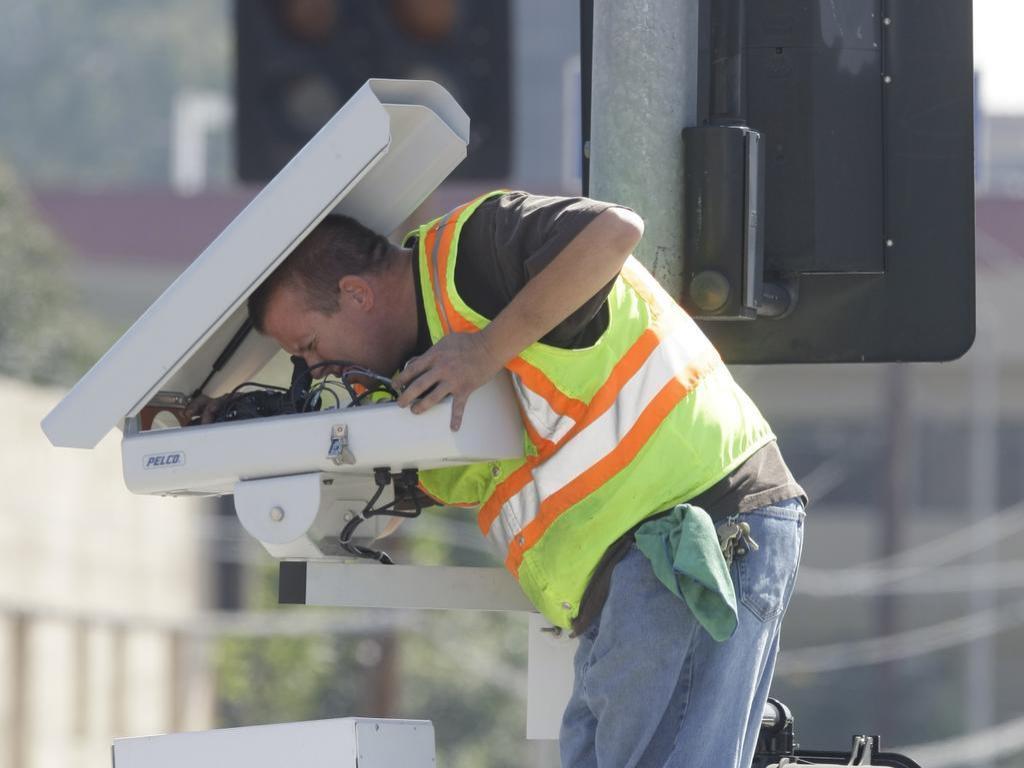
Yep, that's a camcorder. (Click image to enlarge.)
4.
Dueling Studies - and Candor by Officials
"Figures often beguile me, particularly when I have the arranging of them myself; in which case the remark attributed to Disraeli would often apply with justice and force: 'There are three kinds of lies: lies, damned lies, and statistics.'"
Mark Twain, American author and humorist, 1835 - 1910
The Industry sponsors a lot of studies but
fails to make the most important kind. For
example:
In Sep. 2010 I saw a guest
editorial (archived
copy) [City's red-light cameras are mitigation
tools, not 'cash-extracting' machines], where the
author, a traffic engineer employed by the City of
Bakersfield, said that the cameras' primary purpose is
to gather data so that "mitigation measures may be
devised." In other words, the pictures, etc., of
red light runners and accidents will tell the City's
engineers what to change in order to cut
accidents. His piece was 604 words long, but he
did not tell us whether mitigation measures had actually
been devised since 2003, the year the cameras were
installed in Bakersfield.
Now it's 2019, and nineteen years should have been long
enough for Bakersfield engineers to study the data and
install simple/cheap mitigation measures, like brighter
street light bulbs at camera enforced intersections,
more and bigger warning signs, better pavement markings,
bigger diameter red lights and more of them, and longer
yellows. We hope the Bakersfield newspaper will be so
kind as to grant the City engineer a new guest
appearance in their columns, so he can tell us about the
studies they have made and the mitigation measures they
have installed to stop the running.
Most cities have failed to study or install
mitigation measures, despite having had cameras for
many years. Perhaps it is because they know that
such measures would show that the cameras never were
necessary. See FAQ # 6,
Alternatives to Cameras.
Because
it would raise the sort of question
posed above - Why hasn't the city
installed mitigation measures?) - the
Industry doesn't want the public to
focus on any particular city or
town. To distract us, the
Industry churns out state-wide or
nationwide studies, often by the
authoritative-sounding Insurance
Institute for Highway Safety (IIHS),
always touting the safety benefits of
red light cameras. These studies
are widely available in the popular
media, and many are listed on an Industry
site, so will not be listed
here.
Camera
opponents point to several studies
of studies:
1. The 2004 Burkey/Obeng
study, which criticized and reworked
a large pro-camera study by the IIHS.
2. The peer-reviewed 2011
University of South Florida study which found:
| "Q: Of the seven studies
identified by the NHTSA compendium as the best
observational RLC research, is there any consensus
in the findings?" "A: There is convergence: None of the seven studies identified as the best in design and data in the NHTSA's compendium statistically permits concluding RLCs provide a safety benefit." "A common error among inexperienced researchers is to make simple before and after comparisons." "This reveals the complexity of conducting public health research because an outcome can be incorrectly attributed to an intervention if variables necessary to explain the outcome are excluded." (Langland-Orban et al., Florida Public Health Review, 2011; 8, 1-9 ) |
3. The peer-reviewed 2012 University
of South Florida study which criticized
the methods used in another large pro-camera study by
the IIHS.
4. The University
of South Florida's Jan. 2014 study. Additional
Article
5. The USF's Aug.
2014 study.
None of us should blindly bet his or her life on studies from either side, just because the studies are numerous or appear to be independent and rigorous. Read this article about studies in the field of medicine; it will open your eyes about all kinds of studies.
Returning to the field of red light cameras, the
June 2014 Grand Jury
investigation into the Marysville (California)
camera program was another eye-opener. Their
report harshly questioned the City's safety and
financial claims:
"This investigation found that generally the City of
Marysville has provided conflicting,
non-relevant, and/or unsupportable data to
justify the use of RLCs within City boundaries. Data
provided by the City of Marysville do not
correspond to data available through State-maintained
collision databases."
From page 62 of the report linked above. (In May
2016 Marysville ended their camera program.)
Then there is this, from another Grand Jury:
"Citrus Heights chronically and systematically
ignores its own policies for oversight, testing,
monitoring, maintenance and record keeping."
See Set # 5 on the Citrus Heights Docs page
for more info. To read reports from other Grand
Juries, see Grand Jury in highwayrobbery.net's Site
Index.
4.5 Candor from
Officials - Statements by Authorities in More than
Twenty-Five California Cities
My personal inclination is to give more weight to what I hear from the local officials who, after years of hands-on experience with red light cameras, see through the safety claims and choose to speak out. See box below.
|
CANDOR FROM OFFICIALS Statements by Authorities In
More Than Twenty-Five California Cities
Sample page from Annual Report 2014: 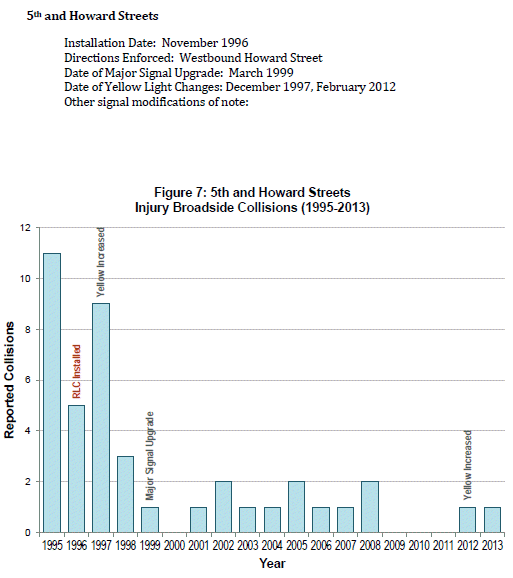 From San
Francisco's Annual Report 2014: 5th
& Howard collisions went up after camera
was installed in Nov. 1996,
then went down after yellow was increased in Dec. 1997 and down some more after March 1999 signal upgrade. In the next year's report (Annual Report
2015) staff conceded that one of the
cameras may have had no effect whatsoever. (See
page 12 of the pdf.) The SFMTA's next report, dated May 4, 2018 (Annual
Report 2016), properly narrowed the focus
to just those collisions caused by red light
violations. (See note 5 on page 2 of that
report.) That report showed that following
the installation of the cameras there were
accident reductions at only two of the nineteen
intersections studied. It should be read
side-by-side with the one-year-older Annual
Report 2015, as the older report provides
intersection-by-intersection dates and details
about the engineering improvements while the Annual
Report 2016 no longer does.
Required Annual Reports: A bill
passed by the California Legislature in 2012 and
effective Jan. 1, 2013 required:
Twenty seven of California's red light camera
cities filed the required annual report covering
2018, and two did not. Of the twenty
seven, only eleven cities provided both before
and after collision counts, and five of those
eleven cities - Bakersfield, Citrus Heights,
Culver City, Del Mar and Rancho Cordova - posted
figures showing no significant reduction in
collisions. The 2013 - 2018 annual
reports are available at http://www.highwayrobbery.net/redlightcamsdocsIndustryAnnualReps.html
City of San Mateo, City of Menlo Park, California: In mid-2019 the Silicon Valley cities of Menlo Park and San Mateo chose to shut down their camera programs. They did so after their (separate) studies showed that the cameras were ineffective. (The relevant staff reports are online on the two cities' websites. See the Menlo Park council agenda for April 9, 2019 and the San Mateo council agenda for July 15, 2019.)
City of San Leandro, California (cameras installed in 2006, still operating in 2020): In 2016, as part of its application to Caltrans for re-issuance of its annual red light camera encroachment permit, the City of San Leandro commissioned and submitted a study by an independent engineering firm. From the study, pages 6 and 10:
City of Stockton, California (cameras
installed in 2004, closed in 2015): “Staff
determined the program was not cost neutral for
the city and found no evidence that it has
significantly reduced traffic collisions. In
February 2015, we sent Redflex a letter stating
we were terminating the contract."
Stockton police spokesman Joe Silva in 6-5-15
Stockton Record article. http://www.recordnet.com/article/20150605/NEWS/150609770
(archived
copy)
More from Riverside: "It’s impossible to
attribute causality to one thing. I don’t know
whether and to what degree the red light cameras
have contributed to a reduction in traffic
crashes." Chief of Police Sergio Diaz. More from Riverside: "I have spoken
publicly against the program several times in
the past, once before the public safety
committee and twice before the entire council.
Each time, I expressed my dislike of the general
concept of the program, the unethical tactics
used to collect fees, inconclusive data
regarding their effectiveness, and the
realization of corporate profits at the expense
of our citizens. My position on these
matters has not changed." Retired 28-year
Riverside fire captain, in letter submitted for
the Oct. 2, 2012 city council meeting.
City of Poway, California (cameras
installed in 2004, removed in 2013): "On
March 5, 2013, the City Council addressed the
potential termination of the program and
directed staff to turn off the cameras and
evaluate the program's safety benefit for a six
month period." "During the six month
period preceding the March 9, 2013 turn-off
date, there was a total of eight [later
corrected to seven] accidents at these three
intersections. During the six month period
after the March 9, 2013 turn-off date, there
were five accidents. This represents a
decrease in accidents of 37.5% [later corrected
to 28.6%]. There were no serious injury
accidents during this period." City
Manager, in report submitted for 10-15-13 city
council meeting.
City of El Cajon, California (cameras
installed in 2002, removed in 2013): "On
February 26, 2013 the El Cajon City Council
voted to suspend the "Agreement" with Redflex
Traffic Systems, Inc. for a period of six
months." "The data shows that from
February 27, 2013 to August 31, 2013, while the
cameras were covered, there were 39 reported
collisions at red-light photo enforcement
intersections as compared to 36 reported
collisions during the same time period in
2012." "Based on these comparisons, the
overall increase in traffic collisions is
statistically insignificant." Chief of
Police, in report submitted for 9-24-13 city
council meeting. Source: http://www.highwayrobbery.net/TrcDocsElCajonContr2013SeptStaffRep.pdf
City of Emeryville, California (cameras
installed in 2004, removed in 2012):
"Staff also
analyzed the number of accidents for the
same seven year period and found that the
red light cameras did not significantly
impact the number of accidents."
"Finance has estimated that elimination of
the program would result in a $200,000 per
year savings to the City." Chief of
Police Kenneth James, in reports submitted
for 5-15-12 city council meeting.
More from El Monte: "We're spending a lot of staff time on this just to gain $2000 a month. It doesn't reduce accidents -- that's what our studies and results have come back." City Manager James W. Mussenden. Source: Granicus video of council meeting of 10-21-08, at 1:28:40, available at City's website.
City of Bell Gardens, California
(cameras installed in 2009, removed in
2012): "To date, 95% of the funds
collected from verifiable violations have been
paid to RedFlex Traffic Systems for operating
the cameras. The remaining 5% of funds
collected have been utilized to partially offset
costs of personnel to manage the system.
The red light camera program has contributed to
a moderate decrease in the overall number of
accidents; however, no change in the overall
number of injury accidents. Furthermore, the
police department has recognized unanticipated
personnel costs to manage the program.
Based on this analysis, the red light camera
program is not significant enough of a community
safety benefit to justify the continuation of
the program beyond the existing three (3) year
agreement term that expires on March 29,
2012." Staff report presented at 9-26-11
council meeting. http://www.highwayrobbery.net/TrcDocsBellGdnsContr2011staffRep.pdf
More from Hayward: “There is no concrete
data that supports the fact that red light
cameras are supposed to reduce
collisions." “That’s not been our
experience here in Hayward. We’ve had much
better results with a redeployment of our motor
officers. I think that having that personal
contact with our community members makes a
lasting impression. It’s an opportunity for us
to change behavior when it’s wrong versus
getting a ticket in the mail 2-4 weeks down the
road.” Police Chief Diane Urban, during
3-5-13 city council meeting. http://sanfrancisco.cbslocal.com/2013/03/06/hayward-to-get-rid-of-red-light-cameras/
(archived
copy)
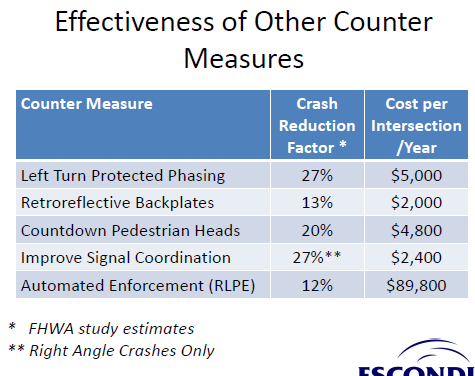 Slide shown by staff at 8-21-13 Escondido council meeting. More from Escondido: "Some of the best footage of really drastic collisions comes from red light cameras." "The cameras are there, the collisions still happen." Councilwoman Olga Diaz. Source: Video of council meeting of 8-21-13, at 1:30:00. City of South Gate, California (cameras installed in 2003, removed in 2013): "The most disappointing thing from staff's perspective is the lack of change in behavior at the intersections." "If you look at the statistics that were provided by RedFlex, you didn't see a dramatic impact in the behavior over the years. In fact, a limited correlation between the implementation of RedFlex and the change in behavior. That's disappointing in the deployment, not just in this city, but everywhere." City Manager Michael Flad at council meeting of 9-10-13. Source: audio clip audio of full item City of Moreno Valley, California (cameras installed in 2008, removed in 2009, City of Riverside camera on shared border removed in 2012 at Moreno Valley's request): "We took the heat without having any control over it." “I’m happy to see all those red light cameras go. …The few people that like them just haven’t looked at the reality of what it does. It takes away the discretion of a police officer.” Moreno Valley Mayor Richard Stewart. Source: Riverside Press Enterprise article 8-6-12 http://www.pe.com/articles/camera-654226-riverside-city.html (archived copy) City of Glendale, California (cameras installed in 2008, removed in 2012): "In short, the nearly 4-year-old red-light camera program became 'cumbersome' and not 'the best use of our resources,' Capt. Carl Povilaitis said." Source: Glendale News-Press article of 3-13-12 http://www.glendalenewspress.com/news/tn-gnp-0314-glendale-police-shut-down-redlight-camera-program,0,1343078.story (archived copy)
From the San Mateo County Grand Jury:
"Based on the data provided by the cities, there
was no overall trend indicating a noticeable
change in accident rates before and after
installation of red light cameras." "Recently,
the City of San Carlos extended
the yellow light time to comply with state
standards and found that the number of
citations fell dramatically." "As a result
the revenue from red light citations could no
longer cover the associated costs."
Source: 2010 Grand Jury Report
In Other States
City of Dunnellon, Florida: "Within just a few months after removing the cameras the positive feeling throughout the community was palpable. Our business and new development has greatly improved since removing them. People were learning ways around town to avoid the cameras, which is never good for business. Also, rear end collisions went up considerably, so safety was hardly a winning argument to keep them. The revenue that the city lost due to removing the cameras is a drop in the bucket compared to the negative aura and loss of business the city experienced. You can't put a number on negativity. The yellow lights had also been set to the minimum length allowed by state law by the previous city manager, so they were near entrapment-level cameras. We noticed a reduction in accidents just by lengthening the yellow light time months before we removed the cameras. We also extended the red light time in the opposite direction allowing intersections to clear and this also made a huge difference in accidents." City of SeaTac, Washington: "Councilman Peter Kwon spent forty hours personally reviewing the best available data on the program's performance and was disturbed by what he found. 'Over the last seven years it actually shows collisions have increased at the intersections where the cameras are located,' city councilman Peter Kwon said. 'I don't mean they've increased because traffic has increased. Collisions in relation to total traffic flow have increased -- the collision rate has increased, which goes against what red light cameras are supposed to do.' " From article about SeaTac's 10-10-17 decision to end its camera program. https://www.thenewspaper.com/news/63/6318.asp City of Jacksonville, Florida: "(Sheriff) Williams, who took office in 2015, isn’t sold on their effectiveness. 'We know from the data that it’s not really reducing crashes at intersections,' he said. However, Williams said he stuck with the program because he had high hopes in a nascent and potentially life-saving technology that was offered by the city’s red-light camera vendor, Redflex. Known as the Halo System, the cameras purportedly could detect cars running a red light and delay the opposing traffic signal from turning green until the intersection was clear. The city installed that technology at five intersections, but Williams said it was riddled with problems that limited its effectiveness. He said his department concluded the 'technology just isn’t there yet,' so he’s decided not to renew the city’s red-light camera contract after it expires at the end of this year." Florida Times-Union, 8-10-17. Source: http://jacksonville.com/news/metro/2017-08-10/sheriff-mike-williams-scuttles-jacksonville-s-red-light-camera-program (archived copy)
City of Peoria, Arizona (cameras
installed in 2008, removed in 2011): "The
city will not renew its contract with Redflex
Traffic Systems after learning from police that
crashes at monitored intersections actually
increased during the three-year pilot program.
Collisions at the four intersections with
red-light cameras saw an average uptick of 29
percent, Peoria police said in a Tuesday
presentation to City Council." Arizona
Republic, 9-14-11. Source: More from Peoria: "The Red Light Camera
Photo Enforcement Safety Program has not met the
goal of reducing collisions at the monitored
intersections, however, the goal of reducing the
frequency of red light violations has been
met." Chief of Police Roy W. Minter, in
staff report prepared for 9-13-11 council
meeting.
Corpus Christi, Texas (cameras installed
in 2007, closed in April 2017): “My
recommendation after review is that we do not
renew this program, we cut ties and move
on. I think there's been some wins, some
single-digit drops in accidents and such, but
when you have this volume of traffic of hundreds
of thousands of vehicles crossing interactions
and you are moving numbers by single digits,
it's not real relevant. Again, we do not
renew.” Source: Chief of Police Mike
Markle at City of Corpus Christi council meeting
of 2-14-17, beginning at 3:26:30 on City's
online video. Also in the local news, at http://www.caller.com/story/news/local/2017/02/13/city-council-discuss-whether-red-light-cameras-working/97851396/
|
5.
Crash Photos
Examining the Crash Photos
the Industry Publishes
New 11-6-05,
more added 8-29-07, 8-3-09, 12-11-09, 8-7-12
I have attended over 1000 red light camera ticket
trials, and have noticed that the average Late Time on
a through (not turning) violation is about 0.4
seconds, with many tickets issued for violations of
0.1 second. Yet, the crash photos released by
the Industry nearly always depict violations that are
many seconds longer - unintentional running that is
little reduced by the presence of cameras.
Or, the Industry photos depict crashes where, after a
little examination, it is clear that the running of a
red light was not the primary cause of the accident.
I did a Google photo search (images.google.com) for
"red light camera" and "photo enforcement" and came up
with the following.
Photo # 1
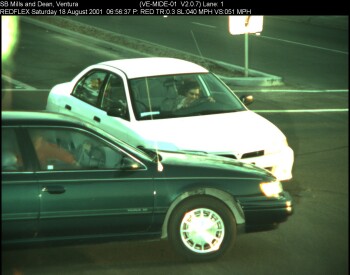
Source: October 2002 issue of ITS
International (itsinternational.com)
The photo above has been widely circulated. It
is from Ventura, California (Southbound Mills at
Dean), and shows an imminent accident. Someone
quickly reviewing the photo might assume it was caused
entirely by the white car. However, if we look
at the small white numbers in the black strip above
the image, we can see that the Late Time, the amount
of time that the white car's signal had been red, was
0.3 seconds ("TR 0.3"), and that the white car was in
Lane 1. (For more info on how to read Late
times, see the purple box in Defect # 7 on the Home
page.) That short Late Time raises the question
of how the green car got so far into the intersection
so quickly after the onset of his green. Did he
jump the green?
Furthermore, the speed of the white car is indicated
as being 51 MPH ("VS 051 MPH") - so in 0.3 second it
would cover 22 feet. Thus, at the instant the signal
turned red, it would have been 22 feet or less behind
the position depicted, probably with its nose well
past the limit line - not a violation.
I suggest that responsibility for the accident is
shared by:
1. The City, which presumably knew that the
intersection was problematic (that's supposedly why
they put the camera there), and should have had an
"all red" interval of at least 0.5 second programmed
in the signal, and
2. The driver of the green car, who apparently
jumped his green light at high speed (note his skid
marks).
On a couple occasions in the past, I have asked the
Ventura PD about this photo. So far, no
additional information has been provided. Maybe,
now that I am publishing it with my interpretation,
they will respond with their own interpretation.
Photo # 2

Source: Washington Post, Nov. 15, 2004,
Page B2 (washingtonpost.com)
The photo above, from Duke and Walker streets in
Alexandria, Virginia, shows an imminent accident
(unless everyone is very lucky). However, it
should be noted that the Late Time was 8.1 seconds
("R081"), and that the limit lines have been worn away
to the point where they could easily be overlooked,
and that the signal lights are on the far side of the
intersection.
Photo # 3
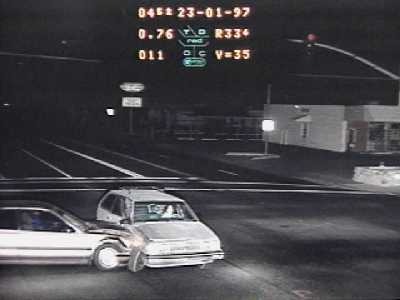
Source:
www.pedestrians.org/episodes/details31to60/episode31.htm
The photo above is from Mesa, Arizona. It should
be noted that the Late Time was 33.4 seconds ("R334").
The next photo, below, is from the same intersection.
Photo # 4

Source: www.pedestrians.org/episodes/details31to60/episode31.htm
This photo above is also from Mesa, the same
intersection, one week later. Note that the Late
Time was 45.2 seconds ("R452"). If drivers are
totally failing to notice that the light is red, maybe
the City needs to put up bigger lights, or more of
them. These pictures were taken in 1997.
It would be interesting to inquire as to what
improvements the City has made to the intersection in
the years since then.
Photos # 5(a) - (c)


Source:
http://www.mesaaz.gov/POLICE/photo-enforcement/photos.aspx
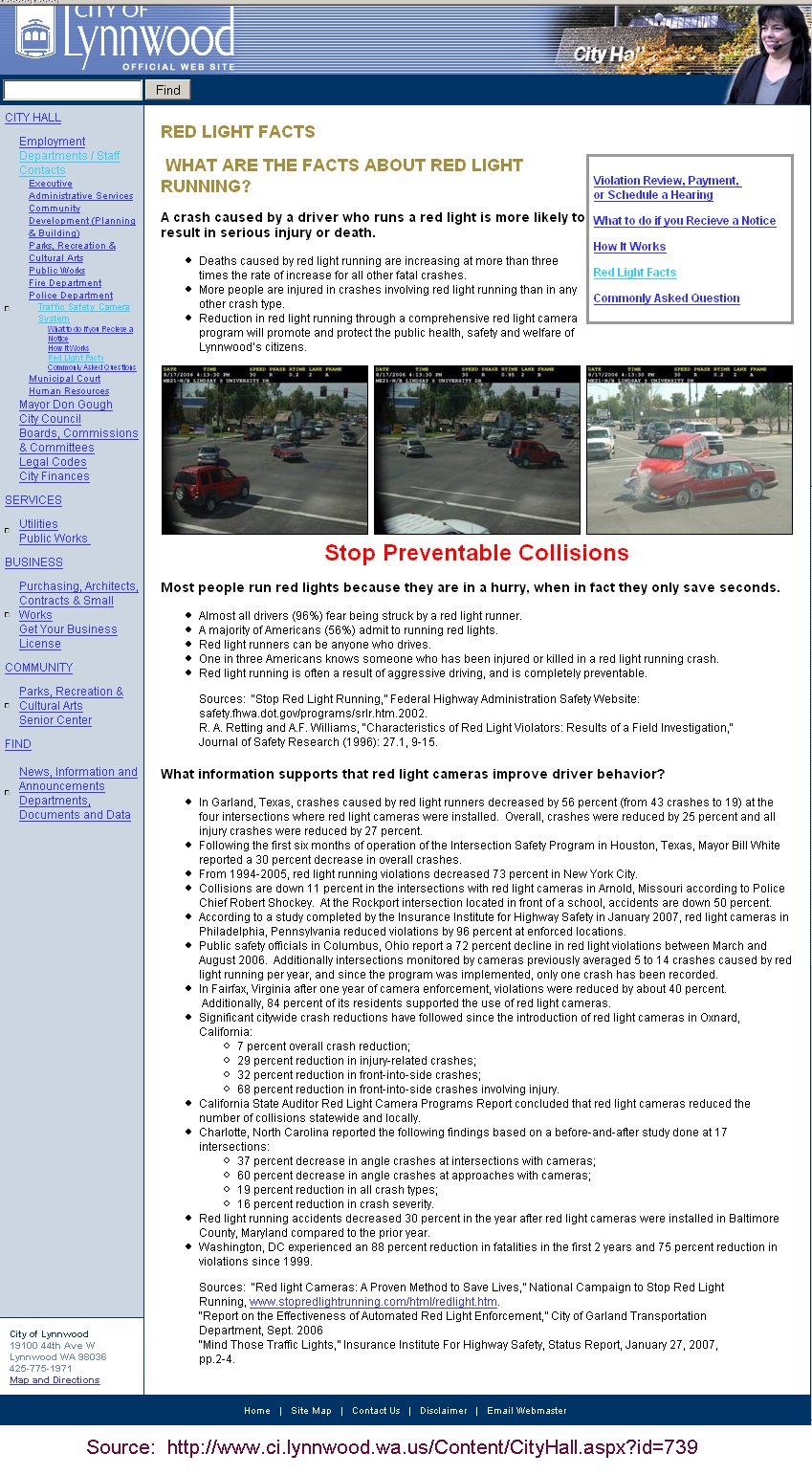
The three photos above are from a Aug. 17, 2006 crash
in Mesa, Arizona and have been used extensively as a
red light camera sales tool in other states.
The MPD did not provide a caption or other information
about the accident depicted.
Someone quickly reviewing the photos could assume that
the red SUV caused the accident, but it's not that
simple.
If we look at the small white numbers in the black
strip above the first photo, we can see that the Late
Time, the amount of time that the SUV's signal had
been red, was 0.2 second ("RTIME 0.2"). (For
more info on how to read Late Times, see the purple
box in Defect # 7 on the Home page.) The SUV's
speed is indicated as 30 MPH, so in 0.2 sec. it would
cover 9 feet. Thus, at the instant the signal
turned red, the SUV was 9 feet or less behind the
position depicted in the first photo, which would mean
that its front bumper (and probably much more) would
be past the first line of the cross walk. In
California and many other states, that would not be a
violation. But in Arizona - it is a
violation!
Why?
Arizona law
says:
...vehicular traffic facing a steady red signal
alone shall stop before entering the
intersection..."
and then goes on to define
"intersection" as:
"...the area embraced within
the prolongation or connection of the lateral curb
lines...."
So, in Arizona you have to get the front of your car
past the "prolongation" - the thinnest white line
(I've added a yellow arrow in the second photo above)
- before the light goes red, or it is a
violation. And, since you are expected to
actually make your stop before the crosswalk (so that
you're not blocking pedestrians), the net effect is
that you will have 12 - 15 feet less room (crosswalks
are 10 -12 feet wide) to stop in Arizona than at a
California intersection having the same length of
yellow. That's equivalent to having a yellow
that is 0.3 second shorter.
Discussion of the accident continues below
this box.
|
Attempts to Change
Arizona's Definition of "Intersection" In early 2016 a bill
was introduced in the Arizona legislature, to
change the definition of "intersection."
It is HB 2593. Will it pass?
Host Host Jim
Nintzel: Speaking of signature
gathering, Frank, were you disappointed when
we learned this week that John Kromko had not
gathered enough signatures to put his red
light proposition on the ballot?
|
So who is responsible for the accident pictured above?
First we look at the sedan's actions. In the first photo, the light has been red for only 0.2 sec., but the front of the sedan is already well into the SUV's lane. To get there, the sedan traveled about 20 feet beyond its "safe" zone. If we guess that the sedan moved at an average of 10 MPH ( = 15 ft./sec.) up to that point, it would have taken 1.3 sec. to move that distance. Thus, the sedan began its turn approx. 1.1 second before the light turned red.
Next we look at the SUV's actions. The first picture shows what appears to be a clear violation - the SUV is not yet past the limit line, and is facing a light that had been red for 0.2 second. But the SUV was braking hard at the time the first photo was taken, in response to the sedan having begun its turn some 1.1 secs. or more before. (The skid marks are visible in the second photo.) It's arguable that if the SUV had not been forced to brake, it would have made it to the limit line 0.2 sec. or more sooner, before the light went red.
I suggest that responsibility for this accident is shared by:
1. The City, which presumably knew that the unprotected (no arrow) left turning at the intersection was unsafe (they should have installed an arrow, but chose to put in a camera instead), and
2. The driver of the sedan, who carelessly began his left turn without checking to make sure that opposing traffic - which was not facing a red light at the time he began his turn - would clear the intersection.
Arizona's unusual Limit Line location seems to be a trap for visitors from out-of-state - and maybe even some Arizona residents. (See a further example, in Photos # 6, below.)
Photos # 6(a) - (b)
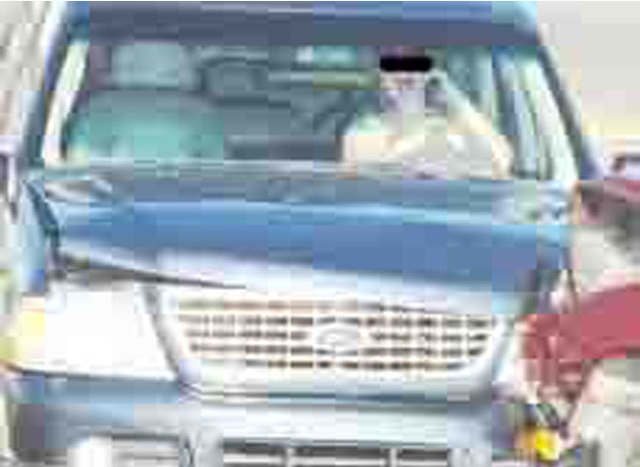
Source: Peoria AZ Police Department video, Sept. 2008
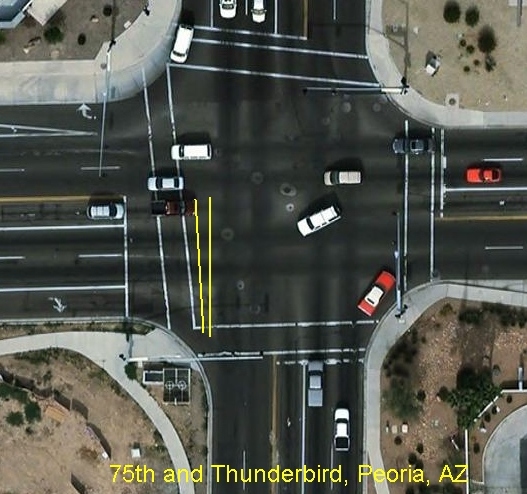
The photo above is from another "That woulda been legal in California" accident from Arizona. (See also Photos # 5, above.) Well OK, it "woulda been legal" here in CA before the ban on hand-held cellphones. If you play the video (YouTube copy) a frame at a time, you can see that the eastbound SUV was past the first white line before the light turned red. The actual Limit Line is not visible in the video - in Peoria, it is marked using red "Thermo" tape, and I was told that at this intersection the tape is just beyond the third white line. It may be the dark area in the video. Below is an aerial view of the intersection, with yellow lines added to indicate the two possible Limit Line locations - both of which are two car lengths beyond the Stop Line.
I suggest that responsibility for this accident is shared by:
1. The City, which presumably knew that the unprotected (no arrow) left turning at the intersection was unsafe (they should have installed an arrow, but chose to put in a camera instead), and
2. The driver of the pickup, who carelessly began his left turn 1.5 secs. before the light turned red and without checking to make sure that opposing traffic - which was not facing a red light at the time he began his turn - would clear the intersection.
Photos # 7(a) - (b)
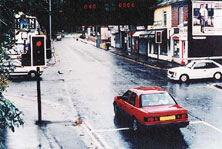

Source: www.devon-cornwall.police.uk/dcsc/enfotech/redlight.htm
The photos (above) are from the UK. The caption for the photos said:
"The first image was taken at 4.5 seconds [Late Time]after the lights turned to red, the second was taken at 5.5 seconds."
Photos # 8(a) - (b)
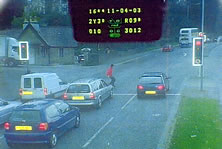

Source: www.devon-cornwall.police.uk/dcsc/enfotech/redlight.htm
The photos (above) are also from the UK. The caption said:
"The built up traffic suggests that the light has been red for some time and the pedestrian has already crossed half of the road."
However, the caption did not reveal the actual Late Time, and it is hard to read it in the photos. But, since the cumulative Late Time in the second photo is 10+ seconds ("R10x"), the Late Time in the first photo must be 9+ seconds.
Photos # 9(a) - (b)

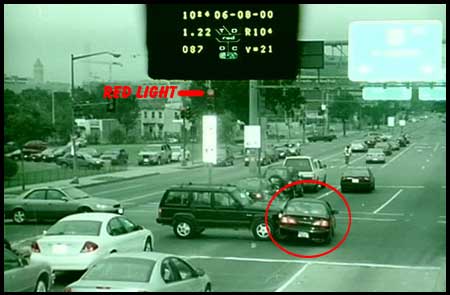
Source: http://mpdc.dc.gov/mpdc/cwp/view,a,1240,q,547893,mpdcNav_GID,1552,mpdcNav,|31885|.asp
The photos above are from the website of the Washington, DC police department, which added the arrow pointing to the red light. The caption said:
"These photos were taken recently [June 2000] by the photo enforcement camera at the corner of New York and New Jersey Avenues, NW. They show just how dangerous it is to run red lights for both the offending driver as well as other motorists and pedestrians."
Note that the late time was 9.2 seconds, and that the location has three limit lines in quick succession as well as a lot of signage, which could confuse drivers. If this location is experiencing a lot of accidents, perhaps the design and marking of the intersection is a contributing factor.
Photos # 10 & 11
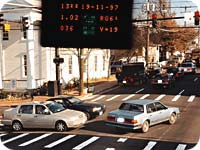

Source: http://www.iihs.org/research/qanda/images/rlc_1.jpg and http://www.iihs.org/research/qanda/images/rlc_2.jpg
The photos above are from the website of the Insurance Institute for Highway Safety. The IIHS did not provide a caption.
Note that the late times were 6+ and 7+ seconds.
Photos # 12 (a) - (g)
In Aug. 2009 ATS (American Traffic Solutions) published a video "Montage" (YouTube copy) of seven crashes as part of the annual National Stop on Red Week promotion.
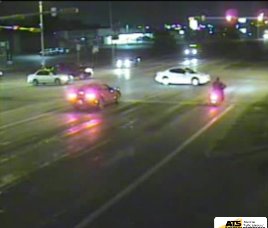
(a) Motorcycle rider missed red by 4 secs. or
more, most likely due to inattention or impairment;
not on purpose. Cameras will not stop such
accidents.
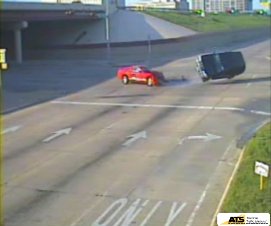
Signals located right after cars emerge from dark
underpasses are known hazards and a popular site for
red light cameras. The local traffic engineers
need to put in larger diameter signal lights and
improve/better maintain the pavement markings.
Cameras can't stop the running.
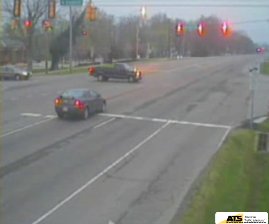
Signal was red 3 secs. or more, so running probably
was due to inattention or impairment. Improve
pavement markings and visibility of the signals.
Arrest impaired drivers. Cameras cannot stop
such accidents.
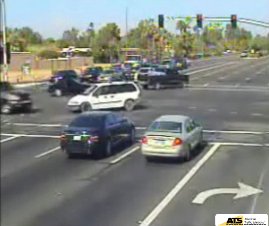
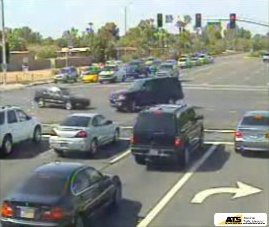
(d) & (e) The drivers made a left turn
without checking for oncoming traffic. Since the
same accident is happening repeatedly at the same
intersection, maybe it is time for the traffic
engineers to install a left turn arrow for the cross
traffic. Cameras cannot stop such
accidents.
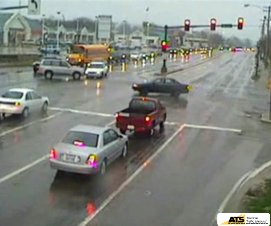
(f) This crash was probably due to confusion -
traffic cones, rainy day. Some accidents just
happen; cameras can't stop them. And it
can be argued that the initial flash of the camera may
have added to the driver’s confusion/distraction.
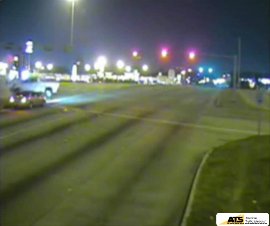
(g) We can't see the light the white truck was
facing, so there is no evidence that he had a red
light, or for how long. He probably is an older
driver or one with poor night vision, or otherwise
impaired, and even if his signal had been green would
have been just as likely to hit the poorly marked
traffic island and (overly sturdy) pole. As in
(f) above, the initial flash of the camera may have
been a contributing factor. Proper marking of
the "nose" of the island, and pole, is needed.
Overall, ATS' video collection fails to support the
use of red light cameras. A critic suggested
that ATS' pictures actually say:
"Look at all the accidents our cameras didn't
prevent."
Intererestingly, none of the seven accidents was a
right turn accident. You'd think that to justify the
company's heavy emphasis on right turn enforcement,
ATS would have provided footage of a few right turn
accidents.
Despite the fact that the majority of tickets issued
nationwide are for a Late Time of less than 1/2
second, all of the accidents depicted showed cars that
were obviously multiple seconds late. Where's
the videos justifying the numerous 1/10th, 2/10th and
3/10th Late Time tickets?
Photos # 13 (a) -
(c)
These photos are from the three videos displayed on
the City of Glendale, California red light camera web
site in late 2009.
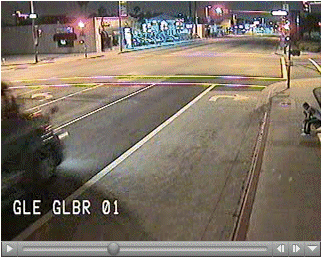
(a) This is southbound Glendale Ave. at
Broadway, in Glendale. The video's
(YouTube
copy) title, "A Big Truck at 55,"
suggests that the truck was doing 55 MPH ( = 81
ft./sec.). The still image above is the first
frame where the light was red.
The truck, which is just entering the frame, looks to
be 60 feet from the limit line. Per the signal
timing chart provided on the City's red light camera
website, the yellow for Glendale Avenue is 3.6 secs.
long. (Interestingly, the yellow for Broadway is
3.9 secs.) 3.6 secs is the minimum yellow in a
35 zone. But from this video, and from the
very high speed in the other nighttime video below, it
appears that this wide boulevard is allowed to operate
at higher speeds at night. Were the yellow to be
set at 4.3 secs., which is the minimum length required
in a 45 zone, this truck would not have violated the
red.
Further, this wide intersection needs to have signal
lights positioned on the "near" side.
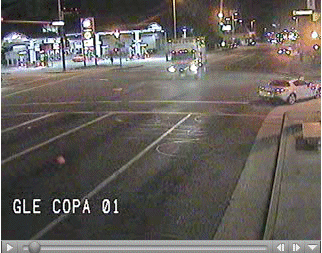
(b) This is eastbound Colorado Blvd. at
Pacific Avenue. The video's
(YouTube
copy) title, "A 68 MPH Violation,"
suggests that the car was doing 68 MPH ( = 100
ft./sec.). The still image above is the frame
where the light was changing from green to yellow -
the yellow is strongly lit, and the green is just a
pinpoint of light.
The eastbound violator's car has not yet entered the
frame. Per the City's chart, the yellows in all
four directions are 3.9 seconds. (Unlike
Glendale/Broadway, above.)
In the image above, the light will not be red for
another 3.9 seconds but the left-turning truck has
already begun his (unprotected) left turn. The
truck driver probably underestimated the speed of the
oncoming car - or failed to see it coming.
A longer yellow, or a red light camera, might have
kept the car from violating the red, but it would not
necessarily have prevented the (near-) accident.
An accident like this could happen any time during the
signal cycle. All that is required is for
someone to carelessly begin a left turn without
checking oncoming traffic.
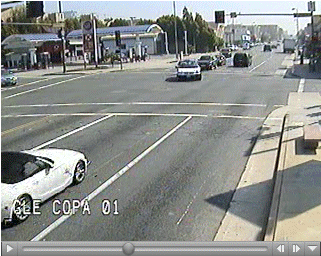
(c) This is eastbound Colorado/Pacific again.
The video can be viewed at "A
Near Collision" (YouTube
copy).
The still frame above was grabbed at the instant the
light was changing from yellow to red - as a result,
neither the red light nor the yellow light is visible.
The front of the taxi is already well into the sports
car's lane. To get there, the taxi traveled about 20
feet beyond its "safe" zone. If we guess that
the taxi moved at an average of 10 MPH ( = 15
ft./sec.) up to that point, it would have taken 1.3
sec. to move that distance. Thus, the taxi began
its turn at approx. 1.3 second before the light turned
red, and with oncoming traffic clearly visible.
As with (b) above, a longer yellow might have kept the
sports car from violating the red, but it would not
have prevented the (near-) accident. An accident
like this could happen any time during the signal
cycle. All that is required is for someone to
carelessly begin a left turn without checking oncoming
traffic.
Near-accidents (b) and (c) show that the City needs to
protect left-turners by installing a left-arrow.
Further, this wide intersection needs to have signal
lights positioned on the "near" side.
Interestingly, none of the three near-accidents
involved a right turn accident. You'd think that
to justify the City's heavy emphasis on right turn
enforcement, Glendale would have provided footage of a
few right turn accidents.
Late Note:
In 2012 Glendale closed their red light camera
program.
Photo # 14
In Dec. 2011 ATS (American Traffic Solutions)
published a number of video compilations of
crashes supposedly caused by red light running,
including one compilation of crashes in New Jersey
cities.
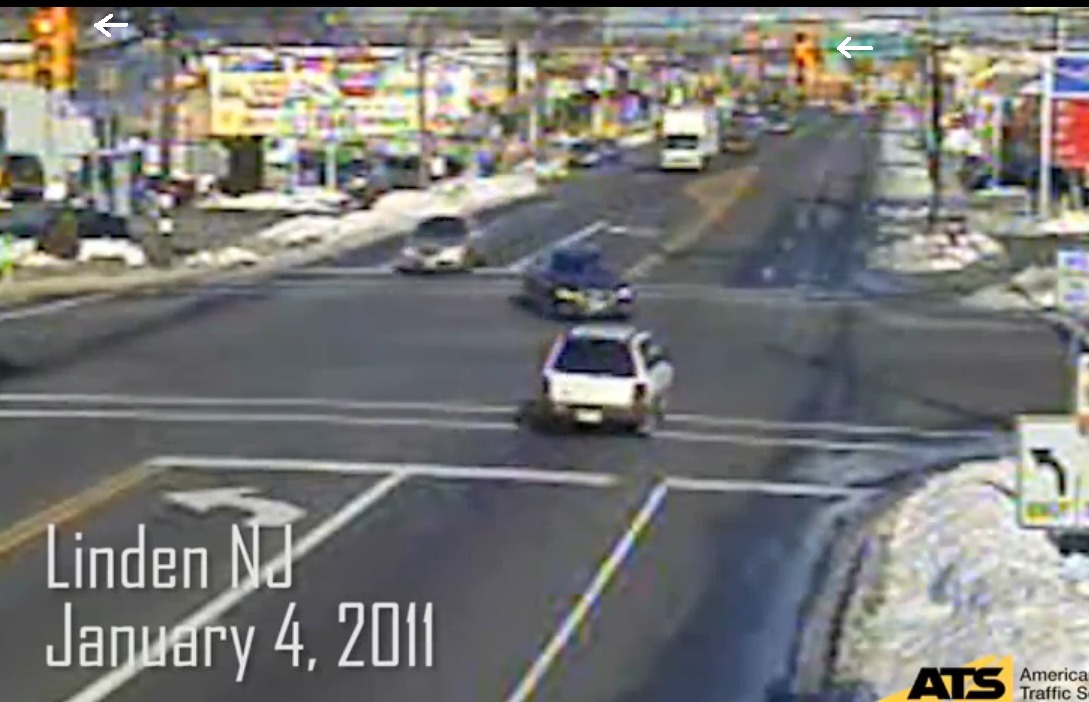
NE bound St. Georges Ave. (Route 27) at Stiles Road, in Linden, NJ (click photo to enlarge)
The Linden left-turn accident shown above (begins at
0:58 on the YouTube
video alternate
copy) was not caused by a red light runner. The
lights were yellow (follow the white arrows added by
highwayrobbery.net). The left turner carelessly
started his left turn too soon, several seconds before
the light went red.
Did ATS fail to notice that the Linden segment was not
an example of red light running, or did they like the
violence in the video so much that they decided to put
it up anyway, hoping the public would be fooled?
The Linden police weren't fooled, though. A
"change report" page of their official Crash
Investigation Report assigned fault to the
premature left turner.
Photo # 15
In Aug. 2012 ATS (American Traffic Solutions) made a
promotional video featuring Tom and Lauren Hanley, an
Indianapolis couple whose 2010 wedding was ruined when
the driver of a shuttle bus carrying the wedding party
ran a red light and collided with another vehicle,
killing the groom's best friend and injuring
fourteen. The video was distributed by ATS'
front group, the National Coalition for Safer Roads.
The Hanley's advocacy for red light cameras carries
with it the suggestion that a red light camera would
have prevented this tragedy, and will prevent
recurrences, but the facts do not support their
conclusion. The shuttle bus driver didn't run the
light by just a fraction of a second. He wasn't
cutting it close, he just "blew" it. His light
had been red long enough for the large SUV he hit to
be more than half way across the intersection.
Either he didn't see that an intersection was coming
up, or didn't notice that the light was red, until it
was too late. It is understandable how he could
have overlooked the intersection and the signal - they
are poorly designed and badly maintained.
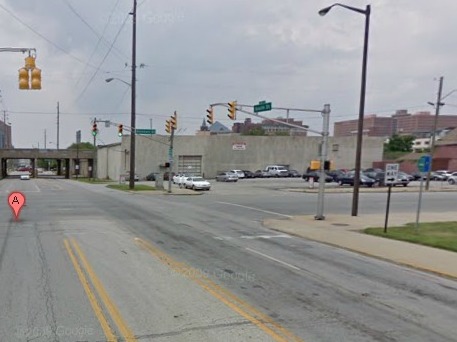
Missing Limit Line Paint, Westbound South Street at Delaware Street, Indianapolis, Site of June 5, 2010 Fatal Crash
1. The limit line and crosswalk paint is worn out.
2. The signal heads are small with no backboards and
are on the far side of the wide intersection, amid the
visual clutter of the signal heads for the other
directions of traffic, a railway overpass, and large
industrial buildings.
3. The street name signs are on the far side of the
intersection, and are not illuminated.
4. There are no pavement markings warning,
"Signal Ahead."
From 200 feet away, you can't tell there's an
intersection there, at all.
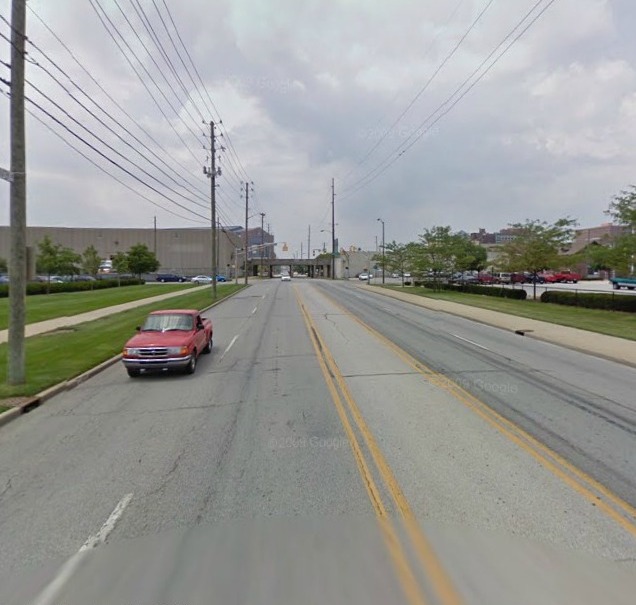
There's an Intersection Ahead? South Street Looking West 200' to Intersection with Delaware Street
---------------------------------
RED LIGHT CAMERAS
www.highwayrobbery.net
www.highwayrobbery.net