If
you haven't already done so, please read the info
at the top of the main City of
Los Angeles page.
City of
Los Angeles Documents
- Continuation Page -
Is your ticket really issued by the City of
LA?
Probably not, because the City closed its
camera program in 2011.
To figure out who issued your recent ticket at
a location inside the City of LA or close
nearby, read the info at the top of the main
City of Los Angeles page.
City
of Los Angeles Docs Set # 1 (ticket
counts) is at Los
Angeles, Main Page
2007 Tickets
(If you are looking for info about the ability to ignore tickets in LA County, go here.)
Your 2007 Los Angeles ticket may have a number of unusual things about it.
One of those could be that the street address and phone number for the court may be missing.
Like this ticket that gives only a post office box to send the money to.
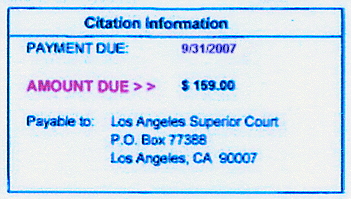
Leaving the court's phone number and street address off the ticket makes
it harder for defendants to have their day in court. See Defect # 8 - C on the Home page.
The next unusual thing is that in nearly ever other California city, the red light camera fine
is [was] $340 - $400.
The $159 fine shown above is because LA chose [until Aug. 2008, see Set # 4, below] to cite right
turns under CVC 21453(b) instead of 21453(a).
The fine for the (b) violation, not usually used for camera tickets, never was
increased like the fines (a) (straight through violations) and (c) (left turns) were.
Be sure to read Set # 4, below, and the details about AB 909 of 2010.
City of Los Angeles City Docs Set # 3
2004: More Details
April 2004 - LA's Move for More Cameras Provides Some Figures and Statistics
(This item is about LA's first camera system.)
In the LA Times of Apr. 13, 2004 Staff Writer Patrick McGreevy reported that the LA city
council is considering adding more red light cameras. The article said that the city currently
has cameras at sixteen intersections, and that they have issued 48,062 citations in three
years, of which approximately 3600 have been challenged in court, with 159 having been found
not guilty. The article said that there were another 16,000 violations that did not result in
citations, because the camera failed to capture the necessary photos (mostly cars with
no front license plate). The article quoted Councilmember Cindy Miscikowski (during the April 12
Public Safety Committee meeting) as saying: "Obviously this is a program that is well-received.
Let's really look to accelerate the program."
The article said that there had been a one-year decrease of 9.8% in accidents at
camera-equipped intersections. That claim seemed low compared to the (approx.) 40% reduction
claimed by many other cities, so I called the LAPD and spoke at length to Sgt.
Steve Foster, who runs [ran] the program. Among many things, he explained that there had been
a 10% decrease the year before, 2001-2002, which was the first year of operation.
He also mentioned figures indicating that at the two intersections where
the red light cameras had been equipped to also generate warning notices for speed
in excess of 65, the one-year (2002-2003) reduction in accidents had been (approximately)
25% and 33%.
That drop indicated to me that the speed warnings are very effective in reducing accidents, perhaps
more effective than even the red light tickets! Despite that effectiveness, there is no plan in
the works to expand the use of the speed warnings.
The dollar amounts mentioned in the Times article didn't depict the true magnitude
of the city's program. In its sole mention of overall operating figures, the article said only:
"In the last three years, the city has collected $490,000."
The article did not specify that that figure was not the gross revenue collected but in actuality
was a net profit on the program after all salaries, expenses and capital costs (including
start-up) were paid. Here are some figures I derived from information provided in the
article and by the sergeant.
Estimated cost to cited motorists of the 48,062 tickets: $14,400,000.
Estimated gross revenue to the city from those tickets: $4,000,000.
City's net profit as percentage of gross revenue: 12%.
Estimated gross revenue to camera supplier ACS ($60 per ticket): $2,880,000.
On the question of how LA determines its yellow times, Sgt. Foster referred me to the city's
Department of Transportation. LADOT personnel said that they most often use the posted
speed limit plus 5 mph do the look-up in the CalTrans table. Or, where there is a speed survey
available, they round the 85th percentile speed from that survey to the nearest 5 mph
increment (up or down), and then use the higher of that number or the posted plus 5.
Thus, for example, a Los Angeles camera on street posted 35 mph would have a yellow of at
least 3.9 seconds - compared to the 3.6 seconds provided by Culver City on their cameras.
Update, 5-21-04: On May 11 the LA City Council voted to go out to bid for more cameras. I
now have tapes of the hearings, and some information from one of the tapes is now
posted under Defect # 9, Churning, on the Home page.
City of Los Angeles Docs Set # 4
2008: No More Mr. Nice Guy - Rolling Right Discount Ends
(The 21453(a) vs. 21453(b) Controversy)
Until Aug. 2008 the City of LA cited its rolling right turns under Subsection (b) of CVC 21453,
instead of (a), which resulted in a much-lower fine - $159 including all fees.
But an Aug. 16, 2008 LA Times article revealed that LA's fine for rolling rights
would more than double, effective immediately,
to the same fine as for straight-through movements - nearly $400.
The Times article, by Rich Connell, said that police spokesman Lt. John Romero said that raising
cash for the cash-strapped City was not part of the motivation. The Times estimated
that the change could bring an additional $2 million to the City.
The article also mentioned that the City issued about 30,000 camera tickets in 2007, and
that about eight in 10 of those were for rolling rights.
The Times article also mentioned a "detailed formal opinion" from the city attorney. I wanted to
know more about their decision, so I sent the LAPD an email:
| I
assume the formal opinion is in writing, and
would like to get a copy. But if it was not
provided to or shown to the Times or otherwise
made public, and cannot be provided to me, then
I would like to get all the other correspondence
and records from the decision making process and
announcement. That would include press releases,
tabulations of the number of tickets issued in
the City (overall and broken down right turns
vs. straights and lefts, and further broken down
by location), statistics, analyses and/or
projections of the effect of right-turn
enforcement upon accidents and/or traffic flow
and/or fuel consumption in the City, any
explanation or discussion as to why consistency
(the higher fine) is necessary, and estimates of
the additional revenue from the increase.
|
Their reply letter, which came promptly, said, in part:
| The correspondence
from the Office of the City Attorney is
confidential attorney-client communication
pursuant to Evidence Code Section 950 et seq. and
therefore exempt from disclosure. Staff from
the Traffic Coordination Section has indicated
that there are no other materials that were
utilized in determining the appropriate Vehicle
Code Section to cite for failing to stop for a red
light prior to making a right turn. Staff from Traffic Coordination Section and Media Relations Section has indicated that no written materials were provided to the Los Angeles Times regarding the aforementioned newspaper article. |
If, as Lt. Romero told the Times, the motivation was not money, what was it?
City of Los Angeles Docs Set # 5
Other
Reports Available
To see examples of standard reports generated by
Nestor (which would be obtained by making a
request to the City), see the reports received from
the City of Fullerton (also a Nestor
customer), Set # 4 on the Fullerton
Documents page.
City of Los Angeles Docs Set # 6
2009: KCBS-2 KCAL-9 Report
On Nov. 9, 2009 KCBS-2 and KCAL-9 aired a report in which they compared the number
of accidents before and after the installation of LA's red light cameras. Those numbers were
available on the stations' websites, via an interactive version of the map displayed below, but now have been taken down.
But you can see them in Set # 1 above (the stats are in the light purple row near the bottom of the big table).
Here is the City's response to the TV report.
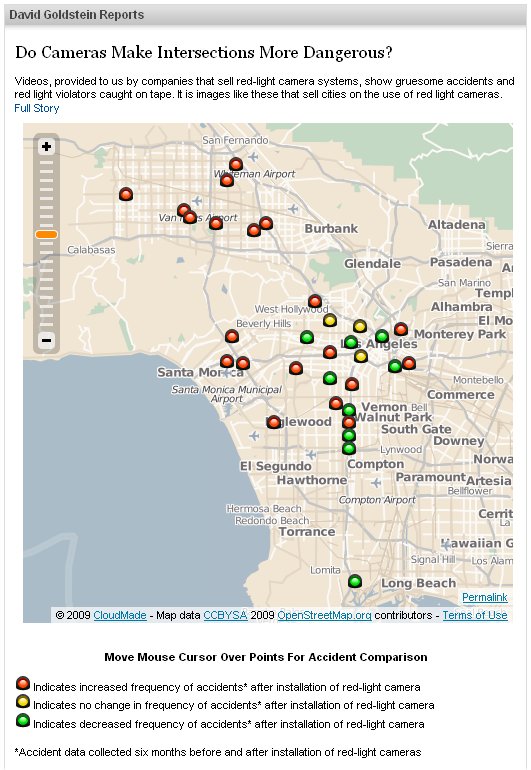
Map by KCBS/KCAL, for Nov. 9-10, 2009 Reports - Now No Longer Available at their Website.
City of Los Angeles Docs Set # 7
2010: No More Mr. Nice Guy, Part II - Sepulveda at Victory, in Van Nuys
The location of the Sepulveda/Victory intersection is nothing unusual. Two medium-size boulevards cross at a right angle, on flat ground, in the Van Nuys area of the City of LA.
Southbound Sepulveda traffic has a green light for a while, then a yellow for the legally-required amount of time, then a round red, and then a split second later, a green arrow that allows people in the curb lane to turn right without making a full stop first.
The problem is that there is a tiny gap - six tenths of a second - between the start of the Southbound round red and the illumination of the green arrow. During that 0.6 secs., it is technically illegal to make the right turn without stopping. No live cop would write a ticket to someone rolling the turn during that less-than-one-second interval, but the robot does, day and night - and his human attendants back at LAPD headquarters approve those tickets.
Tickets are supposed to be written to discourage unsafe behavior, but there's no possible way they can claim that rolling the turn during that 0.6 sec. gap is unsafe:
(a) There is no cross traffic during the six-tenths interval, and none after it - the green right-turn arrow comes on only at those times when there also is a left-turn arrow allowing cars to make the left turn from Eastbound Victory onto Northbound Sepulveda and,
(b) the pedestrian "walk" signs are not on during the six-tenths interval, nor are they on after it.
In April 2010 the popular blog TheNewspaper.com published an article about Sepulveda/Victory - including a link to video of an actual violation. The article should have been enough to get the LAPD to stop the issuance of these Mickey Mouse tickets. Apparently it was not - I've now heard about an identical tickets issued in July and December.
If the LAPD feels that these tickets are justified, I encourage them to send me an email explaining why. I will publish it here.
City of Los Angeles Docs Set # 8
LA Cops Perjuring Themselves
For some reason, LA doesn't use Snitch Tickets. Because they do not have the Snitch Ticket tool available to them, the officers processing the tickets have been issuing many tickets even though there is an obvious age and/or gender mismatch between the driver and the person being cited (who most often is the registered owner). These multiple perjuries inspired the big flow chart in the "It's Not Me" section of the Your Ticket page. Have a look at that flow chart, as well as item 8 in the "sneaky lies" box you'll find just below the flow chart.
City of Los Angeles Docs
Set # 9
The
Contract (Program Closed in 2011)
In 2005 the LA City Council approved
a contract with Nestor Traffic Systems, to replace
ACS, the original supplier of the City's cameras.
See this
article for details about the lobbying
involved.
In 2009 ATS took over the contract
when it bought Nestor, which had gone into
receivership.
The contract did not include a "cost
neutrality" clause.
The contract provided for a 30-day warning period upon
the installation of each new camera. See
Defect # 6.
On Jul. 27, 2011 the city council
voted to end ticketing, effective Jul. 31, 2011.
The issue was hotly contested, right down to the wire:
In late 2010 the City put the contract
out to bid, but on Jun. 7, 2011 the Police Commission
voted 5 - 0 to recommend to the city council that none
of the bids should be accepted (which would end the
program). On June 14 Councilmember Cardenas
introduced a motion to continue the red-light camera
program. Cardenas' motion was considered at a
special meeting on June 17 where it failed to pass, then
it was continued to June 21 for a vote by the full
council, where the motion failed to pass by a narrow
margin, then on June 22 it failed to pass by one vote
and was sent to the Budget Committee. It then came
back for more votes, on Monday July 25, Tuesday July 26,
and (finally) on Wednesday July 27.
http://saferstreetsla.org
LA Weekly Article
Prosecutions Have Ended
A Mar. 28, 2012 LA Times article indicated that the City would no longer show up in court to prosecute existing tickets.
Will Tickets Remain in Court Records?
On May 25, 2012 the LAPD sent me this statement:
"As a result of the contract between the City and Photo Red Light vendor, the LAPD no longer has access to APRLP database and the video evidence contained within for officers to testify in court for contested traffic citations. Consequently, the LAPD will no longer send officers to appear in court for any contested photo red light citations. The Department has requested that all pending and outstanding photo red light traffic citations issued by the LAPD be dismissed. However, this decision to dismiss these citations rests with the court and not the LAPD."
The Info in Set # 9 Applies ONLY to Tickets Issued & Signed by the LAPD
The info here in Set # 9 does not apply to tickets from Metro/MTA Busway and Light Rail cameras, even though many of those cameras are at intersections inside the city limits of the City of Los Angeles.
This list of contracts and amendments may not be
up-to-date - there could be a contract or amendment
later than the ones listed above.
City of Los Angeles Docs
Set # 10
City Auditor Criticizes the
Program
An independent site analyzed the police department's response to the audit report, and responded to it.
City of Los Angeles Docs
Set # 11
Info on
City's Website
There is a red light camera program
FAQ page at the police department's website.
One of the FAQs says, incorrectly,
that if you were not driving the car, you "must" fill
out the affidavit.
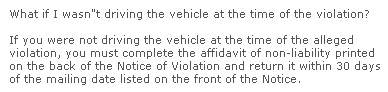
Despite what the above
info on the LAPD site says, you are not
required to fill out the affidavit.
City of Los Angeles Docs Set # 12
More Coming
There may be some more Los Angeles information posted in the next
few weeks. Mark your calendar to remind you to come back here and look!
---------------------------------
RED LIGHT CAMERAS
www.highwayrobbery.net
www.highwayrobbery.net